

More news on this day
London is emerging as a testbed for clean electric air taxis as UK-based Vertical Aerospace advances its Valo aircraft, setting the stage for zero-emission tourist links between airports and city attractions later this decade.
Get the latest news straight to your inbox!
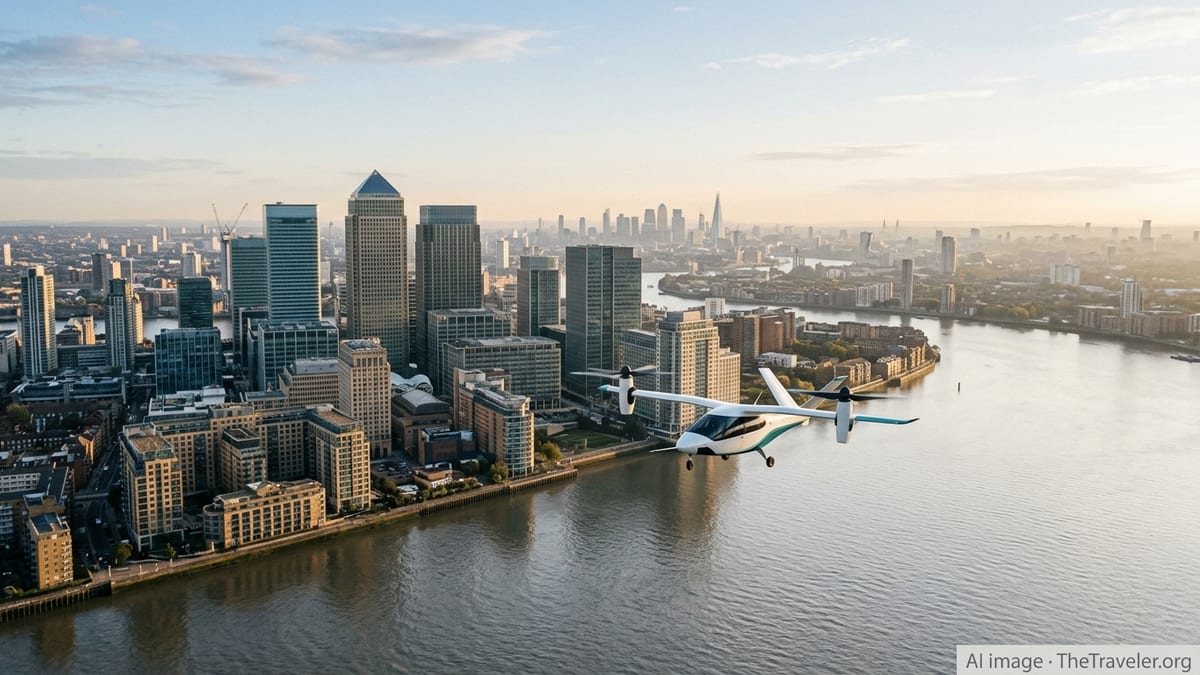
Flight Testing Milestones Point Toward 2028 Operations
Publicly available information shows that Vertical Aerospace has entered an advanced phase of piloted testing for its Valo electric vertical take-off and landing aircraft, a key step toward bringing short-hop clean aviation to London. The company has reported more than a year and a half of piloted prototype flights in UK airspace, gradually expanding the performance envelope under Civil Aviation Authority oversight.
Reports indicate that the UK regulator has granted the company a Permit to Fly for its full-scale prototype, allowing Phase 4 transition trials in which the aircraft shifts from hover to wingborne flight. This transition capability is critical for future tourism routes, where aircraft will need to combine helicopter-style vertical access at city vertiports with efficient cruise performance over the capital and surrounding countryside.
Recent updates suggest the programme is targeting full certification toward the end of this decade, aligned with the UK Civil Aviation Authority’s roadmap for commercial eVTOL services from 2028. For visitors, that timetable means that clean air taxi connections between airports such as Heathrow and central London districts could begin to feature in trip planning within a few years rather than as a distant concept.
From Canary Wharf to Heathrow: New Tourism Corridors
Vertical Aerospace has laid out a vision for electric air taxi corridors linking key London hubs, positioning the technology as an alternative to congested roads and lengthy surface transfers for tourists. Press materials from the company and its partners describe proposed routes between Canary Wharf and major transport nodes including Heathrow and Gatwick, as well as regional links to cities such as Cambridge and Oxford.
These routes are designed to complement existing rail and road options rather than replace them, offering premium, time-saving connections for visitors with tight itineraries. A future tourist could land at Heathrow, clear arrivals and then board an electric aircraft for a short hop to Canary Wharf, the West End, or onward to historic university towns, cutting travel times while avoiding local emissions.
Industry analysis notes that positioning vertiports close to existing rail hubs and riverside districts could make these services particularly attractive for high-value leisure travel. Quick, predictable links between airports, business districts, cultural quarters and major hotels would create a new layer in London’s transport network tailored to both tourists and business travellers.
Building the Vertiport Network Around London
To make clean air tourism practical, Vertical Aerospace and its partners are working on the infrastructure needed to host electric aircraft across the region. Earlier agreements involving infrastructure specialists, including plans for a network of vertiports, highlight sites such as London Heliport in Battersea, new dedicated facilities near Canary Wharf and potential locations along key intercity corridors.
According to published coverage, these vertiports are expected to integrate rapid charging, passenger processing areas and safety systems unique to eVTOL operations. The compact footprint of the aircraft allows developers to consider rooftops, waterfront plots and repurposed heliports, giving planners more flexibility to position access points close to tourist districts without the land requirements of a conventional airport.
Reports also point to ongoing collaboration between industry and regulators on airspace integration, noise standards and approach paths. For visitors, these technical efforts should translate into discrete landing sites woven into the urban fabric, designed to minimise visual and acoustic impact while bringing arrival points closer to museums, theatres and river cruises.
Zero-Emission Tourism and London’s Climate Goals
London has set ambitious climate and air quality goals, and electric aviation advocates argue that eVTOL tourism links can contribute to those targets. Vertical Aerospace presents Valo as a zero-operational-emission aircraft, using fully electric propulsion and high-energy battery packs developed in-house at its UK facilities.
Publicly available company materials describe a cabin sized for four to six passengers, aiming to move small groups quickly rather than large numbers of travellers in one flight. For the tourism sector, this configuration opens up use cases such as premium airport transfers, scenic flights over the Thames corridor and point-to-point journeys to coastal or countryside attractions, all without tailpipe emissions.
Analysts caution that the overall environmental impact will depend on the carbon intensity of the electricity grid and on how these services interact with existing transport. However, if powered by increasingly renewable energy, electric air taxis could help reduce reliance on conventional helicopters and high-emission road transfers, supporting London’s positioning as a sustainable city break destination.
Economic Opportunities for London’s Visitor Economy
Industry observers suggest that clean air taxis could create new economic activity around tourism in London and the wider South East. Faster, more reliable links between airports and visitor hotspots may encourage higher-spending short stays, with travellers able to fit more attractions into limited time.
Data shared in company briefings points to a broader strategy that includes not only passenger services but also potential roles in emergency medical support, cargo and regional connectivity. The investment in manufacturing, battery technology and vertiport infrastructure is expected to support skilled jobs across aerospace engineering, ground operations and digital flight management, many of them concentrated in and around London.
As certification, infrastructure and commercial models evolve over the next few years, tourism bodies and travel companies are likely to explore packages that incorporate electric air segments into wider itineraries. Whether as a fast transfer from Heathrow to a central hotel or a short regional hop to heritage destinations, Vertical Aerospace’s progress suggests that clean air travel could become a visible part of London’s tourism offer before the end of the decade.