

More news on this day
Vertical Aerospace is accelerating the shift to electric air travel, unveiling its Valo aircraft and advancing a high-profile flight test campaign that is moving eVTOL technology from concept to practical reality in major travel markets worldwide.
Get the latest news straight to your inbox!
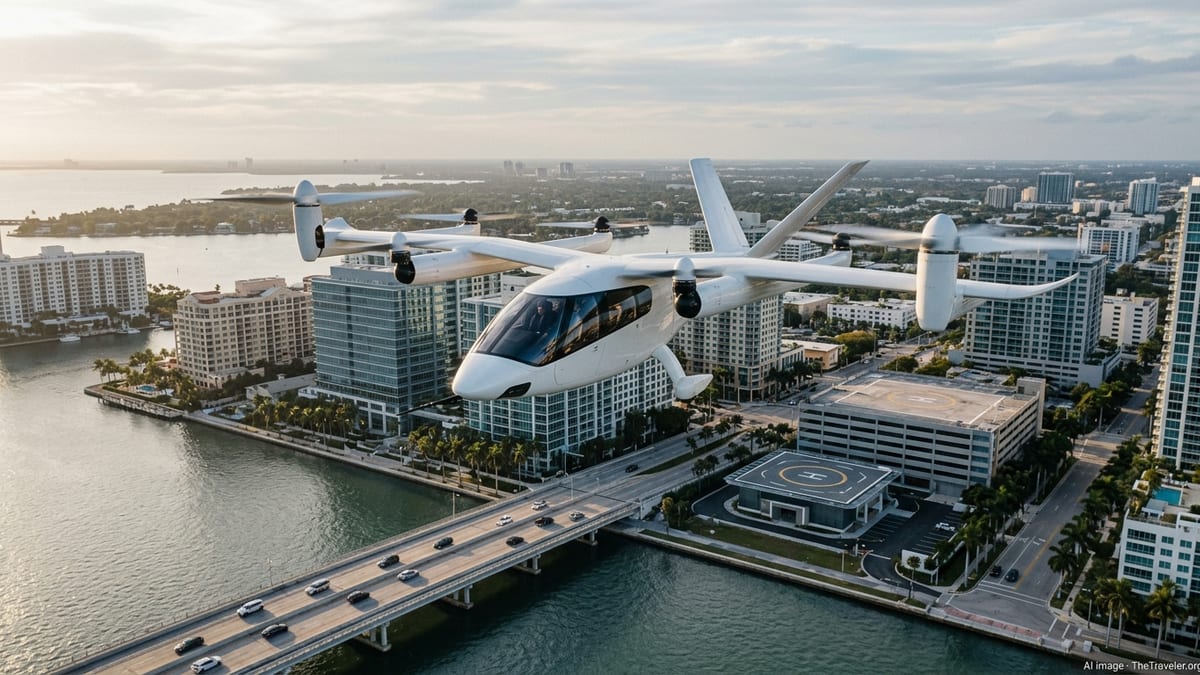
From VX4 Prototype to Valo, a New Chapter in Urban Air Mobility
Publicly available information shows that Valo is the latest evolution of Vertical Aerospace’s VX4 electric vertical take off and landing aircraft, designed as a piloted, four-passenger vehicle with zero operating emissions. The company positions Valo as its first commercial model, intended for short-hop urban and regional routes that today are dominated by helicopters and congested ground transport.
Reports indicate that the aircraft was formally unveiled in London in December 2025, framed as a step toward quieter, cleaner city connections. Coverage describes a cabin configured to feel closer to a modern airliner than a small helicopter, with an emphasis on passenger comfort, large windows and low in-flight noise, elements that are critical if eVTOL services are to appeal to mainstream travelers rather than niche users.
According to industry reporting, Vertical continues to target entry into commercial service following regulatory approval currently expected in 2028. That timeline places Valo among the first wave of eVTOL aircraft aiming for certification in major markets, and it sets a clear milestone for cities and travel providers planning future air taxi and inter-city shuttle networks.
Breakthrough Flight Testing Brings Electric Aircraft Closer to Travelers
Vertical’s accelerating flight test campaign is central to turning the Valo concept into an everyday travel option. Publicly available press materials outline a four-phase piloted flight program using a full-scale prototype, beginning with basic hover and low-speed maneuvers and building toward complex operations in controlled airspace.
Earlier phases focused on thrustborne testing, where the aircraft behaves more like a helicopter, lifting and maneuvering using vertical thrust. Subsequent wingborne testing pushed the prototype to operate like a conventional airplane, flying on lift generated by its wings. Reports from late 2024 highlighted successful piloted flights in open airspace, an important demonstration that the electric aircraft could safely integrate into the wider aviation system.
By late 2025, the company had secured a Permit to Fly from the UK Civil Aviation Authority for “Phase 4 – Transition” trials, the final stage of the prototype program. This phase concentrates on the seamless shift between hover and wingborne flight, the defining technical challenge for eVTOL aircraft and a prerequisite for reliable commercial operations on tight approach paths to vertiports in dense urban areas.
Separate coverage notes that a third, nearly identical prototype has been completed to support piloted testing in 2026, giving Vertical additional capacity to refine performance, validate safety margins and advance toward a certification-ready design. Together, these milestones position the program among the more mature efforts in the emerging electric air taxi sector.
Global Route Concepts From New York to Osaka and Miami
Vertical Aerospace is coupling its technical progress with a series of high-visibility destination showcases that highlight how Valo could change the travel experience in major cities. According to recent announcements, the company launched a United States tour by bringing a full-scale Valo aircraft to New York City, outlining concepts for electric air travel corridors in partnership with Bristow Group and infrastructure specialist Skyports.
Reports describe plans for potential routes that would link key New York hubs and nearby regional destinations, using vertiport infrastructure to shorten trips that can take hours in road traffic. While the aircraft remains in the certification phase, the New York display offered travelers, local stakeholders and tourism businesses an early look at how eVTOL services might mesh with existing airports, heliports and waterfront terminals.
The tour continued in Miami, where Valo has been exhibited at a central cultural venue as part of efforts to explore inter-city links across South Florida. Public information suggests that Vertical is working with several infrastructure and terminal operators to evaluate potential routes that could connect city centers, coastal resorts and business districts, potentially creating new patterns of movement for both residents and visitors.
In parallel, collaboration with Marubeni in Japan is advancing concepts for piloted eVTOL demonstration flights in the Osaka Bay area, building on momentum from the Osaka World Expo. Reports indicate that visitors there have already interacted with a Valo cabin mockup and simulated routes, pointing to a future in which advanced air mobility could complement existing rail and air networks across the Kansai region.
Industrial Ecosystem: Batteries, Propulsion and Certification Progress
Behind the public flight demonstrations, Vertical Aerospace is stitching together a supply chain and regulatory framework aimed at supporting large-scale, low-emission air mobility. Recent announcements highlight a long-term partnership with Evolito to provide electric propulsion units for Valo, aligning the aircraft with high-performance motors designed specifically for electric aviation.
Publicly available information also describes the launch of a battery pilot production line dedicated to Vertical’s proprietary energy storage systems. These batteries are planned to serve both the Valo eVTOL and a hybrid-electric aircraft program, with the company evaluating locations in the United Kingdom and other countries for full-rate production facilities. This move suggests an ambition not only to operate aircraft but to control critical propulsion technologies that underpin performance, range and operating economics.
On the regulatory front, UK and European documentation shows that Vertical is progressing within the eVTOL delivery model defined by the UK Civil Aviation Authority and aligned with the European Union Aviation Safety Agency’s SC-VTOL standards. The framework provides clearer expectations for pilot training, vertiport infrastructure and operational rules, which are essential for integrating electric aircraft into busy airspace shared with commercial airliners and conventional helicopters.
These steps in propulsion, batteries and certification illustrate the broader industrial effort required to bring new classes of aircraft into commercial service. They also underline how closely the success of electric air travel will depend on parallel advances in energy technology, safety regulation and ground infrastructure.
Implications for Future Travelers and Urban Connectivity
For travelers, the developments around Valo point toward a future in which short flights could become quieter, cleaner and more accessible. Industry analyses suggest that eVTOL aircraft could unlock new point to point routes between neighborhoods, airports and regional centers, reducing pressure on congested roads and shortening door to door journey times.
Travel planners are watching closely as cities experiment with vertiports on rooftops, at waterfronts and alongside existing terminals. The kind of operations envisioned for Valo would require careful coordination with local authorities, aviation regulators and transport agencies, particularly around noise profiles, flight paths and community acceptance. Successful demonstrations in New York, Miami and Osaka could influence how other global hubs frame their own advanced air mobility strategies.
Vertical’s latest annual reporting and program updates indicate that demand for the aircraft is emerging not only from operators in North America and Europe but also from regions where rapidly growing cities are looking for alternative mobility options. Interest from private aviation providers in India, for example, suggests a potential role for electric aircraft in connecting secondary cities, industrial corridors and tourist destinations that are not well served by traditional air networks.
While timelines for large-scale deployment remain contingent on certification, infrastructure and public confidence, the combination of Valo’s unveiling, intensive flight testing and international route planning signals a meaningful shift. Electric aircraft that once existed mainly as digital renderings are now appearing on city streets and museum plazas, bringing travelers a step closer to seeing them overhead as part of the everyday transport landscape.