

More news on this day
A brutal snowstorm that swept into eastern Austria on 20 February has turned Vienna International Airport into a case study in climate volatility, travel disruption and Alpine resilience, stranding tens of thousands of passengers and throwing Europe’s winter tourism machine into turmoil at the height of the ski season.
From Routine Winter to Rare Shutdown
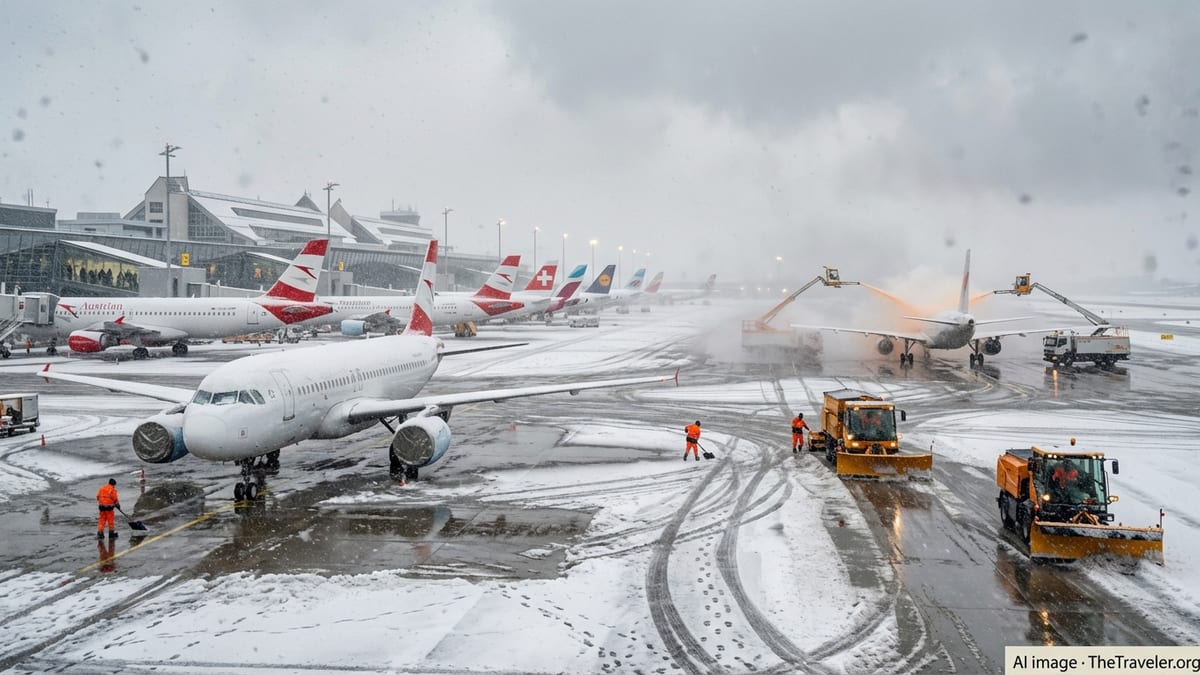
For an airport accustomed to winter, a full stop in operations at Vienna International Airport on Friday was anything but routine. Shortly after dawn, as heavy, wet snow continued to fall across the capital, the hub suspended all departures and arrivals, citing unsafe runway conditions and poor visibility. Within hours, more than 200 flights were cancelled or diverted, according to airport and airline data, affecting tens of thousands of travellers and turning terminal halls into makeshift waiting rooms.
Initial estimates from operators indicated that around 20 centimetres of snow fell in a short window, overwhelming the normal rhythm of snowplows and de-icing teams. Airport statements urged passengers whose flights were delayed or cancelled not to travel to the airport, warning that on-site queues were already stretching capacity. Screens filled with red lines as European city pairs blinked from “delayed” to “cancelled” in rapid succession.
The shutdown, which extended into late morning before limited departures could resume, underscored how even well-drilled winter hubs can be blindsided when several weather variables align. Low cloud, gusty winds and intermittent freezing precipitation combined to push safety margins beyond what could be managed with rolling snow clearance alone, forcing controllers to close runways rather than gamble with reduced visibility and slick surfaces.
By midday, with a cautious restart underway and arrivals resuming later in the afternoon, it was clear that the storm’s impact would extend far beyond a single morning’s flight programme. Crews, aircraft rotations and onward connections were all out of sequence, setting up a messy, multi-day recovery.
Stranded Travellers and a Network in Freefall
Inside the terminals, the storm translated into a familiar but still jarring reality for passengers: long lines, scarce information and limited options. Airline desks quickly filled with travellers seeking rebooking, while those arriving on diverted or delayed flights scrambled to salvage connections to ski gateways like Innsbruck, Salzburg and Munich, or long-haul departures to North America, Asia and the Middle East.
Industry analysts noted that once Vienna lost its morning “bank” of flights, the hub’s carefully choreographed network began to unravel. With at least 150 of roughly 230 scheduled flights cancelled or heavily delayed through midday, aircraft and crews were in the wrong places at the wrong times. That made it difficult for airlines to rebuild their timetables, particularly for itineraries relying on tight connections to reach Alpine resorts or far-flung winter-sun destinations.
On the ground, hotels near the airport reported a surge in last-minute bookings as some passengers resigned themselves to overnight stays. Others scrambled for rail and coach alternatives, filling trains to major Austrian ski regions and neighbouring countries. Travel insurers began fielding claims and queries in real time, as questions mounted about compensation obligations under European passenger rights rules.
For many travellers, the disruption was not just an inconvenience but a lost holiday. With school half-term weeks in several European countries, a large share of those stranded were families en route to Alpine ski breaks. For them, a 24- or 48-hour delay meant missing a significant portion of trips that had been planned, and paid for, months in advance.
Vienna’s Winter Playbook Under Pressure
Vienna International Airport markets itself as an all-weather hub with robust winter operation protocols, and in most seasons that reputation holds. Plows, blowers and de-icing rigs are standard fixtures when snow is in the forecast, and the airport’s winter maintenance crews routinely work overnight to keep runways and taxiways usable in colder months. The storm on 20 February, however, exposed the limits of even well-resourced preparation.
According to airport communications, maintenance teams had been deployed through the night, but the intensity and persistence of the snowfall meant that by early morning the rate of accumulation outpaced clearance. Safety thresholds for braking action and visibility on runways were breached, forcing a halt to movements. At the same time, strong winds pushed snow back onto freshly cleared surfaces and created drifts around parked aircraft and ground equipment.
Operationally, the decision to suspend flights was straightforward: safety outranks schedule. Strategically, however, the episode has raised questions about whether Vienna and comparable European hubs will need to further adapt their infrastructure and staffing to a future of more volatile winter weather. Options under discussion in the aviation sector include additional reserve snow-clearing equipment, deeper cross-training of staff for crisis roles and more conservative slot planning during high-risk forecast windows.
Airport officials stressed that core systems, from runway lighting to backup power, held up well during the storm. The pressure points appeared instead at the interface between infrastructure and passenger experience: crowded terminals, limited seating, and patchy communication as multiple airlines updated their plans simultaneously. That has renewed calls from consumer advocates for more harmonised, real-time information flows between airports, carriers and travellers when severe weather hits.
Austrian Airlines and Europe’s Carriers on the Defensive
As Vienna’s dominant home carrier, Austrian Airlines found itself at the centre of the disruption. The airline had entered the winter season with an expanded network, promoting both classic ski routes into the Alps and winter-sun escapes to destinations such as Dubai, Mauritius and Bangkok. The snowstorm effectively flipped that growth narrative overnight, turning a symbol of connectivity into a knot of cancellations and stranded aircraft.
Operational updates suggested that Austrian and other carriers at Vienna were prioritising a gradual restart over an aggressive catch-up push, focusing first on restoring key long-haul links and essential feeder services. Short-haul and leisure routes bore the brunt of cancellations, a pattern observed repeatedly in European weather events where airlines trim lower-yielding flights to stabilise the wider network.
For low-cost carriers operating from Vienna, including large budget operators with dozens of European destinations, the calculus was similar but the customer impact often more acute. With slim margins built into schedules and limited interline agreements, passengers whose flights were cancelled frequently had fewer rebooking options beyond waiting for the next available departure days later, or purchasing new tickets at walk-up prices.
The Vienna storm also cascaded across Europe’s interconnected aviation system. Flights that were meant to feed into or out of the Austrian capital from hubs like Frankfurt, Munich and Zurich were delayed or cancelled, amplifying a broader pattern of winter disruption already affecting central Europe this season. For airlines operating multi-hub networks, reallocating aircraft and crews around the Vienna bottleneck became a complex logistical exercise in a matter of hours.
Alpine Resorts Feel the Shockwave
While runways and terminals drew much of the immediate attention, the storm’s shockwaves were quickly felt in Austria’s mountain resorts. February is traditionally one of the most lucrative months for Alpine destinations, combining reliable snow with school holidays across key source markets such as Germany, the United Kingdom and the Netherlands. Many of those visitors transit through Vienna on their way to Lower Austria’s family-friendly hills or on long-haul services that connect onward by rail and road into the high Alps.
Tourism boards and local operators reported a spike in late arrivals, shortened stays and, in some cases, outright cancellations as travellers unable to secure timely rebookings opted to abandon or defer their trips. Hotels faced the dual challenge of unexpectedly vacant rooms and guests arriving in compressed waves once flights began operating again, putting pressure on staffing, transfers and check-in systems.
Ski schools, lift companies and guiding services, which often schedule staff precisely around weeklong bookings, also felt the strain. Some resorts responded with flexibility, offering to shift lesson days and rental periods without additional charges in an effort to salvage guest satisfaction and maintain goodwill. Others warned that their own capacity constraints, from instructor availability to fully booked mountain restaurants on peak days, limited how far they could stretch.
In the broader Alpine region, where heavy snowfall had already raised avalanche risks to high or even maximum levels in some sectors, the Vienna disruptions added another layer of complexity. Road closures and rail delays in mountain corridors, imposed for safety as snow and wind intensified, meant that even travellers who did land in Austria on schedule sometimes faced long, uncertain journeys to their final resort destinations.
Resilience on the Ground: Coordination and Criticism
Austria’s response to the snowstorm has highlighted both the strengths and the gaps in its crisis-coordination playbook. National and regional authorities moved quickly to deploy additional road-clearing crews, police and emergency services around Vienna and along key highway links leading to the airport and major resort gateways. Power utilities raced to restore electricity in districts where falling snow and ice had knocked out lines, while meteorological services updated avalanche advisories for popular ski areas.
At the same time, criticism surfaced from passengers and tourism professionals who argued that warnings could have been clearer and earlier. Some travellers said they only learned of cancellations after arriving at the airport, despite airlines and the airport itself pushing notices through digital channels. Others questioned whether more proactive pre-emptive cancellations, announced the previous evening, might have reduced terminal crowding and made rebooking processes smoother.
Within hours, however, examples of improvisation and solidarity emerged. Volunteer teams from aid organisations distributed hot drinks and blankets to stranded passengers. Local transport providers added supplemental bus services between the airport, the city centre and major rail stations, helping travellers connect to alternative routes. Several hotels near the terminal offered discounted distress rates for those stuck overnight.
For policymakers, the episode is likely to feed into ongoing discussions about national resilience strategies in the face of climate-driven extremes. As winter patterns swing between unusually mild spells and sudden, intense storms, Austria is being forced to think beyond traditional notions of “good” or “bad” snow years and toward a more dynamic model of risk management that covers everything from airports to ski lifts.
Europe’s Winter Tourism Model Faces a Stress Test
The Vienna airport shutdown is not an isolated incident but part of a wider story playing out across Europe’s winter destinations. In recent seasons, the continent has seen a mosaic of challenges: lower-altitude resorts battling thin snow cover, higher zones contending with heightened avalanche danger after intense storms, and transport networks buckling under the strain of more frequent extreme weather events.
Central to that story is the role of hub airports such as Vienna, Munich, Zurich and Milan, which serve as bridges between global source markets and mountain valleys. When one of these hubs fails, the impact ripples quickly into ski schools, rental shops, restaurants and lift operators hundreds of kilometres away. As this storm illustrated, a single morning of grounded aircraft can erase days of carefully constructed travel plans and dent the revenues of entire regions.
Tourism economists suggest that destinations may need to further diversify both their source markets and their product offerings to cushion against such shocks. That could mean deeper investment in rail-based access, particularly from nearby European cities, as well as more robust shoulder-season programming that reduces dependence on a handful of peak winter weeks. It may also involve revisiting cancellation and insurance norms to share the risk of disruption more evenly between travellers, operators and intermediaries.
Yet there is also a competing narrative of opportunity. Resorts that can demonstrate reliable access, flexible policies and strong safety protocols in volatile winters may gain market share over those that struggle. For Austria, which has long prided itself on the efficiency of its tourism infrastructure, the chaos at Vienna offers both a warning and a chance to showcase improvements in the seasons ahead.
Looking Ahead: Lessons for Travellers and the Industry
As flights gradually return to normal and stranded passengers filter onward to their destinations or back home, attention is already shifting to what can be learned from Vienna’s snowstorm shock. For travellers, the episode reinforces a growing list of winter essentials: building buffer time into itineraries, especially when connecting through hub airports; considering rail or coach options as backups; and examining travel insurance and airline policies closely, particularly during peak ski weeks.
For airlines and airports, the storm is likely to prompt fresh scrutiny of communication strategies and contingency planning. Clearer pre-trip alerts, more integrated rebooking tools and closer coordination with rail and bus operators are among the measures experts say could soften the blow of future weather disruptions. Technology, from improved runway-condition monitoring to real-time passenger messaging, will be central to those efforts, but so will staffing levels and training.
Austrian tourism officials, meanwhile, are expected to use the incident as both a talking point and a test case in discussions with partners across Europe. The objective will be twofold: to reassure travellers that the country remains a dependable winter destination, and to press for broader European frameworks that recognise and address the interconnected nature of aviation, climate risk and tourism economies.
For now, Vienna Airport’s snowstorm chaos stands as a vivid snapshot of a continent in transition. Europe’s winter tourism power remains considerable, but so too are the pressures reshaping how people move, ski and spend during the coldest months. How Austria and its neighbours respond will help determine whether scenes like those at Vienna become rare exceptions or a recurring feature of the European winter landscape.