

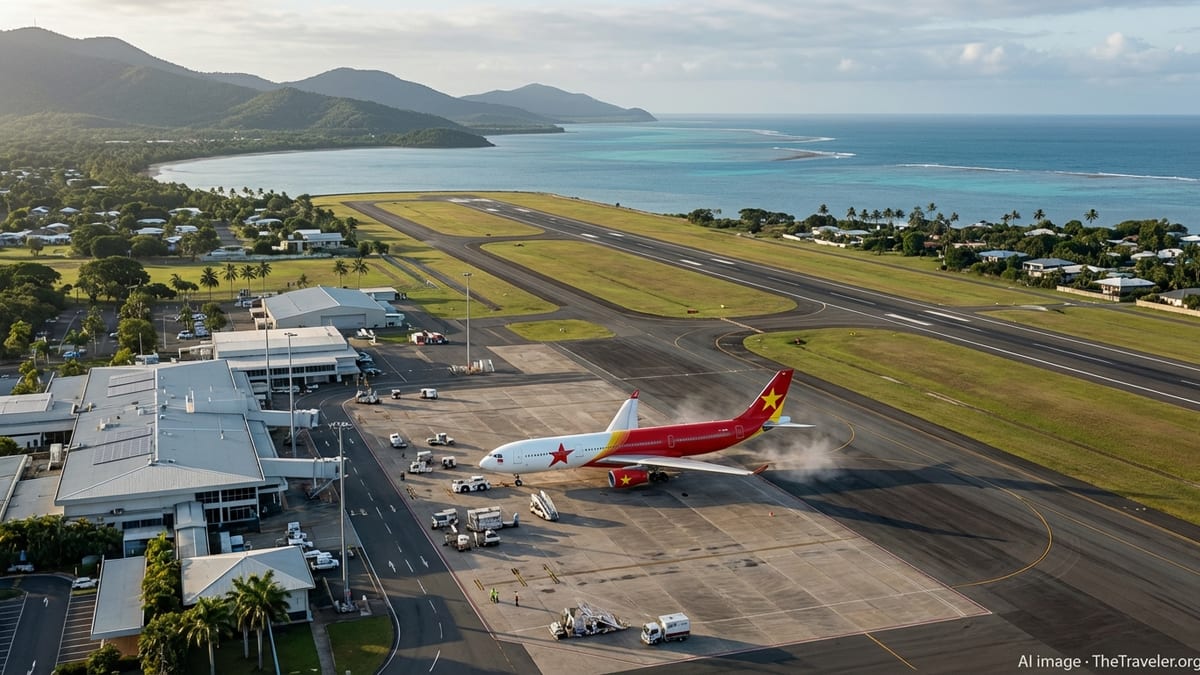
As Vietnam rockets up the ranks of Australia’s favourite overseas destinations, all eyes in Queensland are turning north, where Cairns Airport and Tourism Tropical North Queensland are positioning the Great Barrier Reef gateway as Vietjet Air’s next big prize.
A Low-Cost Challenger Reshapes Vietnam–Australia Links
In less than three years, Vietjet Air has transformed the Vietnam–Australia market from a niche long-haul corridor into one of the most hotly contested aviation battlegrounds in the Asia–Pacific. The privately owned low-cost carrier entered Australia in 2023 with flights from Ho Chi Minh City to Melbourne, Sydney and later Brisbane, quickly marketing Vietnam as both a beach escape and a regional hub for wider Asia and Europe connections. Its hallmark strategy has been simple: deploy widebody Airbus A330-300 aircraft, chase volume with sharp pricing and then thicken routes as demand builds.
By mid-2024, Vietjet was already operating dozens of weekly flights to Australia’s five largest cities, betting that pent-up post-pandemic demand and Vietnam’s growing popularity would sustain rapid growth. The airline also opened new non-stop links from Hanoi to Melbourne and Sydney, briefly shifting part of the Vietnam–Australia flow away from the traditional southern gateway of Ho Chi Minh City. The result was an unprecedented expansion of capacity between the two countries, putting fresh downward pressure on fares and expanding options for both leisure and visiting-friends-and-relatives traffic.
The carrier has not been afraid to adjust course. In 2025 it confirmed the suspension of the newer Hanoi services to Sydney and Melbourne while boosting frequencies from Ho Chi Minh City to Melbourne, Sydney, Brisbane and Perth. The pivot underlined Vietjet’s willingness to redeploy aircraft quickly to where yields and load factors are strongest, a flexibility that is central to any future move into regional Australian gateways such as Cairns.
Cairns Stakes Its Claim as Australia’s Northern Gateway
Cairns Airport has been quietly building a case that it should be next in line for new long-haul and medium-haul services from Asia, including Vietnam. The airport has emerged from the pandemic as one of Australia’s fastest-growing international hubs, supported by a strong domestic tourism base and the enduring appeal of the Great Barrier Reef and the Daintree Rainforest. International passenger volumes are rebounding strongly, with airport management forecasting record combined domestic and international traffic through the 2025–26 summer peak.
Key to Cairns’ pitch is its recent success in restoring and upgrading Asian connectivity. Cathay Pacific returned in late 2025 with a seasonal direct Hong Kong service, delivered on Airbus A330 aircraft and timed to capture both holidaymakers and connecting traffic to mainland China, India and Europe. Singapore Airlines is also deepening its commitment, with additional seasonal widebody flights in 2026 and a move to daily year-round services to Singapore from December 2026. For airlines considering new routes, those decisions are a powerful vote of confidence in the long-term viability of the Tropical North Queensland market.
Cairns has also been selected as host for a major regional aviation and tourism summit in 2025, bringing airline chiefs, tourism strategists and government officials together in the city. Airport executives see the event as a chance to showcase the region’s infrastructure, demand profile and incentives directly to decision-makers at carriers such as Vietjet. With runway capability for widebody aircraft and a compact terminal layout that suits point-to-point operations, Cairns is positioning itself as a ready-made platform for new low-cost long-haul services.
TTNQ’s Strategy to Court Vietnam’s Emerging Middle Class
Tourism Tropical North Queensland, the regional tourism body, has been working in lockstep with Cairns Airport to identify and cultivate new source markets that can support year-round air services. Vietnam sits high on that list, both as an outbound market and as a connecting hub. The country’s middle class is expanding rapidly and its citizens are travelling abroad in record numbers, while Vietnam itself is increasingly popular among Australians looking for affordable culture and nature-focused holidays.
TTNQ’s pitch to Vietnamese travellers centres on the idea of a “reef and rainforest twin escape,” pairing the Great Barrier Reef with ancient rainforests and Indigenous cultural experiences. The organisation has poured resources into trade missions, digital campaigns and partnerships with travel agents and online booking platforms across Asia. It has also supported large corporate incentive groups, such as recent delegations from North Asia, that chartered aircraft into Cairns and demonstrated the region’s capacity to handle high-volume, high-value visitors.
A direct or one-stop Vietjet service into Cairns, marketed via Ho Chi Minh City and Hanoi, would slot neatly into that strategy. It would offer Vietnamese travellers a new short-break destination within eight to nine hours’ flying time, while also providing a convenient link for Australians who want to combine a stay in Cairns with a onward journey to Vietnam’s beaches, heritage towns and emerging island resorts. TTNQ’s leadership has stressed that any route development must be built on strong trade relationships and targeted marketing, rather than simply relying on cheap fares.
Why Cairns Makes Sense for Vietjet’s Network Map
From Vietjet Air’s perspective, Cairns offers several strategic advantages that differentiate it from other secondary Australian cities. First is geography. Cairns is the closest major Australian gateway to much of Southeast Asia, shortening flight times and improving aircraft utilization compared with services to southern capitals. For an airline that watches unit costs carefully, a shorter sector can make the difference between a marginal route and a sustainably profitable one.
Second is the competitive landscape. While Brisbane, Sydney and Melbourne are hotly contested by full-service and low-cost rivals, Cairns has far fewer direct links into North and Southeast Asia. That gives a new entrant room to carve out a clear market position as the primary low-cost bridge from Vietnam to the Great Barrier Reef. With Cathay Pacific and Singapore Airlines focusing on full-service connecting models, a Vietjet service could stand out on price and direct access to Vietnamese and wider regional destinations.
Third is connectivity beyond Ho Chi Minh City and Hanoi. Vietjet operates an extensive domestic and regional network, including services to island hotspots such as Phu Quoc and major coastal cities like Da Nang and Nha Trang. A Cairns link feeding into that network would enable packaged itineraries that combine Queensland and Vietnam in a single trip, a proposition that appeals to both tour operators and independent travellers. For Vietjet, this type of two-way tourism flow is critical: aircraft seats need to be filled in both directions to keep yields healthy.
Capacity Swings Reveal Both Promise and Risk
The pace and volatility of Vietjet’s recent expansion into Australia highlight both the opportunity and the risk for a prospective Cairns route. The carrier’s decision in 2025 to suspend its relatively new Hanoi links to Sydney and Melbourne illustrated that even promising markets can be reshaped quickly when demand patterns or competitive pressures shift. At the same time, Vietjet doubled down on Ho Chi Minh City services to core cities, increasing weekly frequencies to meet surging demand from Australian holidaymakers and the Vietnamese diaspora.
Industry analysts point to a remarkable statistic: Australian short-term visits to Vietnam grew at one of the fastest rates of any destination in the year to mid-2025, underscoring just how hot the route has become. Hotel platforms have reported triple-digit growth in Vietnam bookings from Australian customers, particularly for coastal resorts and city breaks. That surge has validated airlines’ decisions to add capacity, but it has also raised questions about how long the growth curve can be sustained and whether secondary routes will be left vulnerable if the market cools.
For Cairns, these dynamics underscore the importance of structuring any Vietjet partnership for resilience rather than short-term headlines. Tourism leaders in Tropical North Queensland are acutely aware that new long-haul services can be withdrawn if they underperform in their first two or three seasons. Incentive packages, cooperative marketing funds and close data sharing between airline, airport and tourism bodies will be essential to give a Cairns–Vietnam link the best chance of success.
Queensland’s Wider Aviation Play and the Role of Cairns
Vietjet’s existing presence in Brisbane is a crucial part of the story. When the carrier launched Ho Chi Minh City to Brisbane flights in mid-2023, it became the first direct connection between Vietnam and the state of Queensland. State tourism authorities and Brisbane Airport Corporation framed the deal as a milestone in deepening economic and cultural ties between the two countries, coinciding with the 50th anniversary of diplomatic relations. The route also aligned with Queensland’s broader strategy to diversify its visitor markets ahead of the Brisbane 2032 Olympic and Paralympic Games.
Within that strategy, Cairns is increasingly being talked about as a complementary, rather than competing, gateway. Brisbane offers scale, corporate demand and strong domestic connections, while Cairns delivers immediate access to reef and rainforest attractions that resonate strongly in Asian markets. A future Vietjet network scenario that includes both cities would effectively give the airline a two-pronged Queensland footprint, with Brisbane absorbing more business and visiting-friends-and-relatives traffic and Cairns focusing on leisure, packaged tours and seasonal peaks.
State-level policy also matters. Queensland’s government has used aviation attraction funds to secure new services, including into regional airports that support priority tourism zones. If Vietjet can be convinced that a Cairns route aligns with its growth plans and can be launched with a competitive incentive package, it would strengthen the case for dedicating scarce widebody aircraft time to the city rather than to further increases in capacity to existing ports.
What a Cairns–Vietnam Service Could Look Like
While no formal announcement has yet been made, aviation planners and tourism consultants are already sketching possible configurations for a Vietjet service linking Cairns with Vietnam. One scenario would see a non-stop Ho Chi Minh City to Cairns route operating three to four times weekly, likely on A330-300 aircraft configured with both economy and a small business cabin. This would mirror Vietjet’s model on other Australian routes, giving the airline the flexibility to adjust frequencies between peak holiday periods and shoulder seasons.
Another possibility is a one-stop routing via an intermediate Southeast Asian hub where Vietjet’s affiliates operate, using smaller narrowbody aircraft while still marketing a single-ticket journey. This could lower initial risk but might dilute the appeal of “direct access” that Cairns and TTNQ hope to promote. In both cases, the success of the route would hinge on smart scheduling: late-evening departures from Vietnam and morning arrivals in Cairns would allow same-day hotel check-in and reef excursions, while afternoon returns could feed into connecting banks in Ho Chi Minh City.
Critical to commercial performance would be the mix of passengers. Tourism authorities would aim to balance inbound visitors from Vietnam and connecting Asian markets with Australians heading north. Package operators could be offered allotments in the early seasons, while low entry fares and promotional campaigns would be necessary to build awareness. Cairns’ growing calendar of major events, including cultural festivals and international sporting fixtures, could also help smooth demand outside traditional school holiday peaks.
Can Cairns and TTNQ Unlock the Next Tourism Boom?
The broader question is whether a Vietjet move into Cairns could catalyse a new phase of tourism growth between Vietnam and Australia, comparable to the impact of earlier low-cost expansions into Thailand and Bali. There are reasons for optimism. Vietnam offers a compelling value proposition for Australian travellers at a time of high living costs, while Australians are viewed in Vietnam as high-spending, repeat visitors who often combine city stays with coastal or nature-based experiences. A direct link to Cairns would stitch together two ecosystems that are both heavily invested in sustainable, experience-led tourism.
Yet the bar for success is higher than it was a decade ago. Travellers are more conscious of environmental impacts, exchange-rate shifts and geopolitical risks. Airlines face volatile fuel prices and intensifying competition from Middle Eastern and North Asian carriers. For Cairns, winning a Vietjet service would be only the beginning; the harder task would be to nurture the route through its first few years so it becomes part of the permanent aviation landscape rather than a short-lived experiment.
For now, Vietjet Air, Cairns Airport and Tourism Tropical North Queensland are circling the same opportunity from different angles. Vietnam’s rise as a favourite destination for Australians, Queensland’s ambition to broaden its visitor economy, and the airline’s hunger for new markets create a powerful alignment of interests. Whether that alignment translates into aircraft on the apron at Cairns, and a genuine new tourism boom between Vietnam and Australia’s tropical north, will depend on decisions being shaped right now in boardrooms from Ho Chi Minh City to Far North Queensland.