

More news on this day
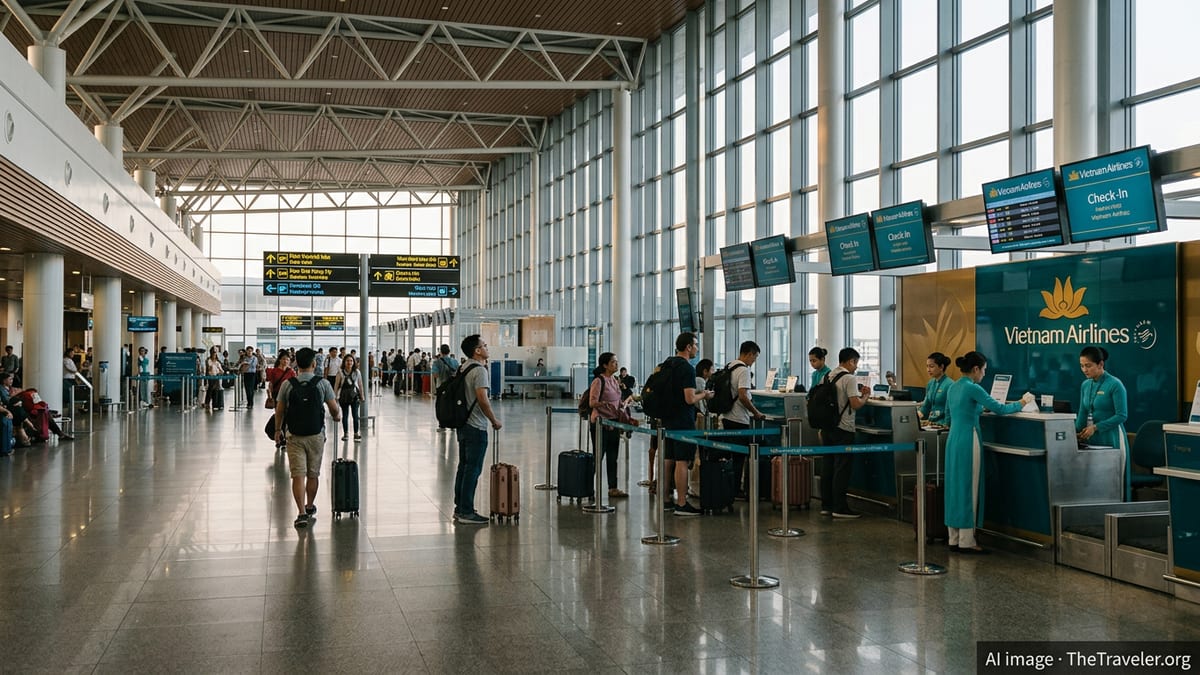
Vietnam Airlines passengers are set to experience a very different airport journey from March 2026 onward, as newly announced and recently implemented terminal reassignments across Asia’s busiest hubs begin to reshape how travelers check in, connect and move through key airports.
Get the latest news straight to your inbox!
Key Shift in Manila Marks Start of 2026 Terminal Changes
The most immediate change for international travelers comes at Manila’s Ninoy Aquino International Airport, where a broad terminal reorganization is being rolled out. According to recent aviation and travel coverage summarizing operator announcements, a first phase beginning on March 29, 2026, will transfer Vietnam Airlines and several other foreign carriers from the aging Terminal 1 into the more modern Terminal 3. The move is designed to ease crowding and rebalance traffic across the airport’s terminals.
Reports indicate that Vietnam Airlines flights currently using Terminal 1 in Manila will check in, depart and arrive at Terminal 3 once the reallocation takes effect. For passengers with long-booked tickets referencing Terminal 1, this means printed itineraries may no longer match day-of-travel reality. Travelers flying around or after March 29 are being urged in public guidance to recheck their terminal information shortly before departure, using airline communications or airport displays, and to build in extra time for first-time navigation of the larger terminal complex.
This Manila change is particularly significant for connecting travelers. Terminal 3 is better integrated with newer security, retail and boarding facilities, which may smooth transits but can also involve longer walking distances and unfamiliar transfer flows. International passengers using separate tickets on different airlines at Manila are likely to feel the shift most strongly, as terminal changes add complexity to baggage re-check and immigration planning.
A second phase of the Manila reshuffle, scheduled for April 1, 2026, focuses on other carriers but further underlines that the airport is entering a period of rapid change. For Vietnam Airlines customers, March 29 is the key date after which all Manila routines they may be used to from Terminal 1 will need to be revisited.
Ho Chi Minh City’s New Domestic Hub at Terminal 3
While Manila’s reassignment is still ahead, Vietnam’s own largest gateway has already undergone a major transformation that continues to influence travel in 2026. Tan Son Nhat International Airport in Ho Chi Minh City opened its new Terminal 3 for domestic operations in 2025, and publicly available information from Vietnam Airlines and local media shows that the flag carrier has relocated all of its domestic flights from the old Terminal 1 into this new facility.
Terminal 3 is positioned as a higher-capacity, more streamlined domestic hub, purposely built to relieve chronic congestion at Tan Son Nhat. Reports describe larger check-in halls, expanded security areas and upgraded passenger amenities. For Vietnam Airlines customers, the practical effect is that journeys which once involved domestic check-in at Terminal 1 and international flights at Terminal 2 may now require different transfer routes, signage and timing, especially when self-connecting between domestic and international segments.
Travel accounts and airport guidance emphasize that passengers connecting from Vietnam Airlines domestic services at Terminal 3 to international flights at Terminal 2 should allow generous transfer buffers. Moving between terminals involves exiting the secure area, transferring landside and clearing security again, and the new layout may introduce unfamiliar walking paths. Experienced visitors who used Tan Son Nhat for years are finding that habitual shortcuts, meeting spots and lounges have shifted or disappeared altogether.
For purely domestic itineraries, however, the passenger experience is generally reported as more orderly than during the peak years of Terminal 1 congestion. The relocation has concentrated Vietnam Airlines’ domestic operations under one newer roof, aligning with a broader push to give the carrier a clearer, more premium presence at its Southern hub.
Hanoi and Long Thanh Signal a Wider Infrastructure Upgrade
Beyond immediate terminal reassignments, Vietnam’s broader airport strategy will further change how travelers experience Vietnam Airlines’ network over the next several years. In Hanoi, the expansion of Noi Bai International Airport’s Terminal 2 is moving ahead, with the enlarged terminal slated to open in late 2025. Official infrastructure updates describe higher capacity and upgraded facilities aimed at easing pressure on the capital’s main international gateway.
For Vietnam Airlines, which uses Noi Bai as a primary hub, this expansion is expected to allow more efficient handling of international flows and smoother connections onto the carrier’s domestic network. Although specific gate and terminal assignments for individual airline operations after expansion have not yet been fully detailed in public schedules, the trajectory points toward a more segmented, higher-capacity terminal environment that should eventually reduce bottlenecks for peak-hour departures and arrivals.
Further south, Long Thanh International Airport near Ho Chi Minh City is under construction and is projected in public planning documents and industry briefings to begin commercial operations in 2026. The new airport is designed as a large-scale international hub, and while formal terminal maps for Vietnam Airlines’ operations have not yet been published, the carrier is widely expected to play a central role once services commence.
When Long Thanh opens, Vietnam Airlines’ long-haul and regional network structure is likely to evolve again, potentially shifting some traffic away from Tan Son Nhat and creating new types of connections within southern Vietnam. For travelers booking flights into the mid- and late-2020s, this means that the combination of expanding Hanoi capacity, a brand-new southern super-hub and existing terminal moves will continue to alter routing and transit patterns for years to come.
Knock-on Effects Across the Region’s Major Hubs
The Manila changes and Vietnam’s domestic infrastructure projects are unfolding in parallel with broader terminal reshuffles around Asia, many of which intersect directly with Vietnam Airlines’ route map. At Tokyo Narita, for example, an ongoing multi-year upgrade project is reshaping terminal usage and passenger flows, with the airport’s North Wing of Terminal 1 serving many SkyTeam carriers including Vietnam Airlines. Airport guidance for Narita highlights phased works stretching into 2026, meaning that gate locations, check-in zones and landside flows for Vietnam Airlines passengers may periodically shift even if the overall terminal assignment remains stable.
In South Korea, Seoul Incheon’s terminal landscape is also evolving. While recent high-profile moves involve other carriers, new long-haul routes into Incheon and a gradual rebalancing between terminals are influencing how connections are structured across the region. As more airlines consolidate alliances and move closer together in specific terminals, Vietnam Airlines passengers transiting through Incheon on partner itineraries could see smoother or, in some cases, more complex terminal-to-terminal transfers depending on the final layout.
Other regional airports are undergoing modernization and expansion efforts that indirectly affect Vietnam Airlines travelers as well. Guangzhou Baiyun’s new Terminal 3, for example, adds further capacity to one of southern China’s main hubs, enhancing options for connecting itineraries that include segments on Vietnam Airlines or its partners. Collectively, these projects form a backdrop in which terminal assignments are no longer static, but rather part of a constantly evolving regional network.
For passengers, the result is a travel environment where familiar airports may feel newly unfamiliar on each visit. Large-scale infrastructure works, new terminals and reallocations are designed to ease long-term congestion and improve service quality, yet in the short term they demand heightened attention to terminal details and flexibility in planning routes and layovers.
What Travelers Need to Do Before Flying in 2026
With Vietnam Airlines’ airport footprint changing in Ho Chi Minh City, Manila and potentially other hubs, the most important step for travelers in 2026 is to verify terminal information close to their date of departure. Public guidance from airports and airlines consistently stresses that even tickets issued months in advance may be overtaken by later infrastructure developments, schedule changes or terminal reallocations.
Experts in consumer travel reporting recommend checking booking confirmations, airline communications and airport departure boards during the 24 to 48 hours before a flight, especially for trips crossing through Manila around or after March 29, 2026, and for domestic journeys involving the new Terminal 3 at Tan Son Nhat. Travelers making self-planned connections using separate tickets should budget additional time for possible terminal transfers, and consider travel insurance that covers missed connections caused by unforeseen operational changes.
Travelers returning to Vietnam after several years away are also encouraged to reset expectations. The experience of landing in Ho Chi Minh City or Hanoi in 2026 will not be identical to pre-pandemic patterns. New terminals, rerouted passenger flows and, soon, a completely new international airport at Long Thanh collectively mean that navigating Vietnam’s air gateways is becoming more complex but also more modern.
For Vietnam Airlines, these developments present both logistical challenges and an opportunity to align its brand with improved airport infrastructure at home and abroad. For passengers, they signal the start of a new era in which double-checking terminals and planning extra time on the ground will be as essential as choosing the right seat in the air.