

More news on this day
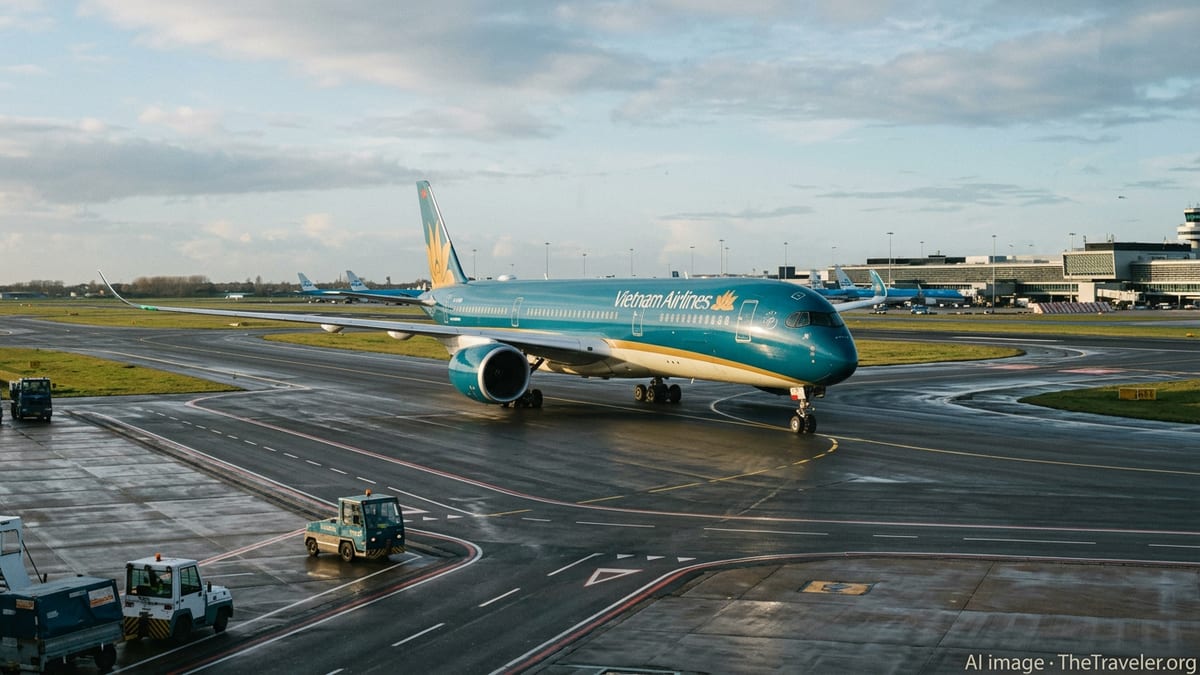
Vietnam Airlines is set to launch the first-ever nonstop flights between Hanoi and Amsterdam in June 2026, a move that strengthens the carrier’s fast-growing European network and creates a new direct bridge between Vietnam and Northern Europe.
Get the latest news straight to your inbox!
New Nonstop Link Between Hanoi and Amsterdam
Vietnam Airlines has confirmed that its inaugural nonstop service between Hanoi and Amsterdam will begin on June 16, 2026, establishing the first direct air connection between Vietnam and the Netherlands. The route represents a strategic expansion for the national flag carrier as it targets stronger links to key European hubs and growing demand for travel between Southeast Asia and Northern Europe.
The airline will operate three round-trip flights per week, with services scheduled on Tuesdays, Thursdays and Saturdays from both Hanoi and Amsterdam. The timetable has been designed to offer overnight flying in at least one direction and convenient arrival times, aiming to minimize jet lag and ease onward connections for both leisure and business travelers.
Vietnam Airlines has indicated that the new route will be served by its long-haul widebody fleet, centered on Airbus A350 and Boeing 787 aircraft. These next-generation jets are already deployed across the airline’s Europe network and are known for quieter cabins, improved fuel efficiency and upgraded passenger comfort in all classes.
Strengthening Vietnam’s Footprint in Europe
The addition of Amsterdam marks a significant milestone in Vietnam Airlines’ European strategy. Once the new service is operational, the airline will offer 12 nonstop routes connecting Vietnam with eight major European cities, including Paris, Frankfurt, London, Munich, Milan, Copenhagen, Moscow and Amsterdam. This positions the carrier as one of the most active Southeast Asian airlines in the Europe market.
Amsterdam’s Schiphol Airport is among Europe’s leading aviation and logistics hubs, with extensive onward links across the continent and beyond. By securing slots and launching nonstop service, Vietnam Airlines gains access to a high-yield catchment area that includes the Netherlands, Belgium, western Germany and the Nordic region, while also offering European travelers a more direct gateway into Vietnam.
The move aligns with Vietnam’s broader ambitions to deepen trade, tourism and investment ties with Europe. Direct flights typically stimulate two-way flows of visitors and cargo, making it easier for businesses to reach partners and for travelers to explore new destinations without backtracking through traditional hubs in the Middle East or other parts of Asia.
Improved Connectivity for Tourism and Business Travel
For leisure travelers, the nonstop Hanoi–Amsterdam route opens up new, shorter itineraries between Vietnam’s heritage-rich north and Europe’s Low Countries. European visitors will be able to reach Hanoi in a single overnight flight, then connect onwards to popular domestic destinations such as Da Nang, Nha Trang and Phu Quoc, as well as regional cities across Southeast and Northeast Asia.
Vietnamese travelers will benefit from simplified access to Amsterdam and its neighboring countries, with reduced total travel time compared with itineraries requiring a change of aircraft in the Middle East or other European hubs. The service is expected to be particularly attractive for visitors combining city stays in Amsterdam with cultural and business trips across the Benelux region and northern Germany.
Corporate travelers and exporters are also set to gain from the new nonstop connection. Direct bellyhold cargo capacity between Hanoi and Amsterdam will support trade in high-value products such as electronics, textiles, agriculture and seafood. For multinational companies with operations in both regions, the route offers a more predictable and time-efficient option for business travel and just-in-time shipments.
Network Resilience Amid Global Uncertainty
The Hanoi–Amsterdam launch comes as Vietnam Airlines underscores the resilience of its European network amid ongoing geopolitical and airspace challenges. The airline recently reaffirmed that all 12 of its European routes remain in operation, with flight paths adjusted as necessary to avoid higher-risk areas and maintain safety standards for passengers and crew.
While some long-haul carriers have scaled back or rerouted services in response to tensions in parts of the Middle East and Eastern Europe, Vietnam Airlines has focused on preserving nonstop connectivity between Vietnam and major European gateways. The upcoming Amsterdam service is viewed internally as both a growth opportunity and a diversification measure that helps spread network risk across multiple hubs.
Industry analysts note that demand for travel between Europe and Vietnam has rebounded strongly since pandemic-era restrictions were lifted, driven by tourism, overseas Vietnamese communities and increasing business links. By moving early to secure a presence at Schiphol with nonstop operations, Vietnam Airlines is positioning itself to capture a larger share of this returning traffic.
Competitive Positioning and Customer Experience
The new Hanoi–Amsterdam route also strengthens Vietnam Airlines’ competitive stance against regional rivals that rely on one-stop itineraries via their own hubs. For travelers prioritizing speed and convenience, a true nonstop service can be a compelling alternative to changing planes in the Middle East or East Asia, especially on journeys where every hour of transit time counts.
On board, passengers can expect the airline’s current long-haul product, which includes lie-flat business class seats, premium economy on selected aircraft and updated in-flight entertainment across cabins. Vietnam Airlines has been gradually refreshing its soft product as well, with menus that highlight Vietnamese cuisine alongside Western options and an expanding range of digital services.
Travel industry observers will be watching closely to see how the Hanoi–Amsterdam route performs once launched in mid-2026. If demand proves robust, additional frequencies or seasonal adjustments could follow, and the success of the service may shape future decisions about new European destinations for Vietnam’s national carrier.