

More news on this day
Vietnam is sharpening its focus on trail-based tourism, promoting mountain treks, cycling routes and community-run experiences as the country looks to capture environmentally minded, adventure-seeking travelers in the coming years.
Get the latest news straight to your inbox!
Adventure Growth Meets Sustainability Priorities
Vietnam’s travel market is projected to expand strongly through 2030, and industry analysis indicates that nature-based and adventure products are among the fastest-rising segments. Recent research on the country’s tourism outlook points to a compound annual growth rate above 15 percent, supported by demand for outdoor activities, rural escapes and culturally immersive stays rather than solely city or beach breaks.
Publicly available information shows that this shift is unfolding alongside rising domestic interest in sustainable travel. Surveys conducted in 2025 highlight that a large majority of Vietnamese travelers now say they prioritize sustainability when planning trips, aligning closely with global trends that favor low-impact activities, smaller group sizes and authentic local interaction.
These overlapping dynamics are pushing provincial authorities, tourism boards and private operators to invest in trails, trekking circuits and cycling routes that disperse visitors beyond traditional hotspots. The strategy is intended to reduce pressure on crowded destinations while directing new income streams to mountainous and rural communities.
Analysts note that this approach also supports national environmental goals, as nature-focused itineraries are increasingly paired with initiatives such as waste reduction, clean-energy transport and conservation-linked tourism fees.
Iconic Mountain Routes from Sa Pa to Ha Giang
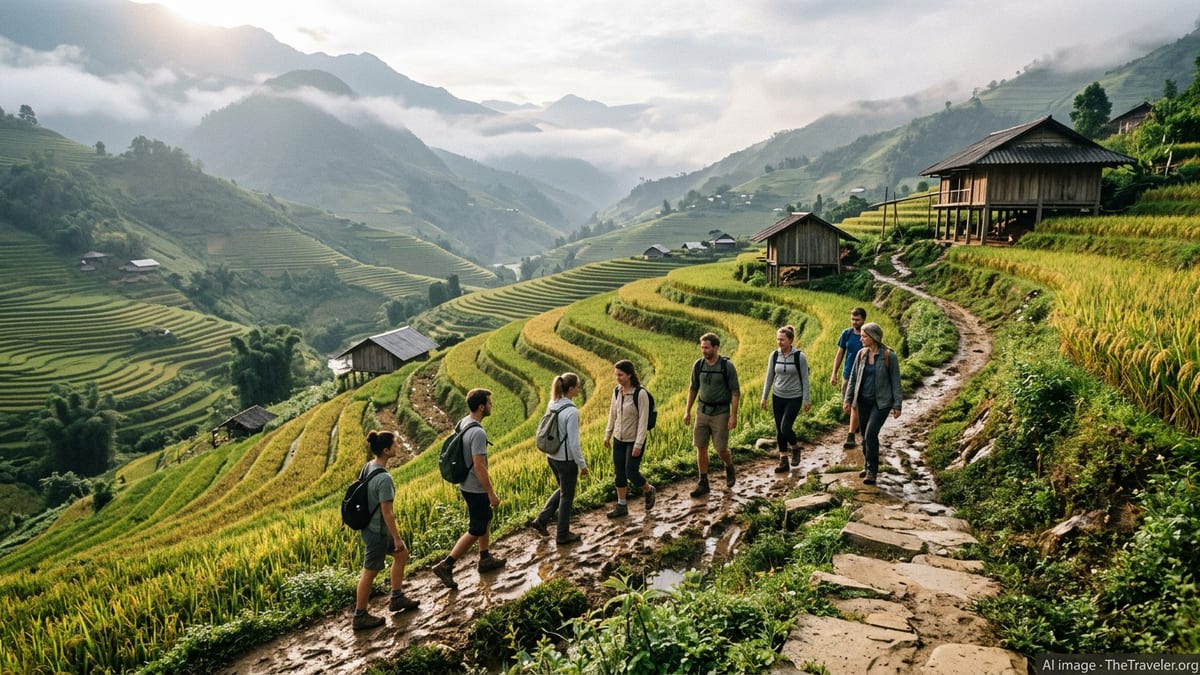
Northern Vietnam remains the focal point for classic trekking and motorbike circuits, where alpine scenery and ethnic minority villages draw both first-time and repeat visitors. Around Sa Pa, long established as a base for hikes into the Hoang Lien Son range, travelers can access routes that cross terraced rice fields, bamboo forests and suspension bridges between villages such as Lao Chai and Ta Van. Recent travel guides emphasize that these routes are now complemented by a growing network of ethical trekking companies and homestays designed around fair income for local hosts.
Farther north, the Ha Giang region continues to feature prominently in travel media coverage through the so-called Ha Giang Loop, a multi-day motorbike and cycling itinerary along National Highway 4C and adjacent mountain roads. The route passes dramatic limestone peaks, canyons and high passes including the Ma Pi Leng area, which has become a magnet for photographers and adventure riders.
At the same time, commentary in travel forums and news features has raised questions about overcrowding and uneven benefits for local communities along parts of the loop. These discussions are feeding into calls for more responsible guiding standards, caps on convoy sizes, better safety practices and a stronger role for community-based enterprises in the region’s tourism supply chain.
Several academic and policy papers published in late 2024 and 2025 also identify northern trekking destinations as test beds for community-based tourism models that integrate indigenous knowledge, with researchers examining how village-level participation can protect landscapes while diversifying livelihoods.
Trail Tourism Expands Beyond the North
While the north retains its reputation for highland adventure, newer trail products in central and southern Vietnam are broadening the map for hikers and runners. In the country’s interior, multi-day trekking routes such as the Ta Nang–Phan Dung trail have gained attention as standout backcountry experiences. The trail links forested hills and grassland ridges across provincial boundaries, and recent pilot programs described in domestic media emphasize improved safety measures, local guiding services and forest protection goals.
Further south and west, spiritual and ecological tourism projects around mountain sites and protected areas are beginning to incorporate walking and pilgrimage trails into their visitor offerings. Academic research on spiritual-ecological tourism in Vietnam notes that trail networks around religious complexes and nature reserves are being upgraded with the dual objective of managing visitor flows and encouraging low-impact exploration.
Coastal and delta provinces are also experimenting with shorter walking and cycling trails that connect mangroves, river landscapes and craft villages. These initiatives tend to be marketed as day trips and weekend escapes for domestic travelers, but tourism planners increasingly frame them as stepping stones toward longer, multi-region trail itineraries that could appeal to international visitors as well.
Industry observers say this geographic diversification is critical if Vietnam is to compete with established trekking destinations elsewhere in Asia, as it offers travelers a mix of mountain, forest and coastal routes within a single trip.
Community-Based Tourism at the Heart of New Routes
Community-based tourism is emerging as a cornerstone of Vietnam’s trail strategy, particularly in ethnic minority and mountainous areas. Reports in national and international travel outlets describe how villages in provinces such as Quang Ngai, Lang Son and Son La are developing homestays, guided walks and cultural activities that keep visitors close to everyday life rather than isolating them in resort compounds.
In Huu Lien Commune in Lang Son, for example, recent coverage highlights how homestay clusters, forest walks and river-based activities have earned regional recognition for sustainable tourism. The model there is cited as a case study in how carefully planned community involvement, environmental zoning and modest-scale infrastructure can attract travelers without overwhelming local culture or ecosystems.
Similar patterns are visible in minority villages near Sa Pa and in remote districts of Quang Ngai, where households host visitors in stilt houses, lead hikes to waterfalls and agricultural terraces, and organize hands-on experiences such as traditional paper making or herbal medicine walks. These offerings are often integrated into multi-day trekking circuits, giving travelers a coherent route while spreading overnight stays among several communities.
Researchers from Vietnamese institutes focusing on human geography and sustainable development have recently analyzed community-based tourism value chains in regions such as Muong, pointing to the potential of linking trails with local products like handicrafts, specialty teas and cultural performances. Their findings underline the need for training, transparent revenue sharing and clear environmental standards if trail tourism is to remain both inclusive and resilient.
Sporting Events and Green Mobility Boost Trail Appeal
Vietnam is also weaving organized sporting events into its trail tourism offer. Provinces such as Ninh Binh have turned running festivals and marathons into headline attractions, using race routes that pass limestone karst landscapes, wetlands and rural villages. Reports indicate that events held since early 2025 have drawn thousands of domestic and foreign participants, with organizers promoting the races as low-impact ways to experience national parks and heritage areas.
To reinforce sustainability claims, Ninh Binh is rolling out dedicated cycling networks and low-emission transport options that give visitors alternatives to private cars and motorbikes. Publicly available information details how an electric shuttle system introduced in 2024 now serves dozens of attractions, while a web of signposted cycling trails allows riders to move between scenic viewpoints, temples and rice fields with minimal environmental footprint.
Other destinations are watching these experiments closely as they consider their own mix of trail running, mountain biking and gravel cycling events. Tourism planners argue that such activities can extend visitor stays and help spread demand beyond peak seasons if they are scheduled carefully and capped to protect sensitive habitats.
Industry commentary suggests that if Vietnam can maintain this balance between growth and stewardship, its emerging network of trails, community homestays and green mobility options could position the country as a leading hub for responsible adventure travel in Southeast Asia.