

More news on this day
Vietnam is weighing ambitious plans for a high speed rail corridor between Hanoi and Halong Bay that, if realized, would dramatically cut travel times on one of the country’s most popular tourist routes and signal a new phase in its rail modernisation drive.
Get the latest news straight to your inbox!
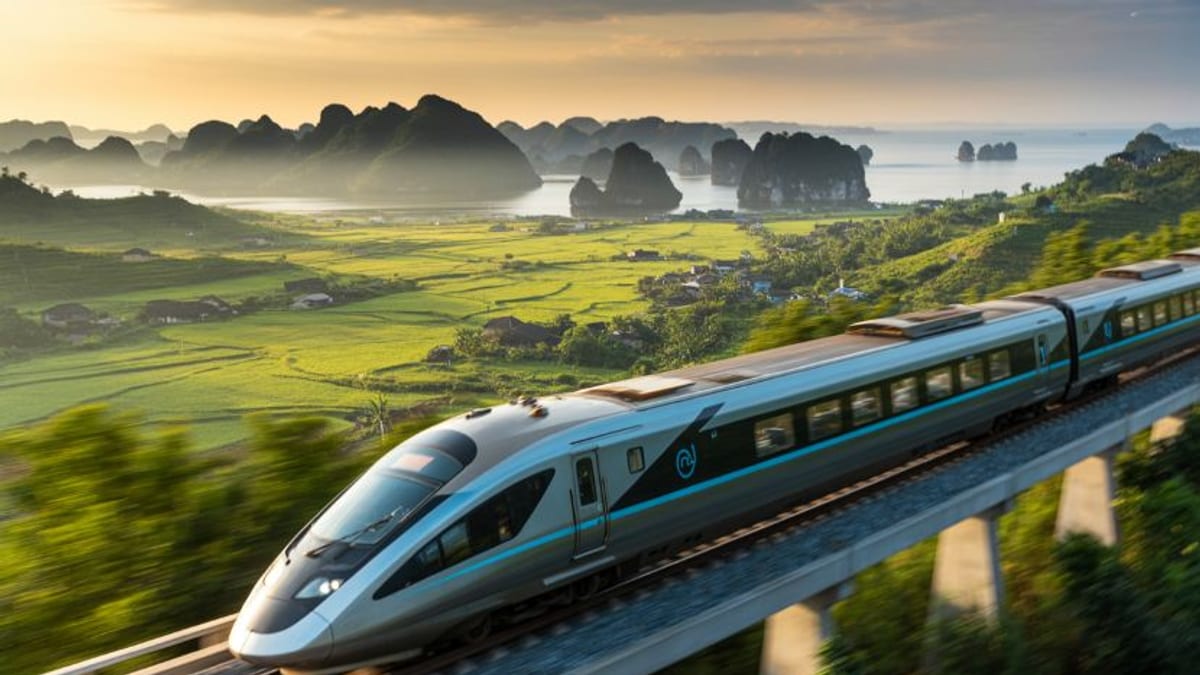
Image by Latest International Railway News, Global Rail Industry News
Ambitious Vision for a Flagship Tourist Corridor
The proposed Hanoi to Halong Bay high speed connection is being discussed in the wider context of Vietnam’s push to upgrade and expand its rail network, including long planned high speed lines on the north south axis between Hanoi and Ho Chi Minh City. Publicly available planning documents and media coverage describe a strategy that prioritizes key economic and tourism corridors, with Halong Bay repeatedly cited as a focal point for improved transport links.
At present, most visitors travel between Hanoi and Halong Bay by highway coach, limousine van or private transfer, typically taking around two and a half to three hours depending on traffic. Reports on the current coach market refer to journey times of roughly 150 kilometers by road along expressways linking the capital with Quang Ninh province. This has long been considered acceptable for day trips but less than ideal for the intensive itineraries of international visitors.
Concepts for a dedicated rail link are framed as a way to reposition Halong Bay not simply as an overnight excursion from Hanoi, but as a destination that can be reached in a fraction of the current time. A travel time in the range of 30 minutes would imply true high speed service, with average operating speeds far above those of existing lines in northern Vietnam. While such figures are being floated in speculative commentary, detailed technical parameters have not yet been published in official tender or feasibility documentation.
For now, the project appears at a strategic planning stage rather than a finalised, shovel ready line. References to the corridor are generally embedded in broader discussions about high speed infrastructure, regional connectivity and the role of public private partnerships in delivering complex rail schemes.
How a Hanoi–Halong High Speed Link Could Work
Preliminary discussions suggest that any new fast rail connection would need to integrate with Hanoi’s evolving rail and metro system while providing a direct, efficient route to the coastline. Existing descriptions of Vietnam’s rail modernisation highlight the use of new greenfield alignments for high speed services rather than simply upgrading the current meter gauge network, which is constrained in terms of allowable speed, geometry and capacity.
In and around the capital, recent rail investments have focused on urban metro lines and station upgrades that could eventually interface with high speed services. Planning references to hubs such as Ngoc Hoi, identified as a future rail complex south of central Hanoi, illustrate how interchanges might be organised between urban, regional and prospective high speed operations. Extending such a node eastward toward Quang Ninh province would likely require substantial new right of way and civil works, including bridges and viaducts over rivers and low lying terrain.
On the coastal side, Halong City and the surrounding bay area are undergoing steady tourism driven development, with port, hotel and cruise infrastructure expanding to accommodate rising visitor numbers. A high speed station would need to be sited to balance access to cruise terminals, city hotels and new urban districts while managing land acquisition and environmental sensitivities in a landscape renowned for its limestone karst formations and protected marine areas.
Engineering studies for Vietnam’s broader high speed ambitions point to design speeds that could support very short intercity travel times on routes of similar length. However, any actual timetable, such as a 30 minute travel time between Hanoi and Halong Bay, would depend on final route geometry, number of intermediate stops, rolling stock choice and operational patterns.
Tourism and Economic Implications for Northern Vietnam
A rapid rail corridor between Hanoi and Halong Bay would have far reaching implications for tourism in northern Vietnam. Today, most cruise operators structure itineraries around early morning road departures from the capital, with passengers spending several hours on buses before boarding vessels in the late morning or early afternoon. A high speed alternative could compress this window, allowing for later departures from Hanoi and more flexible cruise scheduling.
From the perspective of international tour operators, the ability to promise a predictable sub one hour rail journey could make combined Hanoi and Halong packages more attractive, particularly for time pressed visitors following multi country itineraries. It could also encourage repeat tourism by positioning Halong Bay as a destination suitable for weekend visits from the capital, rather than a once in a lifetime excursion requiring a full day of travel time.
Economically, faster passenger flow between the capital and Quang Ninh province could spur investment in hotels, convention facilities and entertainment projects at both ends of the line. Published tourism and transport plans for the region already emphasize the role of improved connectivity in drawing higher spending visitors, diversifying source markets and encouraging longer stays. A high speed link would likely magnify these effects, though it would also raise questions about managing visitor volume and maintaining the ecological integrity of the bay.
Local travel businesses could see both opportunities and disruptions. Road based transport providers might face reduced demand on the core Hanoi to Halong route, while new possibilities could emerge in feeder services to and from future rail stations. Policy makers would need to consider how to ensure that the benefits of any new line are shared across the existing tourism ecosystem.
Integration With National High Speed Rail Strategy
Plans for a Hanoi to Halong Bay high speed connection are best understood alongside Vietnam’s larger national rail ambitions. The most prominent is the proposed north south high speed railway linking Hanoi and Ho Chi Minh City over more than 1,500 kilometers, a project that has been under discussion for years and has passed through multiple rounds of feasibility assessment and political debate.
Recent public reporting on the north south scheme describes a staged approach, with construction of priority sections being considered for the late 2020s. International partners and technology suppliers have been mentioned in the context of potential cooperation on signaling, rolling stock and financing structures. Within this national framework, shorter high speed spurs to key economic centers and border crossings are frequently cited as potential follow on projects or parallel investments.
A fast Hanoi to Halong Bay line would fit this pattern as a northern branch that strengthens links to major ports, special economic zones and tourist destinations in Quang Ninh province. It would also complement expressway investments already completed between Hanoi and nearby coastal cities, reflecting a multimodal strategy in which rail, road, maritime and air links are planned together to support trade and tourism.
However, Vietnam’s experience with large scale infrastructure shows that moving from planning concepts to operational lines can take many years. Questions about funding, technology transfer, procurement models and project phasing will likely shape the timetable for both the core north south line and any associated branches to locations such as Halong Bay.
What Travelers Should Watch For Next
For travelers currently planning trips to Vietnam, the high speed rail vision between Hanoi and Halong Bay remains a medium to long term prospect rather than an imminent option. Existing highways and organized transfers continue to be the primary way to access the bay, and travel planners still recommend allowing several hours for the overland leg of the journey.
Those interested in the future rail link can monitor national transport planning updates, feasibility study announcements and major investment decisions concerning the north south high speed corridor. Developments on that flagship project are likely to influence the pace and design of any subsequent spur to Halong Bay, including technology choices and service standards.
Travel businesses and frequent visitors may also wish to track how new metro and suburban rail projects in Hanoi progress, as these urban systems are intended to interface with intercity and potentially high speed services. The way stations and interchanges are configured in and around the capital will be critical in determining how seamless future journeys to coastal destinations can become.
While a 30 minute Hanoi to Halong Bay trip time remains a headline capturing benchmark rather than a confirmed schedule, the broader direction of policy and investment suggests that Vietnam is serious about transforming its rail system. For travelers and the tourism industry alike, the prospect of significantly faster, more comfortable journeys between the capital and one of the country’s most iconic landscapes is now part of the country’s evolving transport narrative.