

More news on this day
Vietnam’s tourism industry is confronting a new layer of uncertainty as the U.S. dollar’s slide from recent peaks and a widening gap between official and black market exchange rates upend how visitors plan, price and spend in one of Asia’s most popular destinations.
Dollar Loses Steam While Dong Stays Under Pressure
After two years in which a strong U.S. dollar helped make Vietnam feel like a bargain for many foreign visitors, the currency landscape has turned more complicated. The Vietnamese dong has continued to face downward pressure, but the greenback has eased from its highs against a basket of major currencies, leaving tourists grappling with less predictable value for their money once on the ground.
By late February 2026, one U.S. dollar bought just over 26,000 dong at indicative market rates, compared with around 25,000 dong in mid‑2024 and significantly stronger levels for the dollar against other global currencies during that period. While that still makes Vietnam relatively affordable in dollar terms, the trend has softened the “super‑strong” dollar effect that previously amplified Americans’ purchasing power across Southeast Asia.
At the same time, Vietnam’s managed floating exchange regime has required the State Bank of Vietnam to walk a tightrope. Officials have sought to curb excessive weakness in the dong to contain imported inflation while avoiding moves that could make the country appear suddenly more expensive for inbound travelers. The result is a tightly controlled official rate that no longer fully reflects what many visitors actually encounter when changing cash.
This evolving backdrop matters for tourism operators that price tours and hotel contracts months in advance. A softer dollar globally, a weaker dong domestically and a narrow official trading band have combined to produce a growing mismatch between published exchange rates and the prices tourists find on the street.
Black Market Gap Widens in Hanoi and Ho Chi Minh City
The most visible symptom of that mismatch is the spread between the official bank rate and the so‑called “free market” or black market dollar price. Throughout 2025, that gap steadily widened, periodically surpassing 5 percent, the highest divergence in more than a decade, according to analysts who track Vietnam’s currency market.
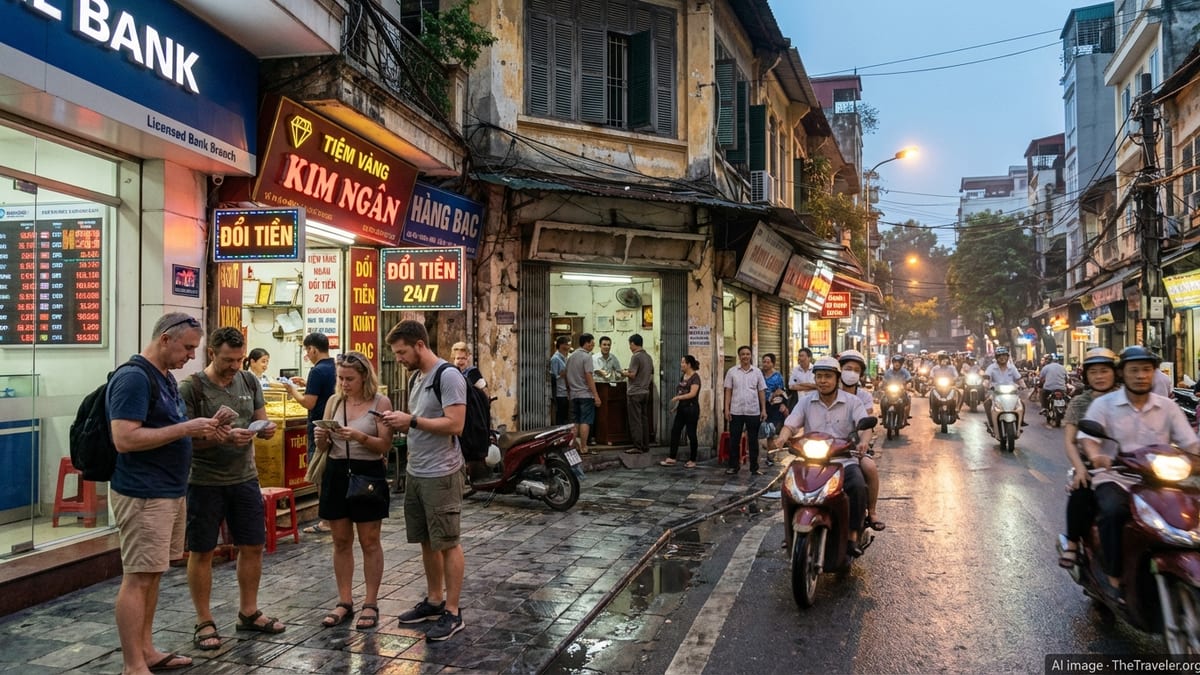
Last October, as pressures peaked, the central bank kept its central exchange rate near 25,100 dong per dollar while brokers in Hanoi’s Old Quarter and commercial districts of Ho Chi Minh City were quoting around 27,500 to 27,800 dong. That left tourists and local businesses facing a stark choice: accept the less generous rate offered by licensed banks and official money changers, or seek out unlicensed gold shops and street brokers willing to pay far more for crisp U.S. banknotes.
The gap is driven by a combination of factors, including tight onshore dollar liquidity, foreign investors hedging against further dong weakness and domestic demand for dollars linked to Vietnam’s buoyant gold trade. When dollars are scarce in the formal banking system, prices in the informal market move higher, widening the difference that travelers quickly notice when comparing online rate screens to offers on the ground.
For visitors, the divergence is not a mere technicality. A tourist exchanging 1,000 dollars can see a difference equivalent to several upscale restaurant meals or a domestic flight depending on whether they use the official or street rate. That creates both temptation and confusion, especially for first‑time travelers who may not understand that many of the most attractive offers come with legal and practical risks.
Authorities Crack Down on Informal Currency Exchanges
The State Bank of Vietnam has responded with a series of directives aimed at reasserting control over the foreign exchange market. In late 2025, regional branches in Hanoi and Ho Chi Minh City ordered intensified inspections of currency exchange agents and urged coordination with police to identify and shut down unauthorized money‑changing points, particularly in tourist‑heavy neighborhoods.
Regulators have reminded banks that agents must clearly display the name of the licensed institution they represent and comply with strict reporting rules. Under existing regulations, exchange counters are generally allowed to buy foreign currency in cash from individuals inside Vietnam but are tightly restricted in selling dollars back to the public. The rules are meant to channel foreign cash into the formal banking system rather than allow it to circulate in an unregulated parallel market.
In practice, enforcement has been uneven. For years, visitors have become accustomed to changing money at gold shops or travel agencies that quietly offered better rates than nearby banks. The latest crackdown, however, is making those workarounds more precarious. Shop owners report more frequent inspections, while some long‑standing unofficial exchanges in central districts have closed or reduced their activity to avoid fines.
Tourism businesses are caught in the middle. Many smaller hotels, tour operators and souvenir shops quote prices in dong but think in dollars when budgeting. When the effective street rate diverges sharply from the official rate they use for accounting and tax purposes, margins can be squeezed. Some have responded by adding informal surcharges, widening spreads on their own in‑house exchanges or tightening cancellation and refund policies to shield themselves from currency swings.
Tourists Rethink Spending, Pricing and Payment Habits
The resulting currency tensions are beginning to reshape how tourists plan and spend in Vietnam. Travel agents say some visitors are arriving with less cash and relying more heavily on cards and digital payments pegged to official banking rates. That approach offers security and clarity but can mean paying effectively more in local terms than travelers who are willing to seek out higher unofficial rates.
Others are trying to time their exchanges, holding dollars until they reach big cities or waiting for perceived “better days” in a fast‑moving market. Social media forums for backpackers and digital nomads are filled with questions about which banks give the best legal rates, whether airport counters are worse than downtown branches and how risky it is to use back‑alley money changers. The lack of clear, consistent information leaves many visitors confused about what is both safe and legal.
Within Vietnam, tourism operators are adjusting too. High‑end hotels and international tour companies increasingly prefer contracts denominated in dollars or euros, with clauses that allow rate adjustments if the dong moves beyond a certain band. Smaller businesses catering to budget travelers are more likely to quote in dong but quietly track the black market rate when setting menu prices or negotiating with foreign partners.
The divergence also influences destination choice. As Thailand and other regional competitors experience their own currency swings, value‑conscious travelers compare not only hotel and flight prices but also the reliability of local exchange markets. Vietnam remains competitive on overall costs, yet the perception of a “two‑tier” currency system can be unsettling for cautious visitors and complicates the country’s efforts to project an image of stability.
Outlook: Managing Volatility Without Deterring Visitors
For policymakers in Hanoi, the stakes go beyond the next high season. Tourism is a key pillar of Vietnam’s post‑pandemic recovery, and officials are keen to avoid headlines suggesting that visitors are being short‑changed or pushed into legal gray zones just to get a fair exchange rate. At the same time, authorities are under pressure to preserve foreign exchange reserves and limit speculative attacks on the dong.
Economists expect the central bank to continue a strategy of gradual, tightly managed depreciation, supplemented by interventions in the interbank market and tougher enforcement against illegal currency trading. If global conditions keep the dollar from returning to its earlier peaks, the dong’s slide may moderate, narrowing the incentive for a large black market premium. But as long as dollar supply remains constrained in the formal system, some degree of parallel pricing is likely to persist.
Travel industry leaders are urging clearer communication in the meantime. That includes better public guidance on where tourists can legally change money, more transparent fee structures at banks and closer coordination between tourism authorities and financial regulators. Some are also calling for more flexible, market‑reflective official rates to reduce the draw of the street market.
For now, visitors heading to Vietnam are being advised to pay closer attention to currency dynamics than in the past. Bringing a mix of cards and cash, checking rates with multiple licensed banks and resisting the lure of unregistered changers are emerging as key pieces of travel planning alongside booking a cruise in Ha Long Bay or a cooking class in Hoi An. How effectively Vietnam manages this delicate balance between exchange rate stability and tourist confidence will help shape the sector’s trajectory through 2026 and beyond.