

More news on this day
New assessments of climate impacts and air quality across Vietnam indicate that millions of children are facing intensifying health and safety risks, even as the government moves to tighten water management, cut emissions and strengthen environmental protections nationwide.
Get the latest news straight to your inbox!
New Data Underscore Children’s Climate and Pollution Vulnerability
Recent regional and national assessments place Vietnam among the countries where children are highly exposed to overlapping climate and environmental hazards. UNICEF’s Children’s Climate Risk Index classifies Vietnam in a category of high risk, reflecting a combination of extreme weather, flooding, heatwaves and pollution that disproportionately affects those under 18. Regional research on Southeast Asia released in late 2025 reiterates that heavy rainfall, extreme heat and related disasters are now routine features of childhood for many Vietnamese families.
UNICEF and partner organizations note that air pollution is a particularly acute threat in East Asia and the Pacific, where toxic air is linked to a significant share of deaths among children under five. While figures are regional, Vietnam’s rapidly urbanizing population and reliance on motorbikes and coal-based power generation mean that its major cities fit the pattern of heightened exposure. Publicly available information highlights that particulate matter can affect children’s development at every stage, from pregnancy through adolescence.
Country-focused reports on Vietnam’s future development, including a 2024–2025 analysis on children and climate, warn that repeated climate shocks can intensify poverty, disrupt schooling and raise risks of exploitation. These studies portray a generation growing up with more frequent storms, floods and droughts, alongside degraded air and water quality in both cities and rural communities. Researchers argue that without accelerated action, climate and environmental stress could undermine hard-won gains in education and health.
Evidence from education research is also emerging. A 2025 study in the journal Economics of Education Review examining Vietnamese children found that spikes in temperature and air pollution were associated with measurable drops in learning outcomes. According to the authors, the findings add weight to calls for stronger pollution control and climate adaptation measures that prioritize schools, informal settlements and low-income neighborhoods.
Urban Smog Puts Millions of Young Lungs at Risk
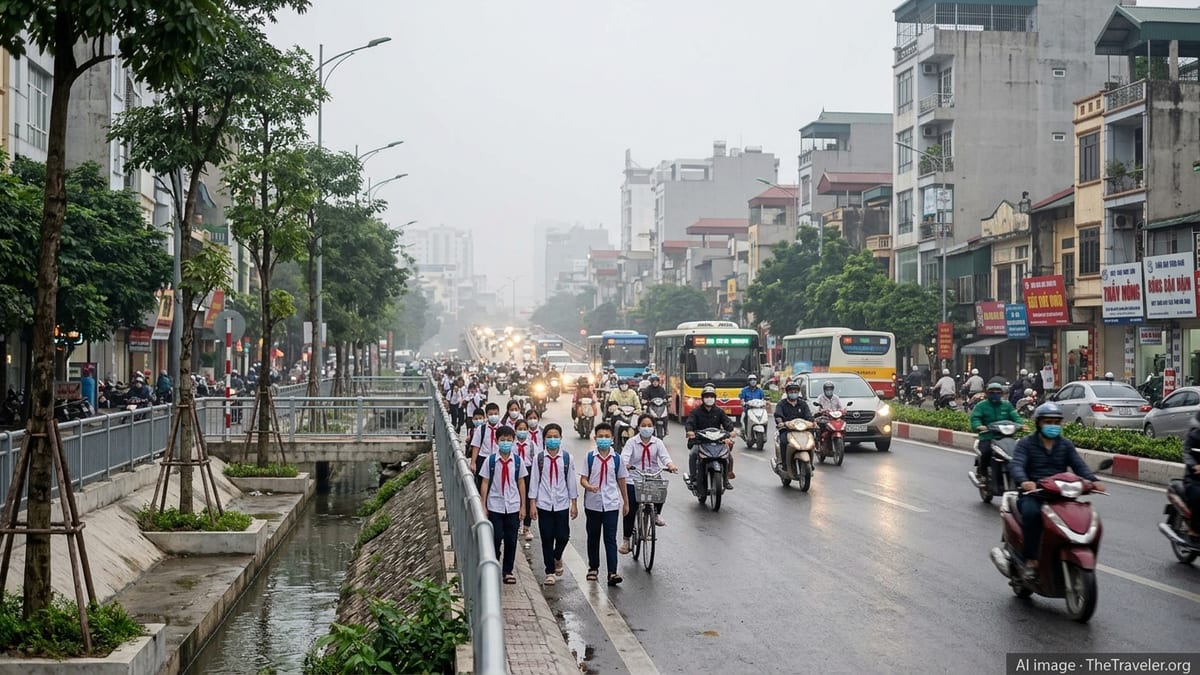
Air quality in Vietnam’s largest cities has become a central concern for public health advocates, with children singled out as one of the most vulnerable groups. Monitoring data from late 2025 show Hanoi frequently ranking among the world’s most polluted cities, with fine particulate levels classified as unhealthy for the general population. Local coverage in early 2025 described the capital’s winter air as being in a prolonged pollution season, often enveloping streets and schoolyards in dense smog.
Vietnamese media and international air-quality platforms have drawn attention to repeated episodes when Hanoi’s air quality index exceeded 150 or even 160, levels at which health experts recommend limiting outdoor activity, especially for children, the elderly and those with respiratory conditions. One widely reported analysis compared long-term exposure in the capital to the effects of passively smoking multiple cigarettes a day, underscoring the cumulative damage to developing lungs.
In response, national and municipal authorities are rolling out a mix of emergency and structural measures. Reports from Hanoi highlight short-term steps such as tighter controls on construction dust, checks on industrial emissions, restrictions on open burning and expanded air-quality monitoring. A national action plan for air quality management for the 2026 to 2030 period sets targets to cut fine particulate concentrations in large cities and significantly increase the number of days with air classified as good or moderate.
Transport policy is emerging as a key lever. State media and international news outlets report that Vietnam is preparing to prohibit fossil-fuel motorcycles and mopeds from central Hanoi from mid-2026 as part of broader efforts to curb emissions. With motorbikes currently dominating urban mobility, the move is being framed as a test case for shifting toward cleaner transport and reducing the pollution burden on children who live and study along congested corridors.
Water Management Reforms Aim to Reduce Disease and Disaster Risks
Beyond air quality, water management has become a focal point of Vietnam’s environmental agenda, with direct implications for child health. Government statistics published in early 2025 indicate that wastewater treatment capacity in industrial and export processing zones has expanded markedly over the past decade, with more than 90 percent of such zones now operating treatment facilities that meet environmental standards. This compares with just over 60 percent in 2015, pointing to a concerted push to curb contamination of rivers and canals near rapidly growing urban areas.
International partners are supporting this shift. A 2024 World Bank announcement detailed a major wastewater and drainage project in Binh Duong province in southern Vietnam, designed to improve the living environment for more than half a million residents. The project is intended to cut the discharge of untreated wastewater, reduce flooding and lower health risks from waterborne diseases, which tend to affect children most severely. World Bank results briefs also highlight a separate program to improve sanitation and drainage in other Vietnamese cities, emphasizing links between cleaner water, public health and economic productivity.
Recent extreme-weather events have added urgency. Floods in northern and northwestern provinces in 2025 led to extensive damage to homes, schools and transport networks, with media reports showing communities inundated after intense rainfall. In response, the government has accelerated drainage and pumping-station projects in flood-prone districts around Hanoi and launched special reconstruction campaigns to repair or rebuild houses in disaster-affected areas. These initiatives are presented as part of a wider effort to protect lives and livelihoods as heavier rains and storms become more frequent.
Rural water security is also under pressure from heatwaves and saltwater intrusion. During the 2024 drought in the Mekong-adjacent Long An province, local authorities requested emergency water releases from the Dau Tieng reservoir to push back saline water threatening farmland and household supplies. Such interventions highlight how upstream reservoir operations, irrigation networks and community water systems are now central to safeguarding children’s access to safe drinking water in a changing climate.
New Institutions and Policies Target Integrated Environmental Protection
Vietnam is reshaping aspects of its governance structure to tackle environmental and climate challenges more coherently. In early 2025, the National Assembly approved the merger of the Ministry of Agriculture and Rural Development with the Ministry of Natural Resources and Environment, creating a new Ministry of Agriculture and Environment. According to publicly available government information, the restructuring aims to reduce overlapping responsibilities in water resources, river-basin management and biodiversity, and to better integrate land use, farming and environmental protection.
This institutional change builds on a series of earlier regulatory steps. A 2022 decree on greenhouse gas mitigation and protection of the ozone layer set the framework for emission reductions up to 2030. In 2025, the government finalized a new decree establishing the legal basis for a domestic carbon market, with rules for emissions quotas and carbon credit trading expected to take effect from August 2025. Observers view this as a significant step toward putting a price on carbon-intensive activities, encouraging cleaner technologies and generating finance that could, in time, support climate-resilient infrastructure and social programs.
In the water sector, policy documents and partnership frameworks emphasize integrated river-basin planning, data-driven groundwater management and the use of public-private partnerships to expand wastewater and sanitation services. International research projects focused on Vietnam are piloting machine-learning tools to improve rainfall and groundwater forecasting, with the aim of giving authorities earlier warning of floods and droughts. These tools are seen as critical for designing infrastructure and emergency responses that prioritize schools, hospitals and densely populated neighborhoods.
Environmental considerations are also being woven into agricultural policy. An OECD review released in late 2025 notes that the country is facing serious agri-environmental pressures, including nutrient pollution and water stress, even as it remains a major exporter of rice and other crops. Government strategies now highlight circular-economy approaches in agriculture, such as reducing input waste, cutting emissions from livestock and crop production, and protecting watersheds that supply drinking water to cities and rural communities.
Balancing Growth, Travel and Child-Focused Adaptation
For travelers, Vietnam’s environmental challenges are increasingly visible. Popular destinations such as Hanoi, Ho Chi Minh City and northern highland provinces have all experienced episodes of hazardous air or severe flooding in recent seasons, prompting periodic advisories for residents and visitors to monitor air-quality indexes and weather alerts. Travel media and regional outlets now routinely mention seasonal smog in the northern lowlands and intense heat in the central coast as factors that can affect outdoor activities.
At the same time, environmental investments are reshaping parts of the urban landscape. New drainage canals, upgraded embankments, wastewater plants and greener public spaces are appearing in fast-growing cities, often funded through a mix of domestic budgets and international financing. These projects are promoted as measures that make neighborhoods more livable for families, while also enhancing the appeal of urban areas for tourism and business.
Child-focused organizations argue that continued economic growth must be paired with targeted adaptation for the youngest generation. Proposals in recent reports include expanding tree cover near schools, improving building insulation and ventilation, ensuring reliable access to safe water in informal settlements, and using early-warning systems that reach parents and teachers quickly when air or weather conditions deteriorate. The aim is to reduce the day-to-day exposure of children to climate- and pollution-related hazards, rather than relying solely on emergency responses.
Vietnam’s experience is increasingly seen as indicative of broader trends across rapidly developing parts of Asia, where industrialization, motorization and climate change are converging. For millions of Vietnamese children, the trajectory of new water, air and climate policies over the next decade will help determine whether their communities can adapt in ways that protect health, preserve opportunity and sustain the country’s reputation as one of the region’s most compelling destinations.