

More news on this day
Vietnam is moving closer to a dedicated high-speed rail link between Hanoi and Quang Ninh, a project expected to cut current travel times by more than 80 percent and usher in a new era for tourism to Ha Long Bay and the wider northeast coast.
Get the latest news straight to your inbox!
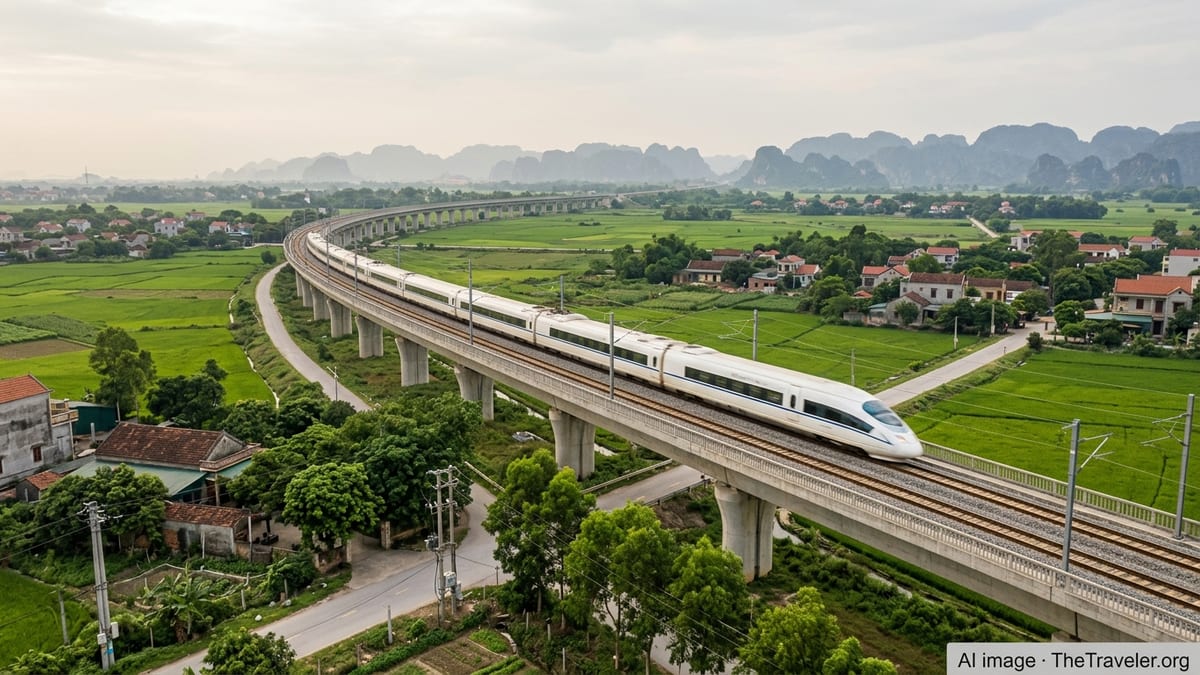
A Flagship Northern Corridor for High-Speed Rail
Publicly available planning documents and recent domestic coverage indicate that the proposed Hanoi–Quang Ninh high-speed railway has now been written into Vietnam’s long-term national railway network vision to 2050. The line is designed primarily for passenger traffic and is set to connect the capital with Quang Ninh Province, home to the UNESCO-listed Ha Long Bay and emerging beach and casino hubs along the Bai Chay and Van Don coasts.
Reports describe a roughly 120-kilometer corridor beginning near Hanoi’s National Exhibition and Convention Center and running east through key industrial and logistics zones before terminating in the Ha Long urban area. The project is being advanced by VinSpeed High-Speed Rail Investment and Development Joint Stock Company, a unit associated with major private conglomerate Vingroup, under a public–private partnership framework.
Current plans envisage construction starting around the end of the decade, in parallel with sections of the larger North–South high-speed railway. While timelines and final technical standards remain subject to government approvals and financing, the Hanoi–Quang Ninh corridor is increasingly framed as one of the country’s first operational high-speed passenger routes.
The line is expected to be electrified and built to speeds broadly aligned with the North–South high-speed network, allowing future through-services and integrated ticketing. That interoperability is seen as central to positioning northern Vietnam as a multi-stop rail tourism region anchored by Hanoi, Ha Long Bay and other coastal destinations.
Cutting Travel Time to Quang Ninh by Over 80 Percent
The prospect attracting the most attention among travelers and tour operators is the dramatic reduction in journey times. Today, travelers typically move between Hanoi and Ha Long by highway, a distance of roughly 150 kilometers that can take 2.5 to 3.5 hours depending on traffic, weather and departure point within the capital.
Based on the indicative design speeds and stop patterns being discussed in technical notes, a non-stop or limited-stop high-speed service could cover the core Hanoi–Quang Ninh section in around 30 to 40 minutes. Even allowing for station access and dwell times, the total city-to-city journey could fall to under one hour. That implies a reduction in headline travel time of more than 80 percent compared with current road-based itineraries.
For tourists, that shift would make same-day excursions from Hanoi to Ha Long Bay considerably more feasible and predictable, even during peak holiday periods when highways are congested. Travel agencies could schedule tightly timed cruise departures and returns around rail arrivals, reducing the buffer time now built into itineraries to account for traffic delays.
For Quang Ninh, the ability to present itself as less than an hour from the capital by train could reposition the province as both a short-break and commuter-accessible destination. Industry observers note that this level of connectivity has historically been a turning point for coastal regions in countries that have deployed high-speed rail at scale.
Tourism Hubs Poised for a High-Speed Boom
Quang Ninh’s tourism strategy has for several years focused on moving beyond its traditional role as a gateway to Ha Long Bay cruises. New integrated resorts, entertainment complexes and conference venues have appeared along the coastline, while Van Don International Airport opened to support both tourism and investment flows.
The planned high-speed rail connection is expected to amplify those efforts by delivering a steady flow of visitors from Hanoi and, eventually, from along the North–South high-speed rail spine. Travel industry analysis suggests that easier weekend access could boost domestic tourism from the capital’s growing middle class, while international visitors landing in Hanoi would be able to reach Ha Long and return in a fraction of the time currently required by road.
Travel companies are already mapping out potential high-speed rail–linked products, such as two-night itineraries that combine Hanoi’s Old Quarter, a Ha Long Bay overnight cruise and time at coastal resorts near Bai Chay or Tuan Chau. Conference and incentive travel planners are also watching closely, as faster ground transport can make large-scale events in Quang Ninh more viable for companies headquartered in Hanoi and neighboring provinces.
Local stakeholders expect knock-on benefits for lesser-known attractions in the province, including spiritual tourism sites, island beaches and border economic zones. With new stations likely to be located near existing urban centers and transport interchanges, the project could help distribute tourist spending more widely beyond the core Ha Long cruise market.
Linking to Vietnam’s North–South High-Speed Vision
The Hanoi–Quang Ninh line is being developed in tandem with Vietnam’s planned 1,500-plus kilometer North–South high-speed railway, which is slated to connect Hanoi with Ho Chi Minh City and key provincial capitals along the way. Government strategies describe the northern coastal corridor, including Quang Ninh, as a priority region for integrating with this backbone.
Once the North–South line enters service, passengers arriving in Hanoi from central and southern provinces could transfer directly to high-speed services bound for Ha Long Bay and the northeastern border areas. That connectivity would, for the first time, make it possible to traverse much of Vietnam’s length and then continue directly to one of its most visited coastal attractions without relying on domestic flights or long-distance buses.
Infrastructure analysts note that the Hanoi–Quang Ninh project is also part of a broader effort to connect Vietnam’s rail network with neighboring China through border gateways in the northeast. Although the Hanoi–Quang Ninh line is conceived as a domestic passenger route, improved links to Ha Long and Mong Cai would indirectly support cross-border tourism flows and cruise development in the wider Gulf of Tonkin area.
For travelers, the integration of the northern spur with the national network could eventually translate into seamless ticketing, coordinated timetables and standardized service quality across long-distance and regional high-speed routes. That model has proved particularly attractive to international visitors in countries such as Japan and Spain, where high-speed rail functions as a backbone for multi-city travel.
Opportunities and Questions for Sustainable Growth
While the tourism potential of the Hanoi–Quang Ninh high-speed rail corridor is widely recognized, questions remain around financing, environmental safeguards and integration with local transport at each end of the line. The project’s large upfront cost, use of advanced technology and need for long-term ridership growth mean that it will likely depend on a careful mix of public investment and private capital.
Urban planners and environmental specialists are watching how station locations, depot facilities and feeder roads are configured along the route. There is growing emphasis on ensuring that high-speed rail construction protects sensitive coastal and karst landscapes while still allowing for new tourism and real estate projects around future stations.
Within Quang Ninh, authorities have previously highlighted the importance of managing visitor numbers to Ha Long Bay itself, where boat traffic and waste management are persistent challenges. The arrival of a high-speed rail link is expected to intensify debates about carrying capacity and the need to diversify tourism products inland and along less fragile stretches of the coastline.
For now, the Hanoi–Quang Ninh high-speed rail project stands as one of the clearest signals of how Vietnam intends to pair next-generation transport infrastructure with its tourism growth ambitions. If current plans hold, the journey from the capital to Quang Ninh within an hour could soon become a defining experience for both domestic travelers and international visitors exploring the country’s rapidly changing north.