

More news on this day
Viking has taken delivery of the Viking Eldir, a new 190-guest river vessel that will sail key European waterways, strengthening the company’s position in the river cruise market and adding fresh capacity to meet surging demand for slow, scenic travel across the continent.
Get the latest news straight to your inbox!
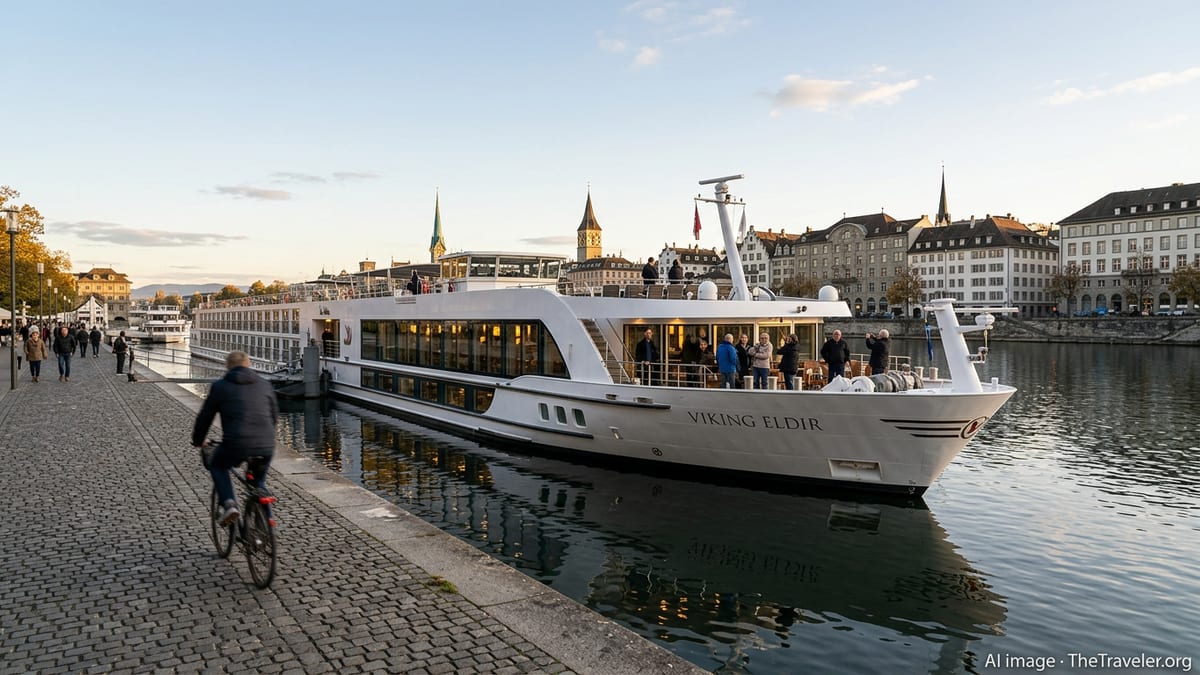
New Longship Delivered in Germany
Viking confirmed this week that it has taken delivery of the Viking Eldir, built at Meyer’s Neptun Werft shipyard in Rostock-Warnemünde in northern Germany. The latest addition to the company’s river fleet follows Viking’s familiar longship blueprint, with a focus on Scandinavian-inspired interiors, efficient hull design and optimized use of space to keep guest capacity relatively low while maximizing river views.
The Eldir accommodates around 190 guests, aligning with Viking’s standard European river configuration and reinforcing the brand’s emphasis on small-ship experiences. The vessel’s compact size allows it to transit historic locks and under low bridges along Europe’s rivers, while still offering a full suite of amenities, including a restaurant, lounge, sun deck and a variety of stateroom categories with floor-to-ceiling windows and French balconies.
The handover ceremony in Rostock-Warnemünde underscores the close relationship between Viking and Meyer’s Neptun Werft, which has been responsible for constructing a substantial share of the company’s modern river fleet. The yard’s dedicated production lines for river ships allow Viking to bring new capacity online quickly as demand for European itineraries continues to climb.
Viking Eldir will undergo final preparations and crew training before welcoming its first guests later this year, entering service at a time when the company is steadily expanding both its river and ocean offerings across Europe.
Expanded Scenic Routes on Europe’s Iconic Rivers
With Viking Eldir, Viking is expected to bolster deployment on several of Europe’s most popular waterways, including the Rhine, Main and Danube, which link cultural capitals such as Amsterdam, Cologne, Vienna and Budapest. These rivers remain the backbone of the continent’s river cruise market, and the addition of new capacity allows Viking to increase frequency on core itineraries while introducing more varied seasonal departures.
Industry orderbook data and Viking’s earlier announcements about up to ten new longships entering service by 2026 suggest that Eldir will be part of a broader wave of vessels allocated to classic routes spanning central Europe. That network connects medieval old towns, vineyard-lined valleys and UNESCO-listed river landscapes, appealing strongly to North American travelers seeking immersive but comfortable cultural journeys.
The new ship is also expected to support shoulder-season and themed sailings, including Christmas market cruises and voyages timed around major cultural festivals. Extra capacity gives Viking more flexibility to tailor departures to niche interests, from classical music and art history to regional food and wine, which has become a growing differentiator as river lines compete for repeat guests.
While specific itineraries for Viking Eldir have yet to be emphasized in public schedules, the ship’s technical profile and capacity point toward deployment on high-demand segments where Viking has already reported near sell-out bookings several years in advance.
Boost for European Tourism Recovery
The arrival of Viking Eldir comes at an opportune moment for Europe’s tourism industry, which has been steadily rebuilding since travel restrictions eased and long-haul air capacity returned. River cruising, in particular, has benefited from renewed interest in slower, more sustainable forms of travel that favor depth over distance and focus on secondary destinations beyond Europe’s largest cities.
Economic data from across the river corridors shows that river ships play an outsized role in sustaining local economies, especially in smaller ports where passengers frequently book guided tours, dine in local restaurants and purchase regional products. Each new vessel represents a steady flow of visitors over an extended season, creating more predictable income for guides, coach operators, artisans and hospitality businesses.
Viking’s own filings indicate that river capacity is rising by close to double digits in the mid-2020s, with incremental gains planned through at least 2026. The delivery of ships such as Viking Eldir helps anchor that growth, particularly in established markets like Germany, Austria, Hungary and the Netherlands, where river tourism is tightly interwoven with national and regional development strategies.
Local tourism boards along the Rhine and Danube have highlighted the role of river cruise guests in extending the tourism season beyond the peak summer months. Additional berths on new ships allow operators to maintain robust schedules into spring and late autumn, smoothing out seasonal peaks and reducing pressure on infrastructure during the busiest weeks of the year.
Viking’s Long-Term Fleet Expansion Strategy
Viking Eldir is part of an ambitious fleet renewal and expansion program that extends across the company’s river, ocean and expedition divisions. The group has orders and options with major European yards stretching into the next decade, including additional river vessels for European waterways, new ocean ships and future expedition units designed for polar and remote regions.
Recent disclosures show Viking increasing its overall operating capacity year-on-year, with river ships accounting for a sizable share of that growth. The model that began on Europe’s rivers, with a focus on destination-centric itineraries and consistent onboard product, has been deliberately exported to the ocean and expedition sectors, where Viking now fields a rapidly growing fleet of mid-sized ships.
On the river side, the strategy hinges on maintaining a modern, homogeneous fleet of longships that can be deployed flexibly across multiple rivers and regions. Ships like Viking Eldir share common technical and design features with their sisters, simplifying crew training, maintenance and logistics. This approach also gives guests a familiar onboard experience regardless of which European river they choose to explore.
Shipyards and maritime suppliers across Germany and other river-building hubs have benefited from this long-term order pipeline. For yards such as Meyer’s Neptun Werft, repeat contracts with Viking create stable workloads and support specialized jobs in steelwork, outfitting and marine engineering tied specifically to river cruise construction.
Rising Demand for River Cruising Among North American Travelers
The deployment of Viking Eldir is also a response to robust demand from North American markets, where river cruising has transitioned from a niche product to a mainstream option for culturally inclined travelers. Viking has reported sold-out or near sold-out seasons on many of its European itineraries, prompting it to open bookings years in advance and to accelerate ship construction timelines.
Travel advisors in the United States and Canada note that river cruising resonates with travelers who want a more relaxed rhythm than large-ship ocean cruising, but still value the convenience of unpack-once itineraries. The relatively small size of river ships, combined with inclusive excursions and centrally located docks, has made them especially attractive to older travelers and multigenerational groups seeking accessible ways to experience Europe’s historic centers.
Viking’s strong brand recognition in North America has helped channel much of this demand toward its longship fleet. The introduction of additional capacity through ships like Viking Eldir allows the company to protect its market share while experimenting with new itineraries and departure patterns, including longer combinations of back-to-back voyages that traverse multiple rivers.
As bookings for future seasons continue to trend upward, Viking Eldir’s arrival signals that Europe’s river cruise sector is entering a new phase of maturity. With more ships, more itineraries and a growing pool of repeat guests, river cruising is poised to remain a cornerstone of the continent’s tourism offering in the years ahead.