

More news on this day
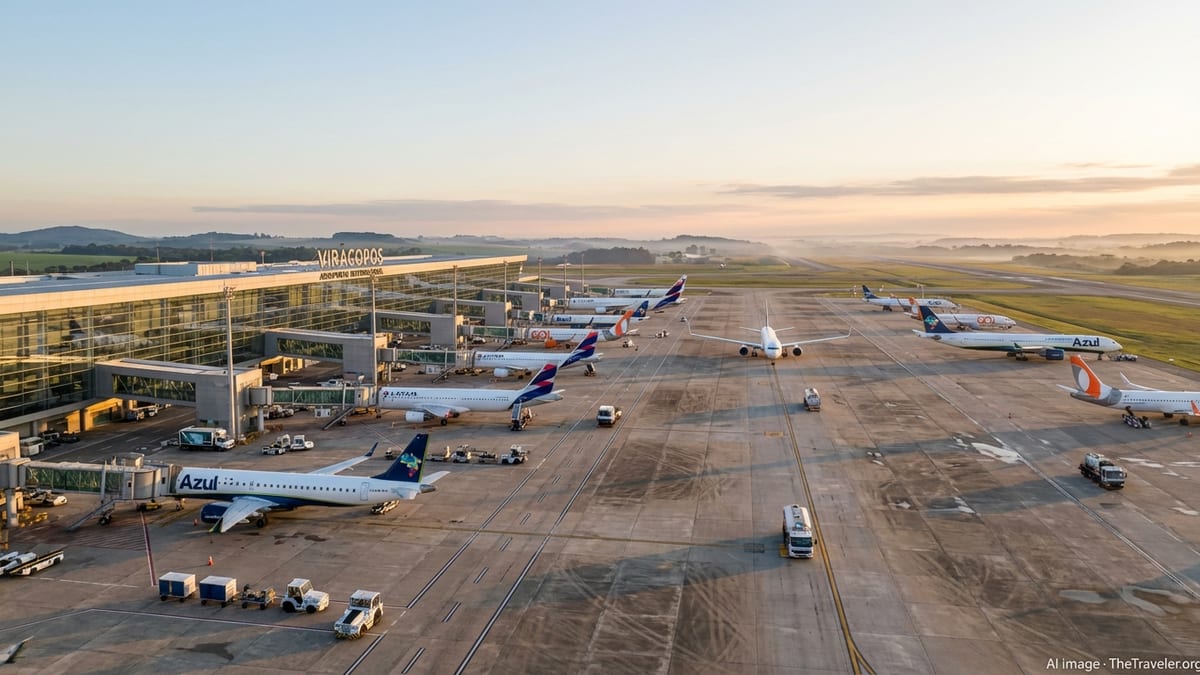
Viracopos International Airport has started 2025 with a powerful signal of Brazil’s aviation resurgence, posting a sharp rise in international passenger traffic in January and cementing its status as a fast-growing global gateway for the São Paulo region.
January Surge Confirms Viracopos’ Upward Trajectory
Fresh traffic data from Viracopos International Airport in Campinas show that the terminal entered 2025 with strong momentum, building on two years of sustained recovery and expansion. The airport handled 1.11 million passengers in January, a jump of 16.3 percent compared with the same month in 2024, securing the second-best January in its history and underscoring its growing importance to Brazil’s aviation map.
Within this broader surge, international travel stood out as the star performer. Viracopos processed 96,700 international passengers in January, up from around 71,000 a year earlier, reflecting a dramatic year-on-year expansion in cross-border demand. Airport operator Aeroportos Brasil Viracopos highlighted that the strong start to 2025 comes on the heels of a record-breaking December, when the terminal closed 2024 with its highest ever passenger tally for that month.
The January results confirm a growth trend that had already pushed Viracopos to 12.4 million passengers in 2024, the second-best annual performance in its history and just behind the 12.5 million recorded in 2023. With 2025 now under way and growth accelerating, Campinas is positioning itself as one of the most dynamic aviation hubs in Latin America.
International Traffic Jumps Sharply Amid Record-Breaking Years
The most eye-catching element of Viracopos’ recent performance has been the sharp increase in international traffic. The 96,700 international passengers recorded in January represent an increase of roughly one third compared with the same month a year earlier, a leap that far outpaces overall passenger growth in Brazil and highlights the airport’s shift from domestic connector to global player.
This latest spike builds on a longer arc of expansion in overseas travel. In 2024, Viracopos handled 858,700 international passengers, while 2025 saw the airport surpass the symbolic barrier of 1 million international travelers in a year, reaching around 1.1 million and setting a new record. That performance reflects growth of close to 30 percent in international movements in 2025 compared with 2024, a rate that outperforms even Brazil’s broader double-digit recovery in cross-border air travel.
As a result, international flows are becoming an increasingly important share of Viracopos’ total traffic mix. What was once chiefly a domestic hub feeding routes across Brazil has evolved into a dual-role airport, combining high-frequency domestic services with a growing portfolio of long-haul and regional international flights, particularly to Europe, North America and neighboring Latin American markets.
Strategic Hub for Azul and a Rebalanced São Paulo Air Network
Viracopos’ emergence as a global gateway is closely tied to the strategy of Azul Linhas Aéreas, which has transformed the Campinas facility into its main hub. The airline has invested heavily in connecting secondary and mid-sized Brazilian cities through Viracopos, giving the airport one of the country’s most extensive domestic networks and turning it into a preferred transfer point for travelers who want to avoid the congestion of São Paulo’s more traditional gateways.
This role has become increasingly visible in traffic data. Azul’s overall passenger numbers hit new records in 2025, with growth led by operations at Viracopos. The airline’s dense domestic schedule from the airport allows it to funnel travelers from across Brazil onto its international services, especially to the United States and Europe. That model has boosted connectivity not only for the Campinas region but for interior cities that previously had limited access to long-haul routes.
The shift is also subtly rebalancing the air network of greater São Paulo. While Guarulhos and Congonhas remain the state’s dominant airports in absolute numbers, Viracopos offers modern infrastructure, room to expand and fewer bottlenecks. Airlines and passengers alike are increasingly drawn to its combination of operational efficiency and growing route map, which together provide an attractive alternative to the more saturated metropolitan airports.
New Routes to Europe and the U.S. Power Growth
The surge in international traffic is directly linked to an expanded menu of routes at Viracopos. In mid-2025, new nonstop services from Azul connected Campinas with Madrid in Spain and Porto in Portugal, strengthening the airport’s role as a bridge between Brazil and key European gateways. These links join established flights to Lisbon, creating a trio of Iberian destinations that cater to both leisure and business travelers.
Viracopos has also deepened its connectivity with the United States, offering regular flights to Fort Lauderdale and Orlando, two major entry points for Brazilian tourists and a growing number of corporate travelers. Seasonal services to Argentine destinations such as Mendoza and Bariloche add a strong leisure component, especially in peak travel periods, and underline the airport’s expanding reach across South America.
The operator is actively negotiating additional international routes for both passengers and cargo, targeting North and Central America, Europe, Asia and Africa, as well as the resumption of connections with other South American countries. Industry events such as the World Routes forum have become key arenas where Viracopos presents its case to airlines, leveraging performance figures that demonstrate sustained demand and room for further growth.
National Context: Brazil’s International Travel Boom
Viracopos’ performance comes against the backdrop of a broader boom in Brazilian air travel. Official figures show that Brazil moved more than 117 million passengers between January and November 2025, an increase of 9.3 percent over the same period a year earlier. International traffic grew even faster, rising by more than 13 percent as airlines restored long-haul capacity and tourists returned in greater numbers.
The federal government expects total passenger numbers to reach around 130 million in 2025, a historic peak for the country’s aviation sector. Officials have linked the jump in international traffic to renewed diplomatic and trade engagement, as Brazil seeks to position itself more prominently in global economic and tourism flows. That strategy includes promoting new air links, easing travel barriers and investing in airport infrastructure.
Within Latin America, the momentum is evident. Regional data indicate that January 2025 set a record for aviation across Latin America and the Caribbean, with more than 42 million passengers carried, a modest but notable increase on the previous year. Brazil, which leads the region in domestic volumes, has been a key driver of that uptick, with airports such as Viracopos helping to distribute demand away from traditional hubs and into emerging secondary gateways.
Capacity, Punctuality and the Passenger Experience
Beyond raw passenger numbers, Viracopos has also distinguished itself through operational performance. In 2025, the airport ranked among the most punctual medium-sized airports in the world, based on a global evaluation of on-time departures. With more than four out of five flights leaving within 15 minutes of their scheduled time, Viracopos has carved out a reputation for reliability that airlines can market and passengers quickly notice.
The airport handled approximately 124,600 flights in 2025, up from about 121,900 movements the year before, as airlines increased frequencies and added new services. Despite the busier schedule, the terminal has maintained strong on-time performance metrics, supported by relatively uncongested airspace around Campinas and investments in ground operations, air traffic management and terminal logistics.
For travelers, these improvements translate into smoother connections, reduced delays and a more predictable journey, particularly for those using Viracopos as a transfer hub between domestic and international flights. Modern terminal facilities, an improving range of retail and food options, and ongoing adjustments to passenger flows all contribute to an experience that aims to match the expectations of increasingly discerning global travelers.
Economic Impact on Campinas and the Wider São Paulo Region
The continued rise in international traffic is having a tangible impact on the Campinas metropolitan area and the broader state economy. As more overseas passengers pass through Viracopos, demand grows for local hotels, transport services, restaurants and tourism operators, supporting jobs and encouraging new investment. Business travelers, in particular, benefit from faster access to the region’s technology parks, universities and industrial clusters.
Viracopos sits at the crossroads of major highways and logistics corridors, making it an attractive hub not only for passenger travel but also for air cargo. The combination of growing passenger services and strong freight operations reinforces the airport’s role as a strategic asset for São Paulo’s interior, helping companies integrate their supply chains with global markets and strengthening the region’s appeal to international investors.
Local authorities and business leaders have increasingly framed the airport as a competitive differentiator for Campinas, arguing that its connectivity can draw events, conferences and corporate operations that might otherwise gravitate toward central São Paulo. As long-haul routes multiply, the argument gains force: executives and tourists can now reach the interior of São Paulo state with fewer connections and potentially shorter total journey times.
Ambitious Targets and the Road Ahead
Looking ahead, Viracopos’ operator has set ambitious goals for the next phase of expansion. Building on the 12.4 million passengers of 2024 and the record 12.8 million reached in 2025, the airport is targeting the historic threshold of 13 million passengers and beyond, driven in large part by continued international growth. That trajectory would have been hard to imagine little more than a decade ago, when the airport handled about 7.6 million passengers in 2011, before the current concession began.
The path to sustained growth will depend on several factors, including the pace of Brazil’s economic expansion, currency trends that shape outbound travel demand, and the capacity of airlines to acquire and deploy new aircraft efficiently. Infrastructure investment will also be critical, as the airport seeks to ensure that runways, taxiways, terminal spaces and ground access can support higher volumes without sacrificing punctuality and passenger comfort.
For now, however, the numbers point clearly upward. With international traffic surging at the start of 2025 and new routes under negotiation to connect Campinas with additional cities across Europe, North America, Latin America, Asia and Africa, Viracopos is steadily evolving from a regional alternative into a primary gateway for Brazil’s most populous state. Its rapid ascent is reshaping travel patterns in and out of São Paulo and reinforcing the country’s broader push to reclaim a larger share of global aviation.