

More news on this day
Limited commercial air links between the United Arab Emirates and the United Kingdom are beginning to return, as Virgin Atlantic and British Airways cautiously restore select services following days of sweeping Middle East airspace closures triggered by the latest regional conflict.
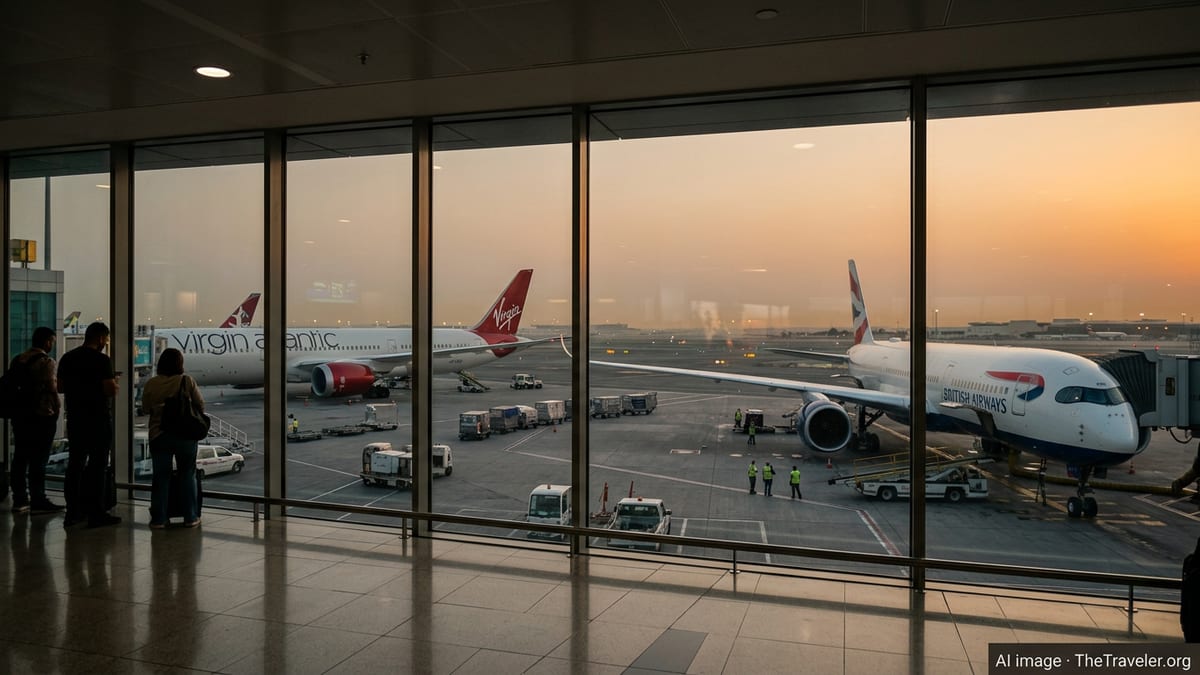
UK–UAE Links Restart After Near Total Shutdown
After almost three days of near total shutdown across key Gulf air corridors, a small but symbolically important number of flights is once again operating between the UAE and the UK. The reopening follows coordinated decisions by regional aviation authorities to partially lift emergency airspace closures imposed after United States and Israeli strikes on Iran on 28 February, and subsequent retaliatory attacks that rippled across the Middle East.
Dubai and Abu Dhabi, normally among the world’s busiest long haul hubs, saw regular passenger traffic collapse as the UAE temporarily restricted its airspace and carriers halted operations. Industry data shows thousands of flights across the wider region were cancelled or diverted, stranding tourists, business travellers and migrant workers throughout the Gulf and beyond.
By 3 and 4 March, regulators began permitting limited commercial traffic on carefully controlled routings. That shift created an opening for a small group of airlines, including Virgin Atlantic and later British Airways, to begin rebuilding the vital UK–UAE corridor, albeit at a fraction of normal capacity and with extensive safety caveats.
Officials and airline executives stress that the current restart phase is designed primarily to move stranded passengers and essential travellers. Schedules remain fluid, they say, and could be scaled back again at short notice if the security outlook deteriorates or additional airspace closures are ordered.
Virgin Atlantic Leads Return to Dubai and Riyadh
Virgin Atlantic has been among the first UK long haul carriers to restore scheduled operations into Gulf airspace. The airline confirmed it resumed flights between London Heathrow and Dubai and Riyadh after parts of regional airspace reopened to limited commercial movements at the start of the week.
Its first post closure departure from Dubai International Airport took place on 4 March, operating close to its planned lunchtime schedule after being grounded during the height of the crisis. Services from Riyadh’s King Khalid International Airport have also restarted, reinforcing Virgin Atlantic’s relatively recent expansion into Saudi Arabia.
The carrier is routing aircraft on revised flight paths that avoid sensitive areas and factor in updated risk assessments. These detours are lengthening some sector times, with Virgin Atlantic advising customers to expect extended journeys and potential last minute changes as the situation evolves.
For travellers, the airline’s return offers an important additional option beyond Emirati and regional carriers, many of which remain largely focused on repatriation and government coordinated evacuation flights. However, capacity remains tight and fare volatility is likely as demand outstrips the limited number of available seats in the short term.
British Airways Edges Back With Limited UAE Connectivity
British Airways has taken a more gradual approach to reinstating its Middle East network, having initially halted flights to key destinations including Dubai, Abu Dhabi and Doha when airspace closures were first announced. The flag carrier has been operating ad hoc rescue and repositioning services while conducting its own security analysis.
An updated operational notice this week outlined plans to reintroduce selected services as conditions permit, with UAE routes among the priorities. While regular London–Dubai and London–Abu Dhabi rotations have not yet returned to pre crisis frequency, British Airways has begun mounting limited flights to reconnect the UK with Gulf hubs and to support government efforts to bring nationals home.
Industry sources say the airline is working closely with UK and regional authorities on flight planning, including altitude restrictions, alternative routings and flexible diversion options. Much of this work is happening behind the scenes and specific tactical details are not being disclosed for security reasons.
In the meantime, affected passengers are being offered rebooking on the handful of operating services, alternative routings via still open hubs, or refunds. Travel agents report that British Airways inventory to and from the Gulf is updating on a rolling basis, with customers advised to monitor their bookings closely in the days ahead.
Ongoing Safety Concerns Shape Flight Paths and Schedules
The gradual restoration of flights is taking place against a backdrop of ongoing military activity and heightened geopolitical tension, particularly around the Strait of Hormuz and airspace across Iran, Iraq and the Levant. Carriers are relying on a combination of government intelligence, real time risk mapping and industry coordination to determine which corridors are considered sufficiently safe for civilian operations.
For UK–UAE routes, this often means flying longer, more northerly or southerly tracks to avoid closed or restricted airspace. The adjusted paths can add up to an hour or more to typical flight times, increasing fuel burn and pushing some aircraft and crews close to duty time limits. Airlines are adjusting rosters, adding contingency fuel and in some cases scheduling technical stops to maintain regulatory compliance.
Airports in Dubai and Abu Dhabi are operating with reduced runway and terminal capacity and prioritising flights linked to evacuations or essential travel. Airport authorities have urged passengers not to travel to terminals unless they have confirmed bookings and have checked in online, warning that walk up ticketing is highly unlikely to be available during the current disruption.
Insurance and corporate travel policies are also influencing who can fly. Some multinational employers have temporarily restricted staff travel to parts of the Middle East, while several insurers are reviewing coverage terms for trips that transit or terminate in the region. That is adding another layer of complexity for travellers attempting to piece together viable itineraries.
What Travellers Between the UK and UAE Should Expect Now
For passengers planning or rebooking trips between the UK and the UAE, the most immediate change is the shift from stable long term schedules to a far more dynamic, short notice operating environment. Timetables from Virgin Atlantic, British Airways and Gulf carriers are being updated daily, and some flights that appear in booking systems may still be subject to late alteration.
Travel advisers recommend building longer connection windows, especially for journeys that rely on onward links to Asia or Africa, and avoiding same day critical commitments on arrival. Where possible, keeping itineraries on a single ticket and with a single airline group can make it easier to access rebooking support if further disruption occurs.
At airports, travellers should allow extra time for enhanced security checks and be prepared for crowded departure halls as airlines attempt to clear backlogs of stranded passengers. Priority is often being given to those whose trips were cancelled earlier in the week, as well as to families, older travellers and those with urgent reasons to travel.
Despite the uncertainty, aviation analysts note that the cautious resumption of UK–UAE flights is a significant milestone in the broader regional recovery. If the security situation stabilises and no further large scale airspace closures are ordered, schedules could gradually rebuild over the coming weeks. For now, though, the message from airlines is clear: limited services are back, but flexibility and patience remain essential for anyone flying between Britain and the Gulf.