

More news on this day
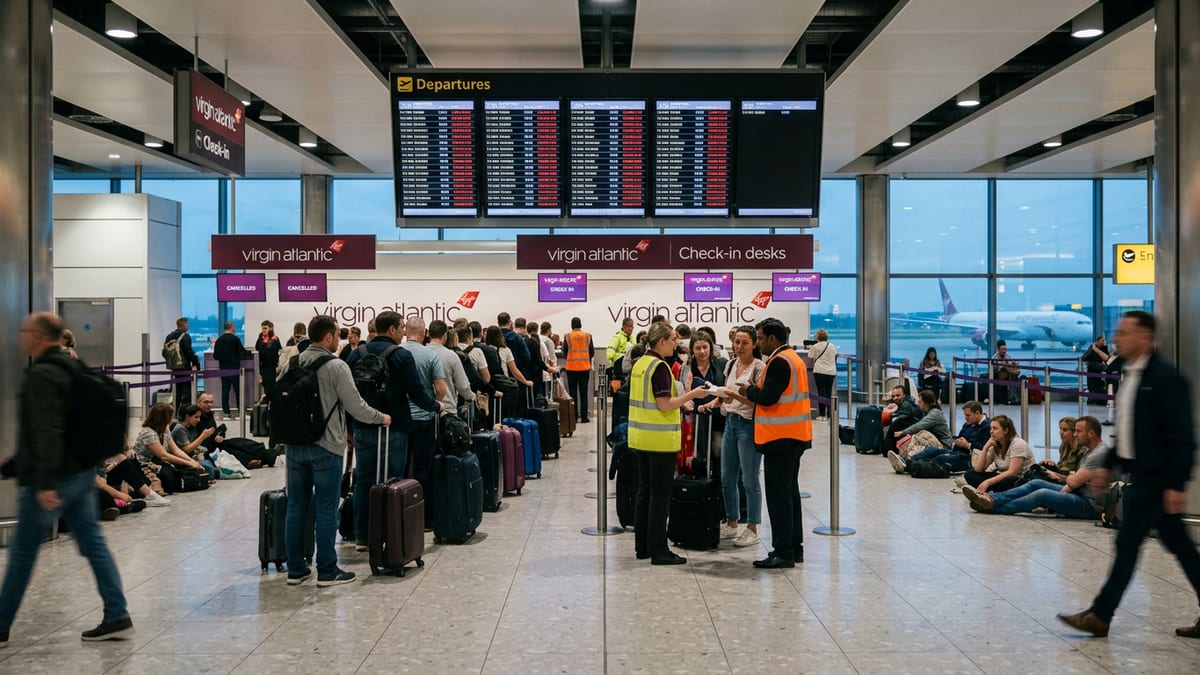
Virgin Atlantic has cancelled its Dubai operations amid rapidly escalating conflict and rolling airspace closures across the Middle East, stranding passengers and forcing last-minute changes to one of the busiest corridors between Europe and the Gulf.
What Virgin Atlantic Has Announced So Far
Virgin Atlantic confirmed over the weekend that it has halted its London Heathrow to Dubai service after a series of abrupt airport and airspace closures in the United Arab Emirates. The move comes only days after the airline had cautiously resumed limited flights through the region, following an initial shutdown prompted by the widening war involving the United States, Israel and Iran.
The latest disruption was triggered by a chaotic sequence that included a Virgin Atlantic flight from London to Dubai that spent hours in the air before being forced to return to Heathrow, described by passengers as a “flight to nowhere.” The airline subsequently cancelled multiple rotations on the route over several days, before moving to suspend the Dubai operation entirely until security conditions and airspace stability improve.
In public statements, Virgin Atlantic has framed the decision as a direct response to evolving security assessments and the patchwork of airspace restrictions imposed across the Gulf. Executives have stressed that safety of customers and crew remains the overriding priority, and that the carrier will only reinstate Dubai service once it is satisfied that routings and airport operations are stable and adequately protected.
While some Middle Eastern hubs have begun handling a reduced number of flights, the overall picture remains volatile. Airlines are balancing pressure to restore vital links for business and leisure travel with mounting concerns over missile and drone activity, shifting military operations and the risk of further sudden closures.
How the Middle East Crisis Is Disrupting Air Travel
The suspension of Virgin Atlantic’s Dubai flights is part of a far broader upheaval in regional and global aviation. Since late February, coordinated strikes and retaliatory attacks have led to sweeping airspace closures spanning Iran, Israel, Iraq and several Gulf states, at times including the United Arab Emirates itself. At various points, authorities have effectively severed one of the world’s key crossroads for east–west travel.
Dubai International Airport, normally one of the busiest hubs on the planet, has seen waves of cancellations and a sharp reduction in movements. Neighboring Abu Dhabi and Doha have faced similar constraints as airlines review routings, add significant diversions to avoid active conflict zones and, in many cases, simply ground flights rather than accept elevated risk.
International carriers from Europe and Asia have either suspended routes into the region outright or drastically thinned schedules. Some long haul services that normally traverse Middle Eastern skies have been re-routed via longer, more southerly or northerly paths, adding hours of flying time and considerable cost. Others, like Virgin Atlantic’s London–Dubai operation, have been paused where safe, commercially viable alternatives are hard to sustain.
Travel data firms and industry observers estimate that thousands of flights have been cancelled since the latest round of hostilities began, affecting hundreds of thousands of passengers. For many, the disruption has meant unplanned nights in airport hotels, long queues at ticket counters and protracted efforts to reach airline call centers already overwhelmed by demand.
What This Means for Virgin Atlantic Passengers
For travelers booked on Virgin Atlantic services to or from Dubai, the immediate impact is clear: there will be no direct flights on the route for the time being. Customers whose flights have been cancelled are being offered a choice of rebooking on alternative dates or seeking refunds, subject to the airline’s standard disrupted-travel policies and any temporary waivers introduced for the crisis period.
Passengers already in the region or those who were due to connect via Dubai to onward long haul routes face more complex decisions. Virgin Atlantic has indicated that it is working with partner airlines and ground agents to support rerouting where possible, but options are constrained by the wider shutdown affecting many Gulf and Levant destinations. In some cases, customers may be advised to reposition overland to other airports that still have limited international links.
Travelers who find themselves stranded outside their home country for longer than planned are being told that reasonable accommodation, meals and essential local transport costs may be reimbursed where the airline is responsible for the cancellation. However, given the fast moving situation and differing local regulations, passengers are strongly encouraged to keep all receipts and to check the latest guidance provided directly in airline communications before incurring significant expenses.
Those with near term bookings who have not yet started their journeys are being urged not to travel to the airport unless their flights are explicitly shown as operating. With schedules subject to rapid change and some departures possible at short notice as airspace windows open and close, the most reliable information will come from real time status tools and direct email or text updates from carriers.
Alternatives for Reaching Dubai and the Gulf
Despite Virgin Atlantic’s suspension on the London–Dubai route, Dubai and other Gulf cities are not completely cut off from international traffic. A limited number of flights are operating in and out of the United Arab Emirates, primarily on regional carriers that have been granted specific approvals or are able to exploit narrow corridors of open airspace. Nonetheless, schedules are thin and seats are at a premium.
Some travelers are choosing to route via more distant hubs in Europe, Asia or Africa, stitching together multi leg itineraries that avoid the most heavily restricted zones. Others are traveling overland from Dubai to neighboring countries such as Oman or Saudi Arabia to access airports where outbound capacity is slightly less constrained, then continuing on long haul flights back to Europe or North America.
These workarounds often involve long drives, overnight stays and higher costs. Security conditions on regional roads can vary, and travelers are being urged by consular officials and risk advisers to check local guidance before attempting cross border trips. Travel insurance coverage may also be limited for journeys into or through areas that governments have placed under “do not travel” or similar advisories.
For many passengers, the most realistic option may be to delay non essential trips until airlines and aviation authorities signal that the regional network is stabilizing. Corporate travel departments are increasingly adopting a conservative stance, postponing business visits to the Gulf or shifting meetings to virtual formats while the conflict remains unpredictable.
Key Advice for Travelers Monitoring the Situation
With conditions in the Middle East changing day by day, and sometimes hour by hour, the most important step for any traveler is active monitoring. Those holding tickets to Dubai or other affected destinations should check their booking status frequently and sign up for airline alerts if they have not already done so. Given that flights can be retimed, rerouted or cancelled at short notice, relying solely on information from travel agents or older confirmation emails is no longer sufficient.
Travelers should also review their travel insurance policies carefully, paying close attention to exclusions related to war, terrorism and known events. Some policies may not cover cancellations or delays tied directly to armed conflict or government warnings, while others might offer limited benefits for additional accommodation or alternative routing. Contacting insurers before travel can clarify what support, if any, would be available if plans are disrupted by the crisis.
Governments including the United States and several European nations have issued strong advisories urging citizens in parts of the region to depart while commercial options still exist, and to avoid non essential travel into impacted countries. Nationals abroad are being encouraged to register with consular services, monitor official alerts and ensure they have backup plans should airports close suddenly or airspace be shut without warning.
For now, Virgin Atlantic customers eyeing trips to Dubai will have to adapt to a landscape in which their preferred nonstop link is off the table. As airlines, regulators and military planners continue a delicate balancing act between security imperatives and the need to keep people and goods moving, flexibility and patience will be crucial companions for anyone planning to travel through the Middle East in the weeks ahead.