

More news on this day
Virgin Atlantic’s move to launch nonstop flights between Seoul Incheon and London Heathrow from March 29, 2026 is poised to reshape South Korea’s outbound travel to Europe, creating a powerful new bridge from Asia to major hubs including Frankfurt, Paris, Madrid, Rome, Milan, Amsterdam, Zurich, Vienna, Prague, Budapest, and Lisbon.
Get the latest news straight to your inbox!
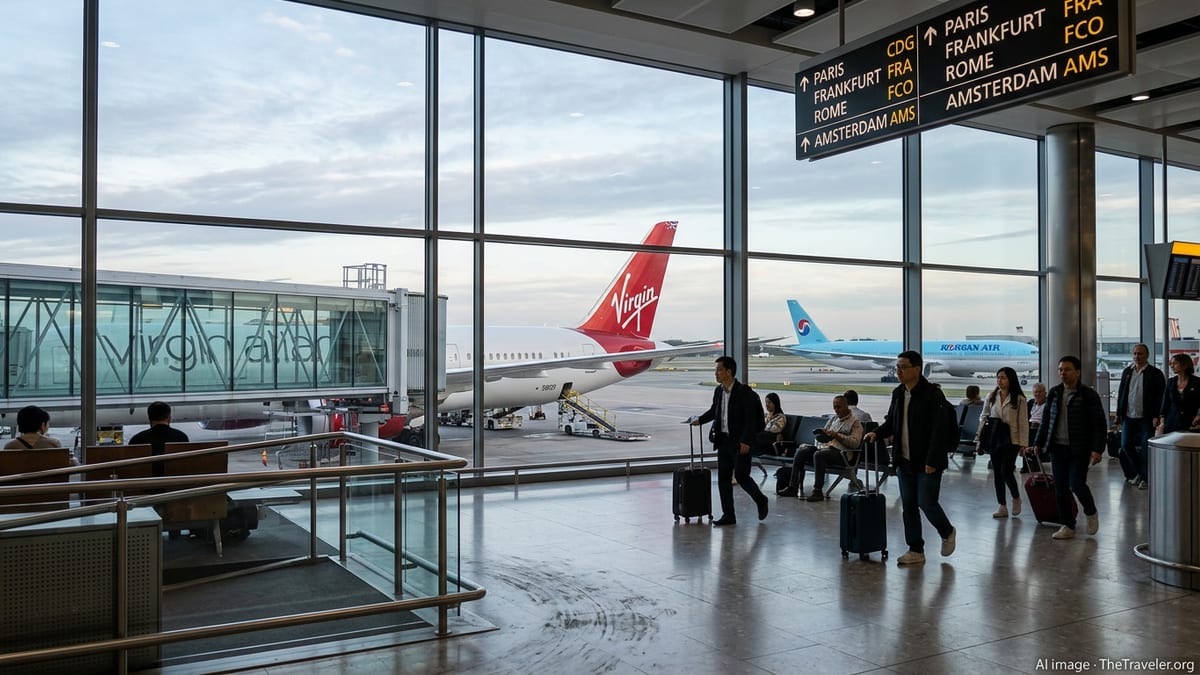
New Seoul–London Route Anchors a Wider European Network
According to Virgin Atlantic’s published route updates, the airline plans to introduce a daily London Heathrow to Seoul Incheon service at the start of the 2026 northern summer season, operated by Boeing 787-9 aircraft configured with Upper Class, Premium Economy, and Economy cabins. The schedule positions London as a central transfer point, with an afternoon departure from Heathrow and a late-morning arrival in Seoul, paired with a midday return from Incheon that reaches London in the early evening.
Information shared through Virgin Atlantic’s partner hub and destination pages highlights that the new route builds on an existing codeshare with Korean Air and on the carrier’s membership in the SkyTeam alliance. This combination gives travelers from South Korea structured one-stop access to a large European network via London, including onward services to financial centers such as Frankfurt, Paris, and Amsterdam, as well as leisure-focused cities like Madrid, Rome, Milan, Vienna, Prague, Budapest, Zurich, and Lisbon on Virgin Atlantic and its joint-venture and alliance partners.
Joint scheduling among Virgin Atlantic, Air France, KLM, and Delta on transatlantic and intra-European routes has already been used to optimize connections through London and other hubs. Industry documentation and network maps show London Heathrow acting as a key transfer node into continental Europe, where frequent flights to major cities allow short minimum connection times and daylight arrival options that are attractive for South Korean leisure and business travelers.
The Seoul–London launch also follows several years of incremental cooperation between Virgin Atlantic and Korean Air. Corporate statements have framed their earlier codeshare, which placed Virgin Atlantic flight numbers on Korean Air’s London–Seoul service, as a stepping stone toward Virgin Atlantic’s own entry into the South Korean market. The transition from codeshare-only access to a dedicated Virgin Atlantic-operated route is expected to increase schedule choice and provide more branded product continuity for passengers connecting onward to Europe.
Outbound Demand from South Korea Bounces Back Strongly
Recent tourism and travel-economy reports point to a strong rebound in South Korean outbound travel since international restrictions eased. Studies compiled by regional tourism boards and investment agencies indicate that overseas trips by South Koreans have either reached or exceeded pre-pandemic levels by 2024, with projections suggesting continued growth in 2025 and beyond as flight capacity is restored and new routes are opened.
Data summarized by travel-industry analysts show that South Koreans’ appetite for international travel is shifting from a primarily regional focus toward a more balanced mix of short-haul and long-haul journeys. While nearby destinations such as Japan, China, and Southeast Asia continue to draw high volumes, surveys cited by travel platforms note that a growing share of South Korean travelers intend to prioritize overseas trips further afield, including to Europe, as household travel confidence improves.
Economic assessments published in 2025 describe outbound tourism spending from South Korea as having recovered to around 90 percent or more of 2019 levels, underlining the strength of pent-up demand. These reports also stress that long-haul travel, including to Europe, is benefiting from a combination of rising disposable income among younger travelers, the growth of remote-friendly work patterns, and increasing interest in multi-country itineraries that combine cultural, culinary, and nature experiences.
In this context, London’s enhanced role as a transfer point between Seoul and continental Europe aligns with broader market dynamics. Strong demand from South Korean travelers seeking diverse European destinations makes consolidated one-stop access via a single hub more attractive, especially when combined with alliance benefits such as through-check of baggage, coordinated schedules, and shared loyalty programs.
London as a Strategic Gateway to Europe’s Major Cities
Virgin Atlantic’s own communications and partner documentation emphasize London Heathrow’s position as a gateway linking long-haul services with a dense web of European connections operated both by the airline and its joint-venture and alliance partners. From Heathrow, travelers arriving from Seoul can connect to frequent flights to major business and tourism centers including Frankfurt, Paris, Amsterdam, Rome, Milan, Madrid, Zurich, Vienna, Prague, Budapest, and Lisbon.
Joint venture arrangements with Air France and KLM, along with coordination with other SkyTeam members, underpin this connectivity. Publicly available summer schedule materials indicate that many of these European cities are served multiple times per day from London or via nearby hubs such as Paris Charles de Gaulle and Amsterdam Schiphol, offering Seoul-origin passengers a variety of connection times and combinations. The ability to route itineraries through London onto different European entry points allows travel planners to build flexible open-jaw or multi-city trips.
For Europe-bound South Koreans, London’s extensive onward network is particularly important for itineraries that combine major capitals with second or third stops in culturally distinctive cities. Travelers aiming to visit Paris and then continue to Lisbon, or planning a route through Vienna, Budapest, and Prague, can now consider London as a starting or mid-point rather than only as a stand-alone destination. This is reinforced by the availability of through-ticketing across SkyTeam carriers, which simplifies booking and irregular operations handling compared with piecing together separate tickets.
Industry observers also note that London’s role as a global financial and cultural center naturally attracts premium and corporate traffic from South Korea. The addition of seamless connections into continental Europe broadens the appeal of the Seoul–London route beyond point-to-point demand, potentially increasing load factors and supporting year-round viability even during shoulder seasons when leisure demand softens.
Competitive Edge Through Alliances, Codeshares, and Product
Virgin Atlantic’s integration into SkyTeam, combined with its existing codeshare with Korean Air, provides the structural framework that underpins its European connectivity from Seoul. Alliance membership enables South Korean travelers to book single-itinerary journeys that combine segments operated by Virgin Atlantic, Korean Air, and European partners, with reciprocal frequent-flyer benefits such as mileage accrual and elite recognition at key points like Seoul Incheon and London Heathrow.
Corporate information from Virgin Atlantic highlights the use of its long-haul product, particularly on the Boeing 787-9, as a differentiator on routes where travelers are sensitive to comfort on flights exceeding 10 hours. Upper Class suites, Premium Economy seating, and upgraded Economy cabins are promoted as part of a consistent travel experience that can extend across multiple legs of a Europe-bound trip when paired with partner airlines offering aligned service standards.
Codeshare and joint venture structures also play an important role in capacity management and pricing. Public filings and competition reviews linked to the consolidation of South Korea’s airline sector mention Virgin Atlantic among carriers that could receive slots and traffic rights as remedies, reflecting regulator interest in maintaining competitive options on long-haul markets. The new Seoul–London service, coupled with broad European access, can be seen within this context as reinforcing consumer choice for South Koreans traveling to Europe.
While other global carriers also connect Seoul to Europe through hubs in the Middle East or continental Europe, Virgin Atlantic’s London-centered approach offers a distinct value proposition for travelers who prefer a UK gateway or who prioritize SkyTeam benefits. This competitive environment is expected to encourage continued product and schedule enhancements across the market, further benefiting South Korean travelers.
Implications for Tourism, Trade, and Regional Connectivity
Analysts following South Korea’s tourism sector suggest that expanded air connectivity to Europe, particularly via well-positioned hubs such as London, can stimulate both leisure and business flows. Easier access to a wider range of European cities supports travel agencies and tour operators in South Korea, which can package more varied itineraries that include multiple destinations such as Paris, Milan, Vienna, and Lisbon without requiring complex ticketing.
Tourism promotion bodies in Europe are likely to view the new route and its associated network as an opportunity to target South Korean travelers more directly. With London acting as a common gateway, marketing campaigns can highlight itineraries that begin in the UK and continue into other European regions, or vice versa, using straightforward one-stop connections and coordinated schedules to reduce travel friction.
On the business side, the strengthened air link is expected to support sectors such as finance, technology, culture, and education by making it easier for South Korean companies and institutions to engage with counterparts across Europe. Faster, more reliable connections improve the viability of short-notice trips and multi-city business travel, particularly to financial centers like Frankfurt, Paris, Amsterdam, and Zurich where flight frequency and alliance coverage are strong.
Overall, publicly available data and network plans indicate that Virgin Atlantic’s Seoul–London service, paired with its extensive European connectivity, is set to play a significant role in channeling South Korea’s revitalized outbound travel demand toward the continent. As the route comes online and schedules mature, travel industry observers will be watching booking trends closely to see how South Korean travelers distribute their trips among Europe’s leading cities.