

More news on this day
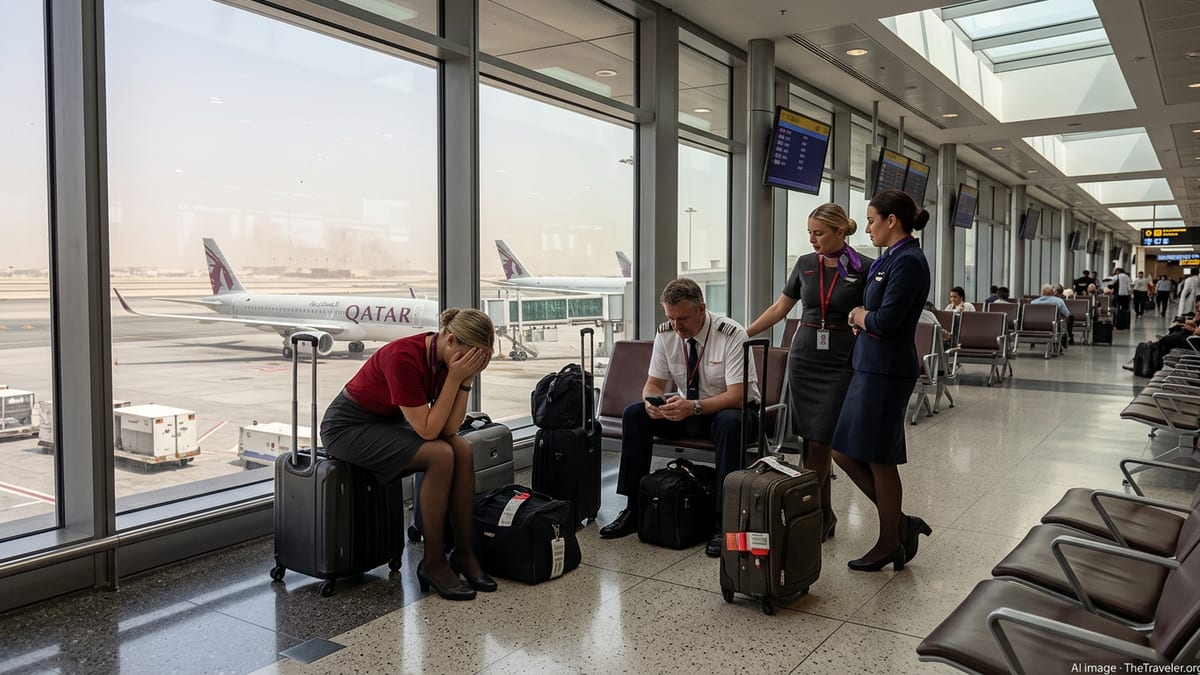
Australia’s deepening aviation ties with Qatar are under sudden strain after about 40 Virgin Australia pilots and cabin crew became stranded in Doha when a sharp escalation in Middle East conflict forced widespread airspace closures and flight diversions.
Get the latest news straight to your inbox!
Partnership Tested as Conflict Disrupts Doha Hub
The disruption comes only months after regulators approved an expanded commercial partnership between Virgin Australia and Qatar Airways, built around Doha as a key long haul hub linking Australian cities with Europe, the Middle East and Africa. Under that deal, Virgin committed to base pilots and cabin crew in Qatar’s capital to support joint operations and to gain long haul flying experience.
The group of approximately 40 Virgin Australia crew were in Doha as part of that program when regional tensions escalated, prompting temporary closures and restrictions in sections of Middle Eastern airspace. Flights transiting the region were rerouted, delayed or cancelled, leaving airline planners scrambling to reposition aircraft and crew.
Industry sources say the stranded pilots and cabin crew are currently housed in airport hotels and crew accommodation, awaiting clearance for safe departure. While no injuries have been reported, crew members face growing anxiety as they monitor developments and wait for confirmation of when they will be able to return to active duty or travel home.
The situation has quickly become a real world stress test for the new alliance between Australia’s second largest airline and the Qatari flag carrier, highlighting the operational and political risks that accompany deeper integration with a hub located in a volatile region.
Safety, Welfare and Diplomatic Channels in Focus
Virgin Australia is understood to be working closely with Qatar Airways’ operations centre, Australian consular officials and local airport authorities to ensure the safety and welfare of its staff. Standard airline protocols for crew stranded by security incidents have been activated, including secure accommodation, daily welfare checks and limitations on crew movements outside designated safe areas.
Australian officials are monitoring the situation as part of a wider assessment of risks to nationals transiting Gulf hubs during the current conflict. Consular staff in Doha are in contact with crew representatives and airline managers, while Canberra weighs the need for updated travel advisories or formal guidance for aviation personnel deployed in the region.
Airline unions representing pilots and cabin crew in Australia have also sought briefings on the evolving security picture. They are pressing for clear thresholds that would trigger the suspension of crew secondments to Doha, as well as guarantees that staff can be rotated out quickly if the conflict worsens or if commercial flights are suspended for an extended period.
For now, both governments have avoided public criticism of each other’s handling of the crisis, but the episode underscores how quickly operational cooperation can become entangled in geopolitics when conflict erupts along major international air corridors.
Knock on Effects for Passengers and Flight Schedules
The presence of dozens of Virgin Australia pilots and cabin crew in Doha as part of its cooperation with Qatar Airways was designed to increase capacity and reliability on long haul routes between Australia and Europe. Their sudden immobility, combined with broader disruptions in the region, is already feeding through to schedules.
Travellers booked on codeshare services operated by Qatar Airways on behalf of Virgin Australia are reporting longer connection times, short notice schedule changes and, in some cases, rebooking onto alternative routings through Southeast Asia and other hubs. Airlines across the region are adjusting flight paths to avoid sensitive airspace, increasing flying time and fuel burn on key routes.
Capacity constraints are emerging as carriers juggle aircraft and crews to maintain minimum frequencies while factoring in new detours and overnight delays. For Australian travellers, that may translate into fewer available seats on popular Europe bound itineraries, higher fares on remaining services and growing uncertainty about travel plans in the weeks ahead.
Travel agents are advising passengers with imminent departures via Doha to monitor airline communications closely and to consider flexible tickets that allow rerouting if the conflict spreads or if additional airspace restrictions are imposed.
Questions Over Future of the Secondment Program
The episode raises fresh questions about the long term viability of Virgin Australia’s crew secondment program in Doha. The initiative, which envisaged placing 20 pilots and 40 cabin crew in Qatar to support joint flying, was promoted as a way to deepen the partnership with Qatar Airways while creating more positions and experience opportunities back in Australia.
Now, unions and aviation analysts are likely to press Virgin’s management and regulators on whether concentrating such a significant pool of Australian crew in a single Middle Eastern hub exposes staff to unacceptable levels of geopolitical risk. They may call for stronger safeguards, such as predefined evacuation plans, additional security briefings and the option for crew to decline Doha postings during periods of heightened tension.
Virgin Australia, which has been rebuilding its international network after administration and restructuring, must balance those concerns with its strategic need for a reliable long haul partner. Qatar Airways offers extensive onward connections to Europe and beyond, and the Doha partnership is central to Virgin’s ambition to compete with rivals that rely on Gulf or Asian hubs.
How the airline responds to the current crisis, and how it supports the 40 crew now stranded in Doha, will influence staff confidence in future overseas deployments and shape the next phase of its collaboration with Qatar.
Broader Implications for Airline Risk Planning
The predicament facing Virgin Australia’s Doha based crew highlights the increasingly complex risk environment confronting global airlines. Routes that pass near or over conflict zones require constant review, while hub and crew basing decisions must factor in the possibility of sudden airspace closures, missile threats or regional instability.
Carriers and regulators have strengthened their risk assessment frameworks since earlier incidents in contested airspace, but the current flare up shows that large numbers of passengers and crew can still find themselves stranded with little warning. Ensuring robust contingency plans, from alternative routings to rapid accommodation and repatriation arrangements, is now a central part of modern airline strategy.
For Australia, whose long haul carriers are heavily dependent on foreign hubs for access to Europe and parts of Africa, the Doha incident is a reminder that aviation policy cannot be divorced from foreign and security policy. As Virgin Australia’s anchors in Qatar come under pressure, policymakers in Canberra are likely to revisit how they weigh commercial benefits against exposure to external shocks.
For the pilots and cabin crew currently stuck in Doha, the focus remains on day to day practicalities: secure lodging, reliable information and a safe route home. Their experience is a human level reflection of the broader geopolitical turbulence now rippling through the global aviation map.