

More news on this day
Virgin Voyages is moving far beyond chatbots, quietly building an army of more than 1,500 artificial intelligence agents that now underpin everything from behind-the-scenes operations to the way guests discover, book and experience its cruises.
Get the latest news straight to your inbox!
A Rapid AI Ramp-Up Behind the Scenes
In a sign of how quickly artificial intelligence is moving from experiment to everyday infrastructure in travel, Virgin Voyages has scaled its fleet of AI agents from just over 50 to more than 1,500 in under four months. The expansion follows the line’s partnership with Google Cloud, announced in October 2025, which gave the cruise brand access to Gemini Enterprise, Google’s platform for building and governing specialized AI agents.
Those agents are not confined to a lab. They are embedded throughout the company, from marketing and revenue management to crew training, commercial operations and Sailor Services. Virgin Voyages describes them as a new digital workforce that runs 24/7 alongside human teams, surfacing data, automating routine tasks and flagging decisions that need human judgment rather than replacing it outright.
Early results reported by the company include a 60 percent reduction in content production time and a doubling of promotional campaign output without added headcount. Internal metrics also show record sales and revenue growth at the start of 2026, with the time from data insight to commercial action cut by roughly three quarters, underscoring how deeply AI is now wired into day-to-day decision making.
From Viral "Jen AI" to Always-On Personalization
Virgin Voyages’ public flirtation with AI began long before this latest technical rollout. In 2024, its tongue-in-cheek “Jen AI” campaign, built around brand partner Jennifer Lopez, allowed users to generate personalized video invitations encouraging friends or partners to join a sailing. The stunt quickly went viral, driving millions of impressions and a spike in web traffic and bookings, and signaled how comfortable the brand was pairing AI with its playful tone.
What was once a campaign gimmick has now evolved into a structural shift in how the company thinks about personalization. One of the flagship internal tools in Virgin’s AI fleet, described as “Know Your Sailors,” ingests booking behavior, preferences and engagement data to help teams tailor offers, communications and onboard programming to different types of guests. That system is designed not only to refine marketing segments but also to inform which events are scheduled, which shore experiences are spotlighted and how crew are briefed before each voyage.
For travelers, much of this work will be invisible. They will encounter it in the form of more relevant pre-trip emails, better targeted offers in the Virgin Voyages app, or restaurant and entertainment suggestions that feel surprisingly aligned with their tastes. For the line, the underlying AI enables more dynamic micro-segmentation and real-time experimentation, letting teams adjust pricing levers, amenities and onboard experiences voyage by voyage.
AI in the Terminals and Onboard: Quiet Efficiency Gains
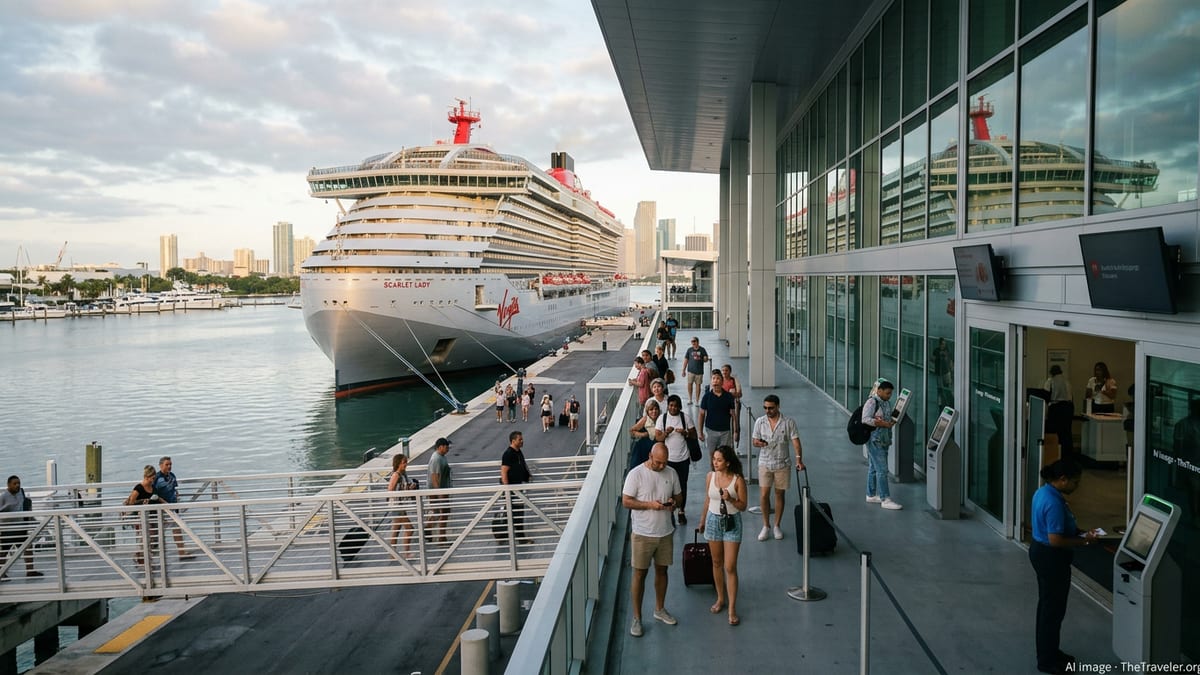
Virgin Voyages’ embrace of AI is also reshaping the physical journey, particularly at its Miami base. Port Miami’s cruise terminal infrastructure has been built out with facial recognition and other automation tools to streamline embarkation, part of a broader move across major cruise lines and ports to adopt biometric checks that verify passengers in seconds instead of minutes.
While biometric systems are often discussed primarily in terms of border control, they are increasingly intertwined with cruise operators’ own AI strategies. For Virgin Voyages, faster processing at the terminal supports its promise of a “hassle-free” start and end to each sailing, reducing queues and freeing guests to board earlier. The company emphasizes that biometric and AI-enabled processes are deployed within existing regulatory frameworks and paired with clear communication about privacy and consent.
Onboard, AI quietly shapes the experience through operational tuning rather than flashy gadgets. Behind the scenes, agents help optimize staffing patterns, predict demand at restaurants and bars, and anticipate peak times at venues like the gym or spa. Those forecasts can guide crew schedules, replenish inventory more accurately and reduce waste in food and beverage operations, all while smoothing the flow of people around the ship.
Smarter Payments, Service and Retail at Sea
The AI overhaul is not confined to logistics and marketing. Virgin Voyages has also linked artificial intelligence to how guests pay and how issues are resolved at sea. A partnership with global payments provider Nuvei, announced in 2025, upgrades in-app transactions with smarter fraud detection and frictionless authorization across multiple currencies. AI tools monitor patterns in real time, aiming to reduce false declines while catching suspicious activity more quickly.
At the same time, the line’s digital service channels are being augmented with conversational AI that can handle common questions, triage more complex issues and surface personalized recommendations through the Virgin Voyages app and support platforms. Rather than a single monolithic chatbot, the company is deploying a constellation of narrow, task-specific agents that specialize in areas such as itinerary changes, onboard credits or dining reservations.
Retail is another frontier. Across the cruise sector, concession partners and onboard retailers are rolling out AI-driven assortment planning and demand forecasting. For Virgin Voyages, that means fine-tuning which brands and products are stocked on specific sailings, informed by seasonality, demographics and booking data. The result could be shipboard shops that feel more closely aligned to each sailing’s mix of guests, with fewer stockouts and more targeted promotions.
A New AI Arms Race in Cruise Travel
Virgin Voyages’ aggressive scale-up of AI agents positions the young brand at the forefront of a wider technological arms race in the cruise industry. Established players including Carnival Cruise Line, MSC Cruises, Princess, Norwegian and others are experimenting with their own blends of generative AI, biometrics and predictive analytics to accelerate personalization and streamline port operations.
What differentiates Virgin Voyages for now is the speed and breadth of deployment. Where some competitors are still running limited pilots, Virgin is pushing toward near-universal adoption of Gemini Enterprise tools across its organization by mid-2026. That gives it a head start in generating proprietary data, refining internal models and training crew to work alongside AI systems as part of their standard operating procedures.
For travelers, the impact will be felt not in a single headline feature but in a series of subtle shifts: smoother embarkation, more relevant offers, better tailored onboard experiences and faster responses when something goes wrong. As Virgin Voyages quietly turns its AI “agents” into an invisible layer running beneath the guest journey, it is betting that the future of cruising will be defined as much by algorithms and data pipelines as by sun decks and sea views.