

More news on this day
Virgin Voyages is rapidly redefining what a cruise can feel like in the age of artificial intelligence, deploying thousands of behind-the-scenes smart agents that now inform everything from pre-cruise planning to on-deck service for its adult-only Sailors.
Get the latest news straight to your inbox!
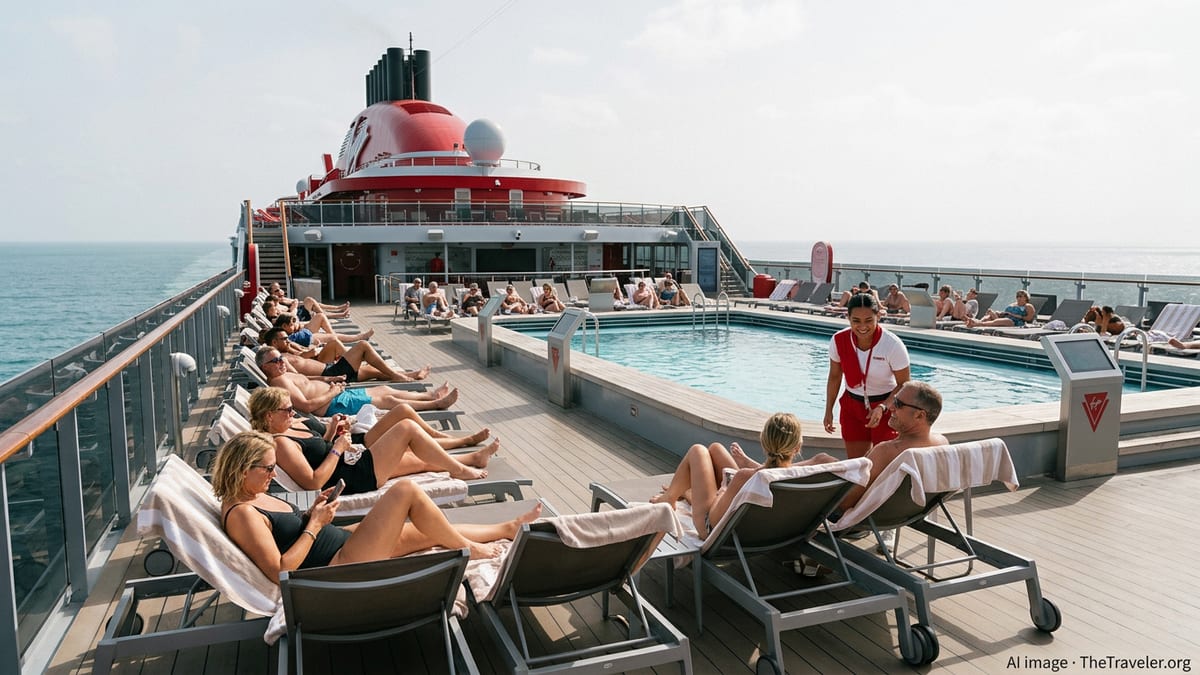
A Quiet AI Revolution Behind the Red Sail
In a matter of months, Virgin Voyages has gone from dabbling in AI to operating one of the most expansive artificial intelligence ecosystems in the travel sector. Working with Google Cloud’s Gemini Enterprise platform, the cruise line has scaled from a pilot fleet of roughly 50 AI agents in late 2025 to more than 1,500 active agents across the business as of March 2026.
These agents are not humanoid robots roaming the decks, but specialised digital workers running quietly in the background. They support everything from marketing and revenue forecasting to crew training and guest support. The company positions this as a way to augment, rather than replace, its crew, freeing staff from repetitive tasks so they can spend more time in face-to-face interactions with Sailors.
The numbers inside Virgin Voyages’ AI build-out illustrate just how quickly the technology has been embedded. Internal reporting highlights significant reductions in content production time, faster decision-making cycles and record early-2026 sales, trends the line links directly to its new AI backbone.
For a brand that has built its identity on design, nightlife and a resort-style atmosphere at sea, the new AI infrastructure is emerging as an equally important part of the promise: a voyage that feels highly curated yet frictionless, even as ships grow busier and itineraries more complex.
From Booking to Boarding: AI in the Sailor’s Digital Journey
The most visible face of Virgin Voyages’ AI strategy for travelers is its updated Virgin Voyages app, which has replaced the original Sailor App across iOS and Android. While early iterations drew mixed reviews, the current generation is designed as a central travel companion, guiding Sailors from pre-cruise planning through to life on board.
New AI-powered agents help streamline check-in, surface the right documentation at the right time and suggest dining or shore experiences based on a Sailor’s preferences and past behavior. The goal is to turn what was once a patchwork of forms, emails and web pages into a single, adaptive digital journey.
Virgin Voyages has also been experimenting with generative AI in consumer-facing campaigns, from interactive booking invitations to celebrity-inspired digital twins. Those marketing-layer innovations now sit on top of a deeper operational stack, meaning that the same data helping to personalise an email can also help refine onboard recommendations once a Sailor steps aboard.
For frequent cruisers, the shift is especially noticeable in how consistently the app and back-end systems recall preferences. Cabins, dining times and wellness activities can be tuned with fewer taps, and new pricing structures, such as the VoyageFair Choices model, are explained and supported by AI agents that help crew handle questions in real time.
Vivi and the Rise of AI-Powered Service at Sea
Central to Virgin Voyages’ AI story is Vivi, an AI-powered digital assistant created in partnership with consulting firm Slalom. Vivi is being integrated into the app and service channels as a kind of always-on concierge, helping Sailors book shore excursions, resolve account questions and navigate the ship’s services without waiting in line at a desk.
Unlike traditional chatbots confined to scripted responses, Vivi is designed to draw on Virgin Voyages’ expanding network of domain-specific agents. A Sailor asking about a spa offer, for instance, is effectively tapping into agents that understand inventory, pricing, loyalty benefits and onboard scheduling, stitched together into a single conversation.
Behind the scenes, other specialised agents handle policy interpretation and training for the human team. One, focused on the company’s VoyageFair Choices pricing program, gives Sailor Services staff up-to-date guidance on fare rules and options. Another, known internally as a “Know Your Sailors” agent, aggregates customer insights so marketing and service teams can refine how and when they communicate.
The result is a layered service model in which AI does the heavy lifting around information retrieval and decision support, while human crew members stay at the center of the experience. For a brand that markets itself on personal style and playfulness, maintaining that balance between automation and authenticity is a strategic priority.
Frictionless Payments and Smarter Operations
Virgin Voyages’ AI ambitions extend beyond customer-facing features to the financial and operational spine of each ship. A partnership with Canadian payments processor Nuvei has overhauled how purchases are handled within the app, enabling more seamless digital wallets for everything from bar tabs to spa treatments.
AI agents monitor and optimise these payment flows, helping detect anomalies, reduce friction at checkout and provide Sailors with clearer, real-time views of their onboard spending. For guests, that means fewer paper receipts and less time queuing at guest services to reconcile accounts on the final day of the voyage.
Operationally, AI is increasingly involved in forecasting demand for dining venues, entertainment and shore experiences. By anticipating when Sailors are most likely to book a particular restaurant or excursion, the line can adjust staffing and availability, smoothing out pinch points that once led to long waits or sold-out slots.
This convergence of AI, digital payments and predictive operations is also reshaping how Virgin Voyages measures success. Beyond traditional metrics like occupancy and onboard revenue, the company is now tracking AI-driven improvements in satisfaction scores and in how quickly it can respond to emerging trends or issues on board.
What AI-First Cruising Means for the Future of Travel
Virgin Voyages’ rapid AI deployment is being closely watched across the cruise industry, where many brands are still piloting a limited number of generative AI projects. By committing to full-scale adoption in partnership with a major cloud provider, Virgin is positioning itself as an early case study in what an AI-first cruise line might look like.
For travelers, the near-term impact is most likely to be felt in the small moments: a faster resolution when plans change, a timelier suggestion for a late-night snack, or a smoother experience managing multiple voyages in a single app. Over time, as the network of agents expands, the company envisions increasingly anticipatory service where Sailors encounter fewer frictions they ever need to complain about.
At the same time, the shift raises familiar questions about data privacy, transparency and the future of work at sea. Virgin Voyages maintains that its strategy is anchored in using AI to “unleash human potential,” not eliminate roles, and points to its investments in crew training and digital tools as proof of that philosophy.
As the technology matures, the line’s experiment with thousands of smart agents is likely to influence expectations well beyond its own ships. If Virgin Voyages can prove that large-scale AI adoption can coexist with high-touch hospitality, the red sails now cutting through the Caribbean and Mediterranean may be charting a course for how the wider travel world will operate in the years ahead.