

Getting from airport to ship is one of the least glamorous but most important parts of any cruise. For Virgin Voyages sailors, the good news is that Terminal V in Miami and Virgin’s other home ports are built for smooth arrivals and departures. The key is understanding your transfer options, the realistic timing, and how Virgin’s own transfer offerings fit alongside taxis, rideshares, private shuttles, and public transport. This guide breaks down how Virgin Voyages port transfers really work today, so you can get from plane to port and back again with minimal stress.
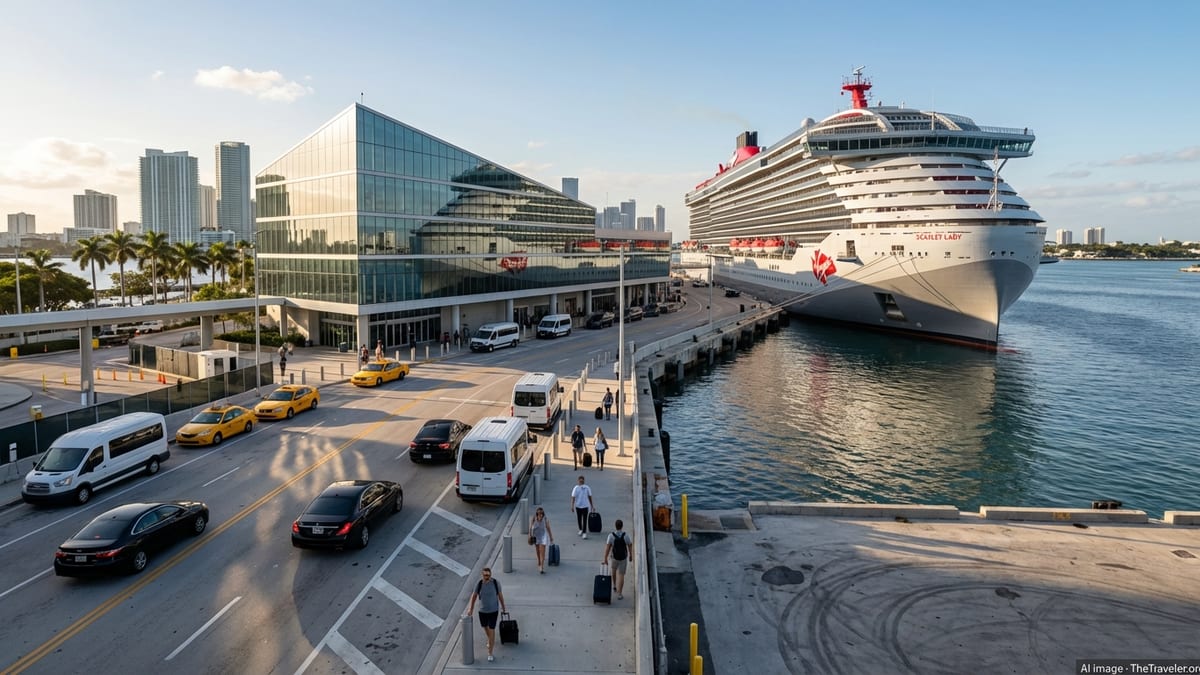
How Virgin Voyages Port Transfers Work Today
Virgin Voyages positions its port experience as an extension of the overall cruise, with purpose-built facilities like Terminal V in Miami offering dedicated drop off zones, early luggage check, and clearly separated arrival areas. While the line focuses on the onboard experience, it does provide limited ground transfer options in certain ports and for specific guest categories, especially suite-level sailors on some itineraries. Most travelers, however, will end up arranging their own transfers using taxis, rideshares, or private shuttles.
At a policy level, Virgin treats transfers as an add on, similar to flights or hotels. The company’s ticket terms state that cruise fares are generally “cruise only,” with air and ground transportation only included when specifically purchased or bundled. That means you should never assume your sailing includes transfers unless it is clearly shown in your booking confirmation. In practice, transfers tend to appear as optional “Shore Things” in the app or as add ons that can sell out before sailing.
Because Virgin partners with local transport providers rather than operating its own large bus fleet in every port, availability and pricing can change. Sailors sometimes see post cruise transfers between Terminal V and Miami International Airport appear closer to sail date, and they may only run at select times early on disembarkation morning. In European and UK home ports, transfers are more common for premium suites or longer-distance airport routes, but they can still be capacity controlled.
The takeaway is that Virgin’s ground transfers are a convenience, not a guarantee. You should treat them as one option in a wider mix of ways to reach the port. Understanding that mix, especially in Miami where most Virgin Voyages itineraries begin, is the best way to avoid last minute scramble or overpaying for a ride.
Transfers at Terminal V in Miami: What to Expect
PortMiami is Virgin Voyages’ primary hub, and Terminal V was designed with a clear flow for vehicles and pedestrians. The terminal sits on the northwest side of the port, with designated areas for ride share pickups, private cars, taxis, and drop offs. On days when multiple major cruise lines are sailing, the access roads can be congested, but Terminal V itself is relatively compact and straightforward once your car clears the entrance to the cruise piers.
On embarkation day, luggage drop generally begins around mid morning, often from about 9 a.m. onward. That allows you to check your bags with porters, then either head into the terminal at your assigned arrival time or go back into the city to explore. Virgin encourages sailors to choose a specific terminal arrival slot in the app and to stick to it. This helps spread traffic outside and inside the building, which matters when many ships are sharing the same access road.
Disembarkation morning has its own rhythms. Virgin tends to stagger departure windows, with early groups leaving first, followed by “self assist” passengers who roll off with their own luggage, and then later times for those in no rush. Traffic leaving PortMiami often spikes between roughly 8:30 a.m. and 10:00 a.m. when several ships clear at once. That can turn a quick 15 minute drive to Miami International Airport into a 45 minute crawl if you hit a bad bottleneck near the causeway, so always build in extra time.
Because Terminal V is slightly apart from some of the other cruise terminals, ride share drivers and taxis know it well and routinely rotate through on cruise days. You should not expect to walk any significant distance from the building to reach ground transport queues. Instead, follow clear signage outside for taxis, pre arranged shuttles, and app based rides, and be prepared for short waits at peak times as vehicles move in and out of the security controlled port area.
Virgin’s Own Transfer Offerings: When They Make Sense
Virgin Voyages offers its own branded transfers in a few different formats, the most visible being post cruise shuttles between Terminal V and Miami International Airport. These typically show up as paid add ons labeled as a shuttle or transfer in the “Shore Things” section of the app or your online account. Reports from recent sailors indicate that these transfers are usually priced per person rather than per vehicle and may be offered in set time slots for disembarkation morning, for example an 8:30 a.m. and 9:30 a.m. departure from the terminal.
Pricing can vary by season and demand, but many travelers describe the cost of Virgin’s Miami airport shuttle as noticeably higher than simply hailing a taxi or ordering a rideshare, especially for couples or small groups. However, for guests flush with onboard credit or Sailor Loot, or those who prioritize a predictable, pre arranged option directly from the terminal, the branded shuttle can still be attractive. It also bypasses the main taxi and rideshare queues, which sometimes stretch when many ships disembark at once.
Beyond Miami, Virgin has periodically offered transfer options in select ports for suite guests and on some UK sailings. These have included ground transport to central London or to nearby airports for an additional charge, especially for Mega RockStar suite categories. These services are usually more personalized, and given their premium audience, they can justify higher per person costs. Crucially, they are not automatically included unless clearly stated; even RockStar guests should confirm whether transport is bundled or simply available to book.
Because offerings evolve, the best practice is to check your voyage details and the app periodically in the months and weeks before sailing. Transfers sometimes appear closer to departure as Virgin confirms local supplier capacity, and they can sell out. If you strongly prefer a Virgin run option, plan to book it as soon as you see it. Otherwise, treat it as a bonus and organize your own backup, especially for flights on tight timelines.
Independent Transfers: Taxis, Rideshares, and Private Shuttles
For most Virgin Voyages sailors, the simplest and most flexible solution is an independent transfer. In Miami, taxis and ride share services such as Uber and Lyft are widely available at both Miami International Airport and Fort Lauderdale Hollywood International Airport, as well as at hotels in Brickell, Downtown, and South Beach. Typical taxi or ride share fares between Miami International and PortMiami are often in the general range of a few dozen dollars each way, depending on traffic and surge pricing.
From Fort Lauderdale’s airport to PortMiami, the distance and highway tolls push prices higher, and travelers frequently see ride share or shuttle costs in the rough ballpark of mid double digits one way. Independent shuttle operators and private car services also run frequent routes between both airports and PortMiami, serving all cruise terminals including Virgin’s Terminal V. These services can be economical for families or larger groups when costs are split across multiple travelers and when luggage volume is high.
One recurring theme among recent sailors is the trade off between cost and certainty. Booking a private car or shuttle can be more expensive than grabbing the next taxi in line, but it locks in a fixed fare and guarantees pickup at a specific time, which some guests value highly on disembarkation day. Conversely, ordering a ride share on the spot is usually cheaper but can involve a short wait outside and some variability in price. Both approaches work as long as you allow sufficient margin in your timing.
Within Miami itself, travelers staying in pre cruise hotels in Brickell or Downtown often find that ride shares to the port are relatively short hops. However, on mornings when many ships arrive and depart, local congestion near the port entrance can still stretch travel times regardless of starting point. The trick is not the distance but the final approach into the cruise terminal complex, which is shared by multiple lines.
Timing Your Airport and Port Transfers
The single most important decision around port transfers is timing. From Miami International Airport to PortMiami, the pure driving time outside of rush hour can be as little as 15 to 20 minutes. During heavy traffic or when many ships are in port, that can expand significantly. As a conservative guide, many travel agents and experienced cruisers still recommend scheduling flights that land at Miami International no later than late morning for same day embarkation, and building at least 45 to 60 minutes of margin between your scheduled airport arrival and your target time at the port.
If you are flying into Fort Lauderdale on embarkation day, widen that margin. The drive between Fort Lauderdale’s airport and PortMiami regularly takes between 35 and 60 minutes, and accidents, construction, or weather can easily tip it beyond an hour. With that in mind, many cautious travelers either arrive the night before or choose morning flights that land very early, giving them plenty of buffer before their Virgin Voyages terminal arrival slot.
On disembarkation day, you are working in reverse, and the key question becomes how early a flight you can reasonably catch. Because PortMiami sits relatively close to Miami International and traffic generally flows opposite the main morning commute, many passengers successfully make late morning or midday flights when they leave the ship in good time. To be cautious, many cruise experts still recommend avoiding flights earlier than around mid morning on the same day you disembark, especially if you prefer a relaxed breakfast onboard and do not want to be among the first wave off the ship.
Regardless of direction, build in time not only for the drive but also for security and check in at the airport, which can vary by airline and season. Just because you can physically drive from port to terminal in 20 minutes does not mean a 90 minute window between disembarkation and flight departure is wise. Think of transfers as one element in a longer chain that includes clearing the ship, retrieving luggage, navigating port traffic, checking bags, passing security, and reaching your gate.
Transfers Beyond Miami: Europe, UK, and Other Home Ports
While Miami dominates Virgin Voyages itineraries, the line also sails from European ports such as Barcelona, Civitavecchia near Rome, and Piraeus near Athens, and has operated from UK ports with connections into London. The basic principles of transfers carry over, but distances and local infrastructure differ, which affects both timing and cost. For example, some Mediterranean home ports are located a significant distance from the primary city airport, making transfer costs higher and journey times longer than in Miami.
In the UK, Virgin has advertised additional transfer services for top tier suite guests, including options to connect to central London or area airports for a fee. These are typically arranged in advance through Virgin’s Sailor Services team rather than self selected in the app. Elsewhere in Europe, Virgin’s focus remains primarily on the cruise itself, and most sailors self arrange their transfers using a mix of airport trains, taxis, rideshares where available, and pre booked private cars or shuttles.
One notable difference outside the United States is the strength of public transport links. Many European airports connect to city centers by rail or metro, and in turn link to port cities by regional trains and local buses. For confident independent travelers, that can be both economical and pleasant, but it requires more planning, especially when traveling with substantial luggage. In contrast, many North American sailors prefer the simplicity of door to door cars even at a higher per person price.
Regardless of port, Virgin’s official website maintains updated port information pages outlining basic directions, estimated distances, and general guidance for reaching the terminal. These resources do not usually include exhaustive transfer price tables, but they are useful for confirming which airport and city you should be targeting and what kind of local connections exist. Always double check those pages as your voyage approaches in case terminal assignments or local access rules change from season to season.
Money, Risk, and Comfort: Choosing the Right Option
Choosing a port transfer is really a balancing act between three variables: money, risk, and comfort. Budget minded couples might lean toward on demand ride shares or public transport, saving significant amounts compared with fixed price private transfers or per person cruise line transport. Families with children and multiple suitcases may prefer the door to door certainty of a private van, accepting a higher overall fare in return for space and predictability.
Risk tolerance plays a big role. If you are booking complex international flights with tight connections, you may appreciate the psychological comfort of a pre arranged car waiting at the airport, or a dedicated shuttle organized by Virgin Voyages on disembarkation day. Some travelers are also wary of language barriers or local taxi practices in unfamiliar cities and are willing to pay extra to remove uncertainty. Others are comfortable navigating local options, asking for metered cabs, and checking approximate fares within their ride share apps before they travel.
Comfort is not only about vehicle type, although larger SUVs, luxury sedans, or minibuses can make a difference on longer drives. It is also about how much control you want over your schedule. With an independent transfer, you can freely decide when to leave your hotel or the ship, within the port’s disembarkation windows. With fixed time shuttles, you may face early departures that have you sitting at the airport for hours. Matching the transfer style to your own travel personality is just as important as comparing prices.
Whatever you choose, remember that any savings evaporate if a missed connection forces you to buy new flights or overnight in a hotel unexpectedly. For that reason, err on the side of more time, particularly on embarkation day. A little extra waiting at the port or airport is almost always better than sprinting through a terminal, watching the clock tick down.
The Takeaway
Virgin Voyages has invested heavily in the port experience, especially at its flagship Terminal V in Miami, but it deliberately keeps ground transfers flexible and largely optional. Official shuttles and premium services are available in some markets, usually at a per person cost that trades higher price for predictability. For most sailors, however, well planned independent transfers using taxis, ride shares, or private shuttles remain the most practical choice.
The keys to a smooth experience are straightforward. First, know your ports and airports, including rough travel times and typical congestion patterns. Second, build generous buffers into your schedule so traffic or slow luggage delivery does not threaten your flight. Third, choose a transfer style that fits your budget, risk tolerance, and comfort preferences, rather than defaulting automatically to either the cruise line or the lowest possible fare.
By understanding how Virgin’s own transfers fit into the broader ecosystem of transport options, you can turn an often stressful piece of the journey into a manageable, even routine, part of your cruise. With a little planning and realistic expectations, your voyage can start and finish as smoothly on land as it does at sea.
FAQ
Q1. Does Virgin Voyages include port transfers in the cruise fare?
Most Virgin Voyages fares are cruise only and do not include airport or hotel transfers. Transfers are typically sold as optional add ons or provided only for specific premium guests in certain ports.
Q2. How do I book a Virgin Voyages transfer between Terminal V and Miami International Airport?
When offered, these transfers usually appear as paid add ons in your online account or in the app under excursions or ground services. Availability is limited and often released closer to sailing, so check periodically and book quickly if you prefer this option.
Q3. Is it cheaper to use a taxi or rideshare instead of a Virgin Voyages shuttle?
In many cases, yes. For couples or small groups, a metered taxi or app based ride from Miami International to PortMiami often costs less per person than the cruise line’s per person shuttle pricing, though exact costs vary with traffic and demand.
Q4. How early should my flight land in Miami on embarkation day?
As a conservative guideline, aim to land at least several hours before your selected terminal arrival time, especially if flying into Miami on the same day. This buffer covers potential delays, luggage collection, and traffic between the airport and PortMiami.
Q5. What about flying into Fort Lauderdale for a Virgin Voyages cruise from Miami?
It is common to fly into Fort Lauderdale, but the drive to PortMiami is longer and more vulnerable to traffic and incidents. If you do this, schedule an early arrival or come in the night before to reduce the stress of same day travel.
Q6. Are transfers provided for Virgin Voyages sailings in Europe and the UK?
In some cases, especially for top suite categories, paid transfer options are offered between ports and major city centers or airports. However, most sailors in Europe and the UK still arrange their own transfers using local trains, taxis, rideshares, or private cars.
Q7. Do I need to book a transfer far in advance?
For Virgin’s own shuttles and for private car or van services, early booking is wise because capacity can be limited on peak days. Taxis and ride shares usually do not require advance booking, although pre scheduling a ride can provide peace of mind at busy times.
Q8. How much time should I allow between disembarkation and my flight home?
Allow enough time to walk off the ship, clear the terminal, drive to the airport, check bags, and pass security. Many travelers aim for late morning or midday flights from Miami on disembarkation day to maintain a comfortable cushion.
Q9. Can I walk or take public transport directly to Terminal V in Miami?
Terminal V sits inside a restricted port area, so walking from downtown is neither practical nor encouraged. There is a city trolley service that stops near the port entrance, but most sailors still use taxis, ride shares, or private vehicles for the final leg.
Q10. What is the best transfer option for families or groups?
Larger families and groups often find that a pre booked private van or shuttle balances cost and convenience, especially when sharing expenses. It provides guaranteed space for luggage and travelers, and allows everyone to travel together on a single schedule.