

More news on this day
Virgin Voyages is accelerating its artificial intelligence strategy across sales, operations and guest touchpoints, deploying hundreds of specialized AI agents and new digital tools in a bid to boost bookings, streamline behind-the-scenes work and reshape how first-time cruisers experience the brand.
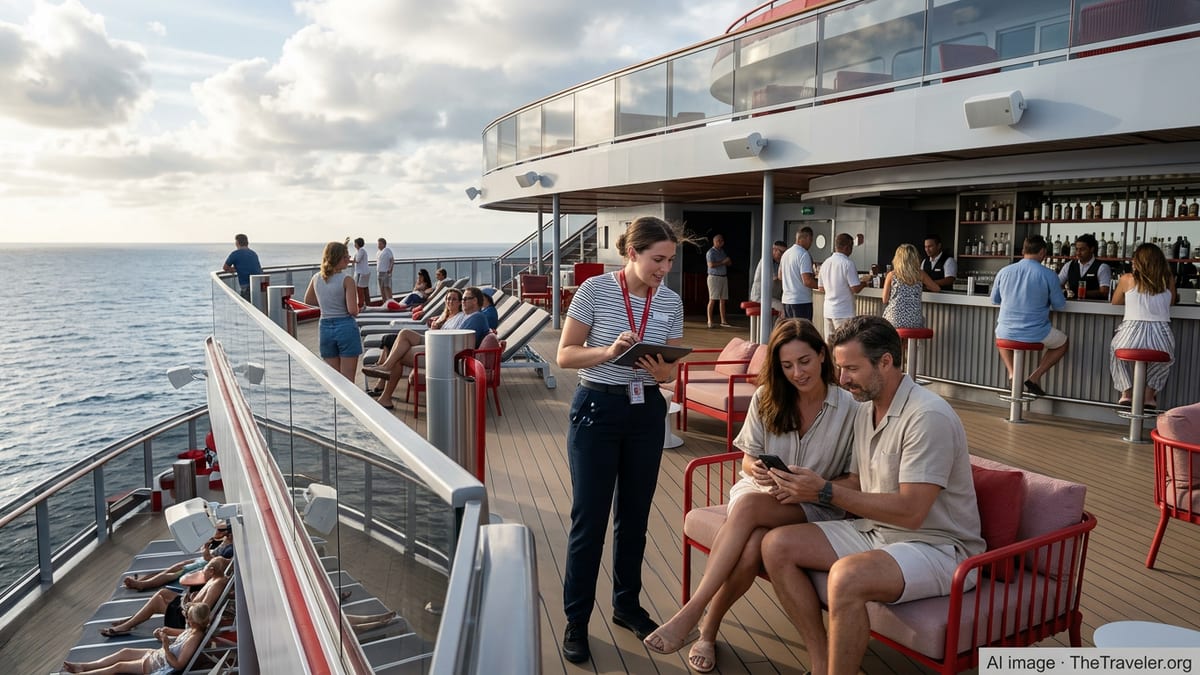
AI Agents Scale Behind the Scenes Across the Fleet
Virgin Voyages has quietly turned itself into one of the cruise industry’s most aggressive adopters of AI, expanding from a pilot of around 50 AI agents in late 2025 to more than 1,500 agents active across the company by March 2026. Built on Google Cloud’s Gemini Enterprise platform, these agents sit inside core business functions from marketing and revenue management to crew training, commercial operations and sailor services, handling thousands of micro tasks that once demanded human time and manual follow-up.
Internally, each agent is designed with a specific operational mandate. Some summarize lengthy performance reports and market data so revenue teams can move faster on pricing and itinerary decisions. Others monitor cultural trends and customer sentiment to inform campaign planning, onboard programming and even menu tweaks. Virgin executives frame the strategy as a fundamental shift in how the line runs, moving AI from a narrow efficiency tool to a foundational layer in day-to-day decision-making.
Leadership has been explicit that the agents are not meant to replace crew but to strip out what they describe as repetitive, mind-numbing work. By letting software take on routine data pulls, documentation, first-draft copywriting and logistics checks, Virgin wants onboard and shoreside teams to spend more time on creative problem solving and direct interaction with guests. The company says it is on track for full Gemini Enterprise adoption across the organization by the end of the second quarter of 2026.
Sales Surge Linked to AI-Powered Campaigns
The AI ramp-up is already being tied to commercial results. Virgin Voyages reported record sales and revenue growth in January and February 2026, crediting its new agent ecosystem for faster campaign turnaround times and sharper targeting. One internal benchmark widely cited is a 60 percent reduction in content production time, allowing the line to test and refine offers at a pace more typical of digital-native retailers than of a traditional cruise operator.
Among the most prominent agents is “Email Ellie,” a marketing assistant that helps craft and personalize outbound communications at scale. Drawing on guest behavior, booking patterns and brand guidelines, Ellie assembles highly tailored messages that can be rapidly localized and A/B tested, giving Virgin more control over tone and visual consistency while increasing the volume and variety of sales outreach.
The company has also pushed AI tools outward to its distributed sales network. A recently launched platform provides travel advisors, known as First Mates, with AI-powered templates and design tools to build on-brand, visually rich campaigns in minutes instead of hours. By standardizing assets while allowing for personalization, Virgin aims to tighten brand control, increase advisor productivity and open the door to more consistent small-group and niche marketing, from themed sailings to last-minute cabin inventory pushes.
From Contact Center Bots to End-to-End Guest Journeys
For travelers, the most visible expression of Virgin’s AI push is its evolving digital concierge and mobile app ecosystem. The line’s generative AI assistant, known as Vivi, has been integrated into its sailor services workflows to help handle a wide range of pre- and post-booking questions. According to implementation partners, Vivi has reduced escalations to human agents by more than 20 percent compared with a previous rules-based chatbot, easing pressure on contact centers while maintaining service levels.
Virgin is layering these conversational tools into a broader digital journey that includes its mobile app, which already lets guests manage dining, shows and shore experiences from their phones. The company positions AI as the connective tissue that will let these touchpoints feel more coherent, learning from interactions to surface better recommendations for restaurants, wellness sessions and nightlife as the voyage unfolds.
New agents are even being trained as internal clones of senior leaders to provide quick access to institutional knowledge. One system, informally branded “Ask Nirmal Anything” after chief executive Nirmal Saverimuttu, is designed to help employees query past announcements, strategy documents and guidelines in natural language. While invisible to guests, these kinds of tools are intended to shorten decision cycles and create more consistent experiences across ships and regions.
Reimagining Cruise Workflows Without Losing the Human Touch
Virgin’s leadership has repeatedly emphasized that the goal is not to turn ships into automated environments. Chief marketing officer Nathan Rosenberg has framed the strategy as using AI to scale feelings rather than just functions, arguing that the line’s value proposition still hinges on human connection, playful design and a more relaxed onboard culture compared with many legacy competitors.
That framing reflects a broader tension facing the entire cruise sector as AI adoption accelerates. Operators see clear upside in predictive maintenance, yield management, itinerary optimization and targeted upselling, especially as new ships and expanded itineraries intensify competition in destinations such as Alaska, the Caribbean and the North Atlantic. At the same time, there is concern that over-automation could make high-priced voyages feel standardized or transactional just as younger, experience-driven travelers are entering the market.
Virgin is betting that by embedding AI agents into back-office workflows first and focusing on tools that help crew members be more present with guests, it can keep the experience feeling distinctly human. Freed from manual scripts, report generation and repetitive queries, staff are encouraged to spend more time walking the decks, responding creatively to special requests and curating the nightlife and culinary scenes that have become the brand’s calling card.
Setting a Template for AI-First Cruise Lines
The speed and scale of Virgin Voyages’ AI rollout is closely watched by peers and ports alike, particularly as the line prepares for the arrival of Brilliant Lady and new homeport patterns in New York, Miami, Los Angeles and Seattle through 2026. Success could validate a template in which mid-sized, design-driven cruise brands use AI as an operating system for everything from pricing to port logistics, rather than as a collection of standalone pilots.
For prospective guests, especially those new to cruising, the changes may be most noticeable in the booking experience and the first days onboard. Smarter digital assistants, more responsive advisors and cleaner pre-cruise communications can reduce friction that has long plagued first-timers, from confusing fare structures to last-minute paperwork and scheduling surprises. Onboard, more personalized nudges and flexible dining and entertainment options promise a feel closer to a boutique resort city than a regimented ocean crossing.
As the cruise industry navigates capacity growth, changing traveler expectations and heightened scrutiny over sustainability and labor practices, Virgin Voyages’ AI drive signals that the next competitive frontier will be cognitive infrastructure as much as hardware. Its experiment with 1,500 and counting AI agents hints at a future in which the most memorable voyages are shaped not only by ship design and destinations, but by the invisible algorithms orchestrating every interaction behind the scenes.