

More news on this day
As Malaysia accelerates preparations for its Visit Malaysia 2026 campaign, Chinese New Year celebrations at Kuala Lumpur International Airport are being leveraged as high-impact showcases to welcome visitors, deepen ties with the Chinese market and turn the country’s main aviation gateway into a powerful tourism billboard.
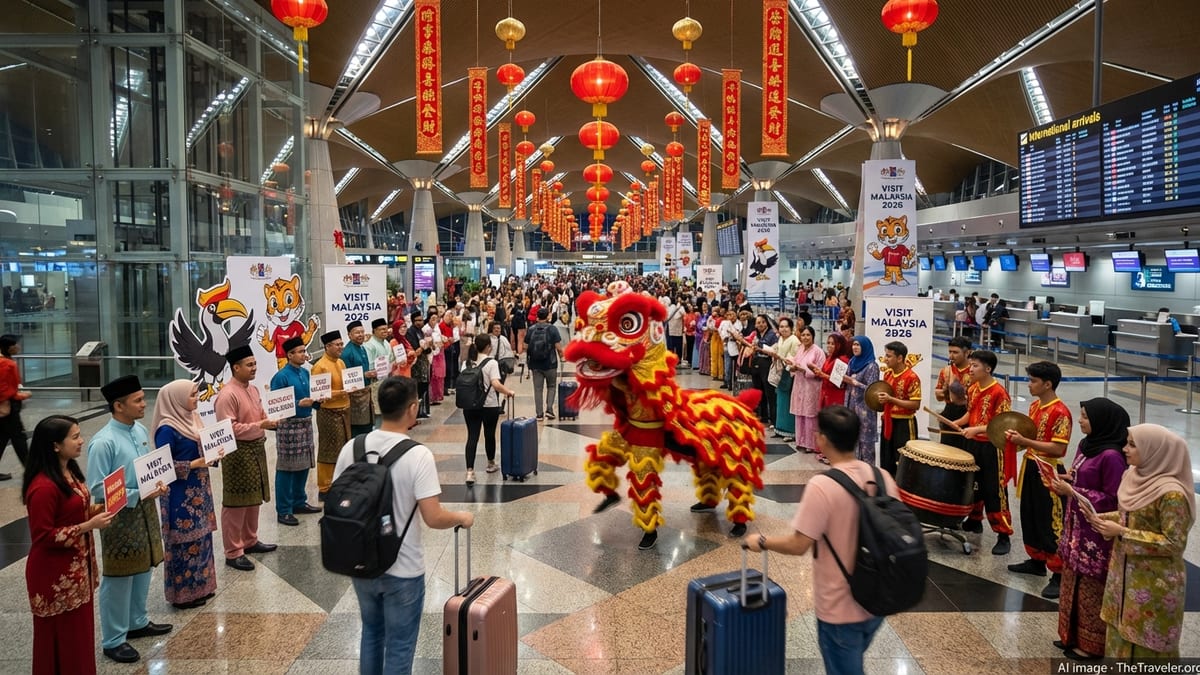
Festive airport greetings set the tone for Visit Malaysia 2026
Tourism Malaysia has placed Kuala Lumpur International Airport at the centre of its Chinese New Year outreach, using the holiday period to demonstrate the country’s trademark hospitality to inbound travellers. On 17 February 2026, the agency staged a major festive reception across KLIA Terminals 1 and 2, positioning the celebrations explicitly under the Visit Malaysia 2026 banner as part of a wider push to enhance first impressions for international arrivals.
The event brought senior officials, including Tourism, Arts and Culture Minister Dato Sri Tiong King Sing, to the arrivals halls, where they personally greeted passengers and handed out Visit Malaysia 2026 souvenirs. The presence of top-level figures, alongside representatives from Malaysia Airports Holdings and private-sector tourism partners, underscored how the Chinese New Year holiday has been reframed as a strategic moment in the build-up to 2026 rather than simply a seasonal observance.
Colourful cultural performances amplified the atmosphere, with lion dances, traditional costumes and festive décor transforming the terminal into a temporary celebration space. The official Visit Malaysia 2026 mascots, Wira and Manja, appeared in special New Year outfits, creating instant photo opportunities for social media and reinforcing the campaign’s visual identity at the very first point of contact for many visitors.
Tourism Malaysia described these activities as part of a broader strategy to strengthen Malaysia’s brand as a safe, multicultural and welcoming destination, while anchoring the Visit Malaysia 2026 campaign in real, on-the-ground experiences at key gateways. The agency has framed KLIA’s New Year greetings as a model for how festive periods can be used to sustain interest in Malaysia between now and 2026.
KLIA passenger flows surge during the Lunar peak
The Chinese New Year window has become one of the most important demand peaks in Malaysia’s aviation calendar, and KLIA’s recent numbers highlight the opportunity this presents for tourism promotion. On the first day of Chinese New Year this year, Tourism Malaysia reported 32 flights and 8,840 passengers arriving during the peak morning window alone at KLIA’s two terminals, a concentrated wave of visitors for whom the airport serves as the first encounter with Malaysia.
More broadly, Kuala Lumpur International Airport has seen international passenger volumes climb as connectivity is restored and new routes to Chinese cities are introduced. Malaysia Airports Holdings has reported that international traffic at KLIA grew by more than 10 percent year-on-year in mid-2025, helped by network expansion that includes new services from Chinese carriers and additional frequencies from existing operators.
Air travel into Malaysia overall has rebounded strongly, with government data showing international arrivals and passenger journeys back near pre-pandemic levels by late 2024. Chinese and Indian travellers have been among the leading contributors to that recovery, reinforcing KLIA’s importance not just as a transport hub but as an active stage for tourism messaging directed at these markets.
Against that backdrop, positioning Chinese New Year celebrations within the terminal as a signature experience is a way to give shape to otherwise routine seasonal traffic. By timing cultural shows, mascots, greetings and media coverage to coincide with peak arrival waves, authorities are seeking to maximise both the reach and the memorability of the Visit Malaysia 2026 brand among high-value travellers.
Chinese market momentum and visa policies boost KLIA traffic
Malaysia’s strategy at KLIA during Chinese New Year is closely linked to the rapid rebound of Chinese outbound travel and the country’s efforts to secure a larger share of that market by 2026. Tourist arrivals from China to Malaysia more than doubled in 2024, surpassing 3.7 million visitors, according to official figures. The continuation of Malaysia’s visa-free entry policy for Chinese nationals until December 2026 has been singled out as a key factor sustaining this momentum.
The tourism ministry and its promotion agencies have set progressively higher goals for Chinese arrivals, projecting around 5 million Chinese visitors in 2025 and up to 7 million in 2026. To reach those targets, Malaysia has encouraged additional charter and scheduled flights from major and secondary Chinese cities, with airlines such as Loong Air and China Eastern launching or ramping up routes into Kuala Lumpur in recent years.
KLIA is at the heart of this aviation push. New and expanded services between Kuala Lumpur and cities like Xi’an and Hangzhou have tightened links to Chinese regions with fast-growing middle-class populations and strong appetite for overseas travel. Chinese New Year, when family visits and leisure trips spike, offers an ideal window to introduce these routes to consumers and to showcase Malaysia’s holiday offerings through airport-based promotions.
Officials and industry stakeholders say the combination of visa facilitation, route expansion and culturally resonant airport experiences is intended to keep Malaysia competitive in a crowded regional landscape, where neighbouring destinations are also courting Chinese travellers. By synchronising policy measures with on-the-ground hospitality at KLIA, the Visit Malaysia 2026 campaign aims to convert rising passenger numbers into repeat visitation and higher spending.
From first impressions to extended stays
The Chinese New Year initiatives at Kuala Lumpur International Airport are designed not only to entertain new arrivals but to influence how long they stay and where they travel within the country. Tourism Malaysia has identified “first-touch experiences” as a priority in its Visit Malaysia 2026 planning, arguing that the way travellers are welcomed at airports can affect subsequent decisions on itineraries, spending and recommendations to friends and family.
To that end, the Chinese New Year reception this year incorporated not just performances and gift-giving but also promotional materials highlighting destinations across Peninsular and East Malaysia. Officials and ground teams used the festive mood to engage travellers directly with suggestions for cultural routes, nature escapes and city experiences that go beyond Kuala Lumpur, aligning with plans to spread tourism benefits more evenly across regions.
Industry representatives say they are seeking to turn KLIA’s terminals into a kind of preview of Malaysia’s diversity, using décor, costumes and multimedia screens to highlight different state attractions. During Chinese New Year, that has meant foregrounding destinations popular with Chinese visitors, from island resorts to heritage cities, while also promoting newer products such as ecotourism, community-based homestays and halal-friendly packages.
Airport operators and tourism officials view these efforts as particularly important in the run-up to 2026, when Malaysia is targeting more than 35 million international visitors overall. With passenger flows already rising, Chinese New Year at KLIA is being treated as a testing ground for concepts that may later be deployed at scale across terminals and other entry points.
Public–private collaboration at the terminal
One striking feature of the recent Chinese New Year celebrations at KLIA has been the degree of collaboration between public agencies and private-sector partners. Tourism Malaysia worked closely with Malaysia Airports Holdings, airlines and ground-handling companies to coordinate reception activities, while hospitality and retail brands within the terminals joined in with their own promotions and themed displays.
Malaysia Airports has positioned the terminal environment as a key part of the country’s tourism infrastructure, not merely a logistical facility. For Chinese New Year, this has included providing prime spaces for cultural performances in arrival halls, synchronising flight schedules with event times where possible, and ensuring operational teams can manage the added foot traffic safely and efficiently while celebrations are under way.
Retailers and food outlets inside KLIA have also capitalised on the festive period with tailored offers aimed at international travellers, including Chinese-language promotions and holiday menus. These activities align with broader moves by airport operators to enhance non-aeronautical revenue, while reinforcing the overall sense of celebration that Visit Malaysia 2026 branding seeks to project.
Tourism stakeholders say similar models of cooperation will be vital as Malaysia scales up its preparations for 2026. Chinese New Year at KLIA offers a template for how government-led campaigns can be amplified by commercial partners, pooling marketing budgets and data insights to target specific traveller segments more effectively.
Tourism targets and the road to 2026
The intensification of Chinese New Year activities at KLIA comes as Malaysia raises its ambitions for tourism growth in the Visit Malaysia 2026 period. The Ministry of Tourism, Arts and Culture has outlined targets of 31.4 million international visitors in 2025 and 35.6 million in 2026, with corresponding tourism receipts projected in the hundreds of billions of ringgit.
After welcoming about 25 million international visitors in 2024, Malaysia is banking on a mix of policy support, marketing campaigns and improved air connectivity to close the gap with regional competitors and pre-pandemic highs. The Visit Malaysia 2026 campaign is the focal point of this strategy, with authorities emphasising sustainability, cultural diversity and community benefits as core themes.
Within that framework, the Chinese New Year travel period is seen as a recurring milestone that allows officials to take the pulse of demand, particularly from China and other Asian markets. Each year’s festive season provides fresh data on passenger flows through KLIA, the performance of new routes and the resonance of promotional messages, feeding into refinements of the 2026 campaign.
Analysts note that while Malaysia has enjoyed strong year-on-year growth in international arrivals, it still faces intense competition from neighbours that are also rolling out visa-free policies and tourism campaigns. Maximising the impact of high-visibility platforms such as KLIA during peak seasons is therefore regarded as essential to differentiate Malaysia’s offer and maintain momentum toward 2026 targets.
Expanding the festive template to other gateways
Although Kuala Lumpur International Airport remains the primary stage for Chinese New Year tourism activations, Malaysian officials are increasingly looking to replicate KLIA’s festive model across other international gateways. Tourism Malaysia has in recent seasons held Lunar New Year welcoming receptions at airports in Penang, Kota Kinabalu and Kuching, signalling an intention to distribute both the spectacle and the economic benefits more widely.
At these secondary hubs, holiday-period arrivals from China and neighbouring countries present opportunities to highlight regional attractions and niche products, from island tourism in Sabah to heritage trails in Penang. Adapting KLIA’s Chinese New Year format to local contexts has meant incorporating state-level cultural elements while retaining the core features of lion dances, festive greetings and Visit Malaysia 2026 imagery.
Officials say such efforts support national goals to spread tourism’s economic impact beyond the capital region and to encourage visitors to extend their stays by combining multiple destinations within a single trip. The prominence of KLIA in Chinese New Year coverage is therefore viewed as a gateway not just in the physical sense but as a communication channel for broader narratives about Malaysia’s varied landscapes and cultures.
As planning for Visit Malaysia 2026 gathers pace, authorities are expected to refine and expand these festive airport concepts, with Kuala Lumpur International Airport likely to remain the flagship example of how Chinese New Year celebrations can be deployed to drive tourism growth, strengthen ties with key markets and set the tone for travellers from the moment they land.