

More news on this day
Hundreds of travelers in Mexico faced unexpected disruptions after low cost carrier Vivaaerobus canceled more than 35 flights on key domestic routes, leaving passengers stranded in Mexico City, Cancun, Guadalajara, Monterrey, Tijuana and several other cities as the airline worked to restore operations.
Get the latest news straight to your inbox!
Widespread Disruptions on Core Domestic Routes
Recent operational problems at Vivaaerobus have triggered a wave of cancellations across its Mexico network, with more than 35 flights reportedly affected in a short window. Publicly available flight tracking data and local media coverage indicate that routes connecting Mexico City with Cancun, Guadalajara, Monterrey and Tijuana have seen the highest concentration of canceled services, along with disruptions on additional point to point routes within the country.
The concentration of affected flights on these high demand corridors has magnified the impact for travelers. Mexico City to Cancun, Guadalajara, Monterrey and Tijuana rank among the airline’s busiest domestic routes, serving both leisure and business traffic. When multiple departures on these city pairs are removed from the schedule, alternative seats on other carriers or later departures quickly become scarce, especially during peak travel periods or holiday weekends.
Reports also describe knock on effects at secondary airports where Vivaaerobus operates connecting or through flights. Travelers departing from or arriving into cities beyond the main hubs have encountered missed connections, rebookings onto overnight services and, in some cases, the need to reroute through entirely different airports to reach their destinations.
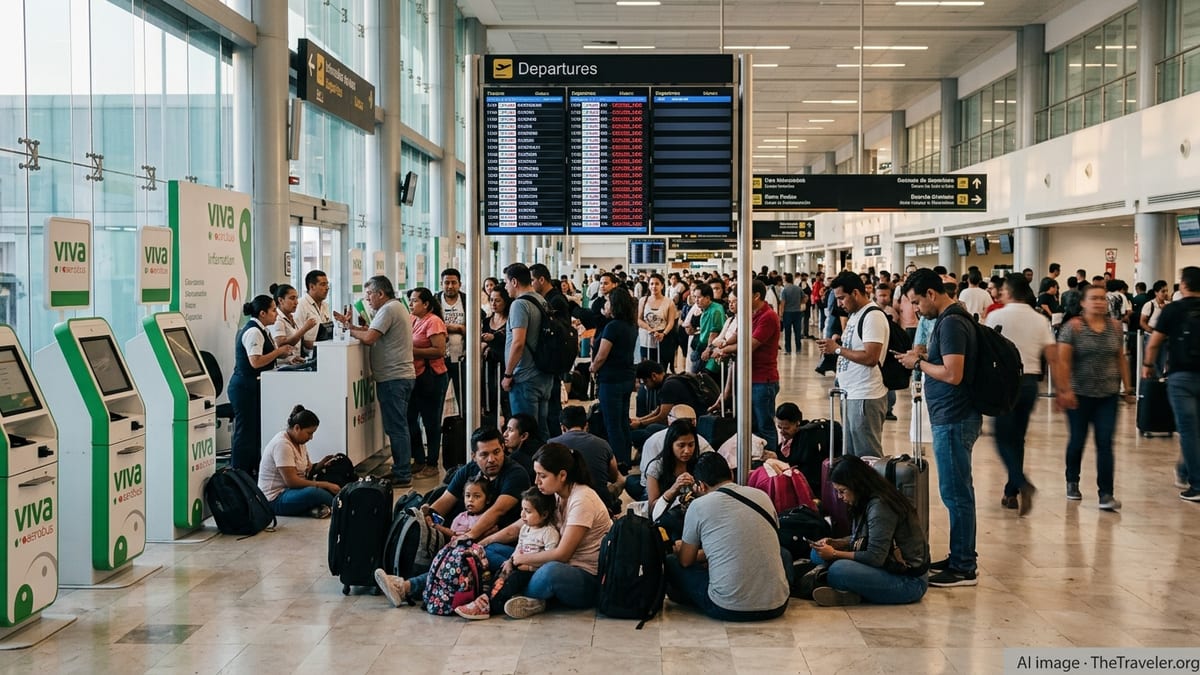
Although the airline has been able to operate a significant portion of its schedule, the cluster of cancellations has been enough to create visible bottlenecks in terminals, longer lines at service counters and mounting pressure on remaining flights that are still operating with high load factors.
Travelers Stranded and Scrambling for Alternatives
Passengers caught up in the disruption have described long waits in terminal halls and at check in areas as they seek information, vouchers or rebooking options. Social media posts and traveler forums reference crowded scenes at Mexico City’s main airport as well as at Cancun, Guadalajara, Monterrey and Tijuana, where groups of passengers have been left to wait for clarification on next steps after learning their flights had been canceled.
According to published coverage and user reports, some travelers have been offered rebooking on later Vivaaerobus flights, while others have needed to secure last minute tickets with rival airlines, often at higher fares due to the surge in demand. In several cases, passengers with onward connections or time sensitive itineraries have opted to overnight in airport hotels or nearby accommodations until replacement flights become available.
Cancellations on routes between northern cities such as Monterrey or Tijuana and leisure destinations like Cancun have been particularly disruptive for vacationers, including those traveling for short weekend stays. Travelers arriving to the airport only to discover their departure had been removed from the schedule have reported losing valuable vacation time, and in some situations, pre paid hotel nights and activities.
Domestic disruptions have also affected international connections. Some passengers connecting onward to the United States or other countries from hubs like Mexico City or Cancun have missed long haul departures after inbound Vivaaerobus flights failed to operate on time, forcing them to rebook transborder or transatlantic segments and, in many instances, absorb additional costs.
Operational and Network Pressures Behind the Cancellations
While Vivaaerobus has not publicly released a detailed breakdown of the causes for every canceled flight, industry observers point to a combination of operational and network pressures that can quickly cascade across a point to point system. If an aircraft is taken out of rotation for unscheduled maintenance or a crew is delayed on an earlier leg, subsequent flights on that aircraft or with that crew may be delayed or canceled, especially when schedule buffers are tight.
Mexico’s domestic air market has grown rapidly in recent years, with low cost carriers competing aggressively on price and frequency on trunk routes such as Mexico City to Cancun, Guadalajara, Monterrey and Tijuana. Analysts note that this competitive environment can encourage dense scheduling patterns and high aircraft utilization, which maximize efficiency when everything runs smoothly but leave limited margin to absorb operational shocks.
Weather, airport congestion and airspace constraints can amplify these challenges. Mexico City’s main airport is known for operating near capacity at many times of day, and any sequence of delays there can reverberate across the networks of airlines using the facility. When a carrier like Vivaaerobus experiences a period of irregular operations, an initial cluster of cancellations in one city or on one route may affect rotations system wide, including flights elsewhere in the country later the same day.
Publicly available information on recent events in several Mexican states also highlights a broader backdrop of periodic transport disruptions, including temporary roadblocks and heightened security in certain areas. While not directly linked to each individual cancellation, these conditions add complexity to travel planning for airlines and passengers alike and can make it more difficult to recover from operational setbacks once they begin.
What Affected Passengers Are Being Advised To Do
Travelers impacted by the latest Vivaaerobus cancellations are being encouraged, through airline advisories and media coverage, to monitor their bookings closely and to arrive at airports with extra time in case of last minute changes. Checking flight status through official airline channels and airport information systems before leaving for the airport can help reduce the risk of arriving to find a flight has already been removed from the schedule.
Passenger rights regulations in Mexico provide certain protections in the event of significant delays or cancellations, including potential compensation or assistance in specific circumstances. Consumer advocates recommend that travelers keep all documentation related to their trip, such as boarding passes, receipts for meals and hotels, and any written notices of disruption, so they can file claims with the airline or, if necessary, with relevant consumer protection agencies.
For those whose flights have not yet been canceled but who are traveling on routes that have been heavily affected, such as Mexico City to Cancun, Guadalajara, Monterrey or Tijuana, travel planners suggest considering alternative departure times, nearby airports or even different carriers if flexibility and budget allow. Travelers with must arrive commitments, such as business meetings or cruise departures, may want to build an additional time buffer into their itineraries until operations stabilize.
Airline industry specialists also emphasize the importance of reviewing fare rules and optional travel insurance coverage. Some policies include benefits for trip interruption or cancellation in cases of airline operational issues, while others may be more limited. Understanding these details in advance can make it easier to make quick decisions if a scheduled flight is suddenly removed from the departure board.
Ongoing Monitoring of Mexico’s Domestic Air Travel Conditions
The wave of Vivaaerobus cancellations underscores how quickly Mexico’s domestic air travel landscape can shift, particularly when a major low cost carrier experiences disruptions on core routes. As airlines adjust their schedules and work to reposition aircraft and crews, additional minor changes or isolated cancellations remain possible in the short term, even after the most acute phase of disruption has passed.
Travelers planning upcoming trips within Mexico are paying close attention to evolving conditions at airports in Mexico City, Cancun, Guadalajara, Monterrey, Tijuana and other key destinations. Tourism boards, travel companies and online booking platforms are updating advisories as new information emerges, helping visitors and residents alike plan around potential bottlenecks.
Although most flights in Mexico continue to operate as scheduled, the recent episode serves as a reminder that even relatively small clusters of cancellations on heavily trafficked routes can strand large numbers of passengers and ripple across the network. For travelers, building in flexibility, allowing extra time and staying informed through multiple information channels remain some of the most practical strategies for navigating a dynamic domestic aviation environment.
Vivaaerobus has signaled through its public communications that it is working to regularize operations and accommodate affected passengers. As schedules are updated and aircraft return to normal rotations, observers will be watching how quickly the airline restores reliability across its key Mexico City, Cancun, Guadalajara, Monterrey and Tijuana corridors, and whether additional schedule adjustments emerge in the days ahead.