

More news on this day
Volotea is sharpening its focus on regional connectivity in Europe for 2026, adding a new public service obligation link between Strasbourg and Copenhagen and unveiling the first-ever direct route between Granada and Porto.
Get the latest news straight to your inbox!
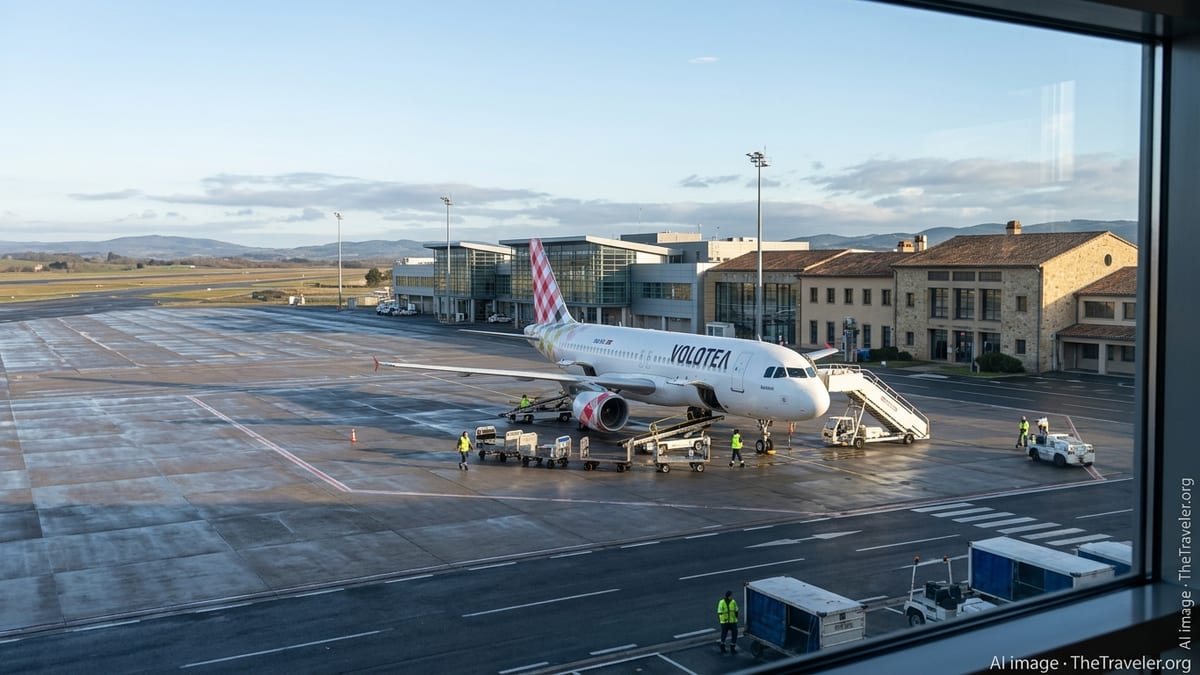
New PSO Link Strengthens Northern European Access from Strasbourg
The planned Strasbourg–Copenhagen connection is set to further entrench Volotea’s role at Strasbourg Airport, where the airline has been expanding its portfolio of regional links under delegated public service contracts. Publicly available planning documents for the 2026 summer season show Volotea preparing to add another northern European capital to its network from the Alsatian hub, complementing existing subsidised routes to destinations such as Munich.
The Strasbourg–Copenhagen service is framed as a public service obligation route, designed to guarantee essential air access between two secondary but strategically important catchment areas. PSO contracts typically prioritise regular frequencies and year-round continuity over high volumes, making them an instrument often used by regional authorities to secure air links that might not be viable on a purely commercial basis.
For Strasbourg, the link to Copenhagen broadens access to Scandinavia, an area not as comprehensively served from neighbouring hubs for point-to-point traffic. The new route is expected to cater to a mix of business, institutional and leisure passengers, reflecting the strong political and economic profile of Strasbourg in the European context and Copenhagen’s role as a major Nordic gateway.
For Copenhagen, the connection provides more direct access to eastern France and the upper Rhine region without forcing travellers through larger and often congested hubs. Industry analysis suggests that such point-to-point routes are increasingly valued by time-sensitive travellers seeking alternatives to long overland trips or indirect connections that involve multiple changes.
Granada–Porto: A First Direct Iberian Link for 2026
On the Iberian Peninsula, Volotea is adding further momentum to its growth in southern Europe with the announcement of a first-ever direct link between Granada and Porto. Regional media in Andalusia report that Granada’s Federico García Lorca Airport will gain a non-stop service to Porto during 2026, extending Volotea’s presence beyond its existing domestic and French connections from the airport.
The flight is described as Granada’s first direct air connection with Portugal, marking a milestone for an airport that has historically relied on links to Madrid, Barcelona and selected seasonal leisure destinations. Available information indicates that the Porto route follows a sequence of recent openings from Granada, including services to Nantes and Santander, underscoring the carrier’s strategy of developing niche, medium-haul point-to-point routes.
From Porto’s perspective, the addition of Granada enhances the northern Portuguese gateway’s growing role as a hub for short- and medium-haul routes to secondary European cities. Recent developments in local transport infrastructure, including expanded urban transit in the Porto metropolitan area, are expected to support onward connectivity for passengers arriving from Andalusia.
While precise start dates and weekly frequencies for the Granada–Porto service in 2026 continue to be refined in schedules and booking systems, industry coverage portrays the route as part of a broader push by Volotea to expand across Spain and Portugal following seat reductions by other low-cost operators at several regional airports.
Regional Connectivity at the Heart of Volotea’s 2026 Strategy
The two new routes highlight how Volotea is positioning itself as a specialist in linking small and mid-sized cities across Europe rather than competing head-on on dense trunk routes. Reports from aviation industry outlets indicate that for the 2026 season the airline is increasing capacity at multiple regional airports, particularly in Spain and France, with new international routes layered onto an already significant domestic footprint.
In Andalusia, for example, coverage of Volotea’s network shows a sharp increase in available seats for 2026, with the airline adding or reinforcing routes from Granada, Málaga and other airports. The Granada–Porto link slots into this pattern as the second international destination from Granada after Nantes, transforming what was once a primarily domestic airport into a modest but growing international gateway.
In eastern France, Volotea’s strategy around Strasbourg involves close cooperation with local and regional stakeholders through PSO and delegated service contracts. Airlines operating under such frameworks commit to minimum service levels, providing regional hubs like Strasbourg with more predictable connectivity and enabling longer-term planning for tourism and business travel promotion.
Industry observers note that this type of network design, based on targeted point-to-point links, can deliver notable economic impact in smaller regions. By reducing travel times and decreasing reliance on distant hubs, routes like Strasbourg–Copenhagen and Granada–Porto can encourage more short stays, weekend tourism and cross-border business trips that might not otherwise occur.
Tourism and Business Markets Poised to Benefit
Travel and tourism stakeholders in both France and Spain are viewing the new Volotea routes through the lens of regional development. In Granada, provincial tourism promotion efforts in recent seasons have already leveraged new air links to attract visitors from France and northern Spain. The addition of Porto opens a gateway to Portuguese travellers, who are considered a natural but under-served market for Andalusian cultural and coastal destinations.
For Porto and northern Portugal, a direct line to Granada reinforces existing city-break circuits that combine heritage cities with inland and coastal attractions. Analysts suggest that twin-city itineraries, pairing Porto’s riverside and wine tourism with Granada’s Alhambra and Sierra Nevada hinterland, could gain traction among both Portuguese and international travellers using each airport as an entry point.
On the Strasbourg–Copenhagen corridor, corporate and institutional travel is expected to form a substantial share of demand, supported by both cities’ roles as regional capitals and major centres for international organisations. However, the route also has potential to stimulate leisure flows, with short breaks in the Alsace wine country and in the Danish capital well suited to the frequency patterns typical of PSO-supported services.
Local tourism boards and airport operators are likely to integrate the new Volotea flights into joint marketing campaigns, although detailed programs have yet to be fully outlined in public documents. Past experience with similar regional links suggests that coordinated destination promotion, combined with schedule stability, is key to achieving sustainable load factors on such routes.
Competitive Landscape and Outlook for 2026
The expansion represented by the Strasbourg–Copenhagen PSO route and the Granada–Porto service comes at a time of heightened competition in Europe’s regional aviation market. Several carriers have recently adjusted capacity or withdrawn from marginal routes, particularly in Spain, creating openings for airlines prepared to work with regional authorities and airports on tailored connectivity solutions.
Volotea’s approach in 2026, as reflected in public network announcements and timetable data, appears to focus on filling these gaps with carefully selected routes that exploit unserved or under-served city pairs. The combination of PSO-backed operations in France and commercially oriented expansion in Iberia offers the airline diversified exposure across different regulatory and demand environments.
Looking ahead through the 2026 summer season, booking trends and load factor performance on both the Strasbourg–Copenhagen and Granada–Porto routes will likely be closely watched by competitors and policymakers. Strong uptake could encourage additional frequencies or seasonal extensions, while also strengthening the case for similar regional links elsewhere in Europe.
For travellers, the most immediate impact will be the availability of new non-stop options that reduce travel time and complexity. Whether connecting the Rhine valley with Scandinavia or linking Andalusia with northern Portugal, Volotea’s latest additions underline how targeted regional routes can continue to reshape Europe’s air travel map in 2026.