

More news on this day
Western Australia is accelerating efforts to deepen tourism and trade ties with China, as new aviation links, fresh market campaigns and record visitor expenditure from Chinese travellers position the state as a key gateway between the two economies.
Get the latest news straight to your inbox!
Record Visitor Spend Underscores China’s Strategic Importance
Publicly available figures highlight that Western Australia’s visitor economy has reached new highs, with total tourism spend in the state approaching 18 billion Australian dollars in the year ending March 2024. Within that result, spending by visitors from China has rebounded strongly from pandemic lows and is again among the state’s leading international markets.
Government data indicates that Chinese visitors spent just over 300 million Australian dollars in Western Australia in the year ending March 2024, rising sharply from the previous quarter and outpacing several long-standing source markets. Analysts note that this performance underscores China’s role as both a high-yield leisure market and a significant driver of education and business travel.
Tourism industry commentary points out that the growth in Chinese spend has outstripped overall visitor volume, reflecting higher average trip expenditure and strong interest in longer itineraries that combine city stays in Perth with regional touring. This pattern is broadly consistent with national tourism research, which shows Chinese travellers remain among the highest-spending international visitors to Australia.
The strengthening of China’s position in Western Australia’s tourism mix is seen as strategically important as the state seeks to diversify its economy beyond resources. Trade profiles released in 2025 emphasise that tourism and education exports are increasingly viewed alongside iron ore and energy as core elements of the economic relationship with China.
New Year-Round Flights Restore Direct Connectivity
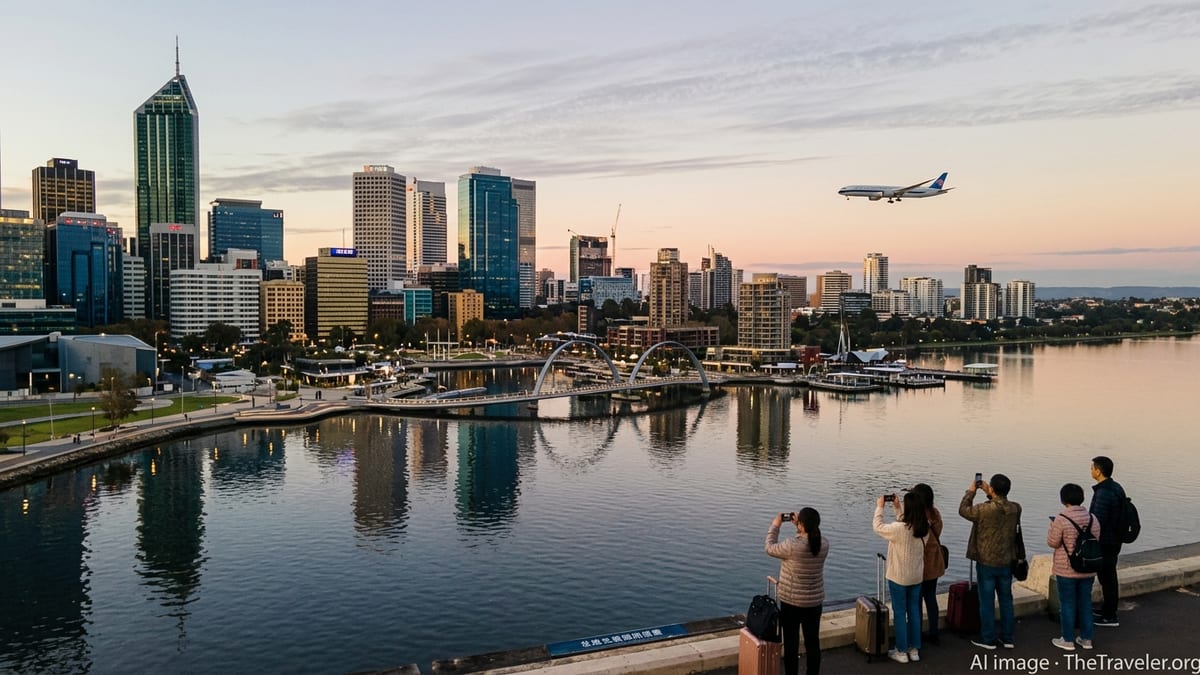
A major pillar of Western Australia’s push to attract more Chinese visitors has been the restoration and expansion of direct air links between Perth and major Chinese hubs. After several years of pandemic-related disruption, non-stop services between Guangzhou and Perth operated by China Southern Airlines have been reintroduced and progressively expanded.
Initial seasonal flights, scheduled around late 2024 to capture Christmas and Lunar New Year demand, have since been upgraded to year-round services. Public information from the Western Australian government and Perth Airport shows that these non-stop routes mark the first continuous direct connection between mainland China and Western Australia since services were suspended in 2020.
Industry observers argue that sustained, year-round connectivity is critical to rebuilding group travel, premium leisure and business segments from China. Direct flights reduce travel time and eliminate domestic connections via Australia’s eastern states, making Perth more competitive against rival destinations in Southeast Asia and Europe.
Aviation analysts also note that the resumption of Chinese carriers into Perth aligns with broader network rebuilds across Australia, with Chinese airlines gradually restoring capacity in key markets. For Western Australia, securing a stable schedule of flights is viewed as a foundation for long-term market development rather than a short-term spike in arrivals.
Tourism Campaigns Target High-Value Chinese Travellers
Alongside aviation initiatives, Western Australia has stepped up destination marketing and trade engagement in China, focusing on high-yield segments such as free independent travellers, luxury small groups and incentive travel. Tourism Western Australia’s recent annual reports highlight a series of campaigns and trade activities designed to reintroduce the state’s experiences to Chinese consumers and travel agents.
These efforts have included participation in major travel trade shows across China, hosting familiarisation visits for Chinese tour operators and online influencers, and tailored digital marketing campaigns on leading Chinese social media platforms. Market profiles released by Tourism Australia show that Chinese travellers are increasingly searching for immersive nature, food and wine and self-drive experiences, product strengths that Western Australia is keen to promote.
Training programs for local tourism operators in Perth and regional centres have also sought to rebuild China-ready capabilities that lapsed during the pandemic. Industry associations in Western Australia have promoted workshops on Chinese payment systems, cultural expectations and digital platforms, aiming to ensure that visitor-facing businesses can meet the expectations of a digitally savvy and quality-conscious market.
Observers suggest that the combination of direct flights and refreshed marketing is helping Western Australia capture a larger share of Chinese travellers who are returning to Australia after international borders fully reopened. With national tourism data showing China back among the top contributors to visitor spend, the state is positioning itself as a distinctive alternative to more familiar east-coast itineraries.
Trade and Education Links Reinforce the Tourism Corridor
The strengthening of tourism ties is occurring in parallel with deeper trade and education connections between Western Australia and China. Trade profiles released in 2025 show that China remains the state’s largest export customer by value, dominated by iron ore, but also encompassing lithium, agricultural products and emerging renewable energy supply chains.
Universities and vocational education providers in Perth continue to attract significant numbers of Chinese students, contributing to both export income and year-round visitation from family and friends. Economic commentators point out that this education corridor supports steady two-way travel, helping to smooth out seasonal fluctuations traditionally associated with holiday periods.
Business travel linked to resources, technology and services exports is also feeding into higher-yield segments of Western Australia’s visitor economy. Trade missions, conferences and corporate delegations from China generate demand for premium accommodation and event services in Perth, while also creating opportunities for regional touring before or after business commitments.
Policy documents from both tourism and trade agencies in Western Australia increasingly reference tourism, education and business travel as interconnected pillars of the state’s partnership with China. The view emerging from this material is that a robust aviation network not only facilitates leisure tourism but also underpins broader economic and people-to-people links.
Outlook: Competition Intensifies for Chinese Market Share
Looking ahead, analysts expect competition to intensify among Australian states and international destinations seeking to capture Chinese outbound demand. Tourism Australia’s market insight reports describe China as a top-tier growth market globally, with total expenditure on trips to Australia setting new records in the year ending September 2025.
Within this environment, Western Australia is seeking to differentiate itself through its combination of urban and wilderness experiences, from Perth’s riverfront precincts and beaches to outback landscapes, wine regions and marine attractions such as Ningaloo Reef. Travel trade commentary indicates that Chinese travellers are showing growing interest in lesser-known destinations that offer space, nature and authenticity, themes that feature heavily in Western Australia’s current campaigns.
Further aviation developments are expected to play a decisive role. Industry observers are watching closely for indications of additional routes from other Chinese cities to Perth, as well as potential increases in frequency on existing services. Any such expansions would likely support further growth in visitor numbers and spend, particularly if coordinated with targeted trade and consumer marketing.
For now, the combination of restored direct flights, record visitor expenditure and renewed trade and education links suggests that Western Australia is well placed to benefit from the next phase of China’s outbound tourism recovery. Stakeholders across the tourism and aviation sectors are signalling cautious optimism that the current momentum can be sustained, provided competitive capacity and consistent destination promotion are maintained.