

More news on this day
Thailand’s eastern seaboard is gearing up for one of its longest and liveliest Thai New Year seasons yet, as Pattaya and Chon Buri prepare to stretch Songkran 2026 into nearly two weeks of Wan Lai water battles, beachside rituals, and time-honoured Thai traditions.
Get the latest news straight to your inbox!
Songkran Dates Stretch From Mid to Late April
Across Thailand, Songkran 2026 is officially centred on April 13 to 15, when the country marks the traditional Thai New Year with merit-making, family reunions, and nationwide water play. Publicly available holiday schedules indicate that many travellers will see an extended break through April 16, reinforcing the festival’s reputation as one of the country’s busiest travel periods of the year.
On the eastern seaboard, however, celebrations do not stop when the national holiday period ends. Pattaya’s Wan Lai festival, long known as an “after-party” to the main Songkran dates, is widely expected to peak around April 18 and 19, while neighbouring coastal areas in Chon Buri province, including Bang Saen, promote additional seaside Songkran events on April 16 and 17. Together, these overlapping dates effectively turn the middle of April into a rolling, region-wide water celebration.
Travel platforms and local event listings describe Pattaya as one of the last places in Thailand where large-scale water throwing continues well beyond April 15, drawing visitors who want to experience Songkran at full intensity after celebrations in Bangkok, Chiang Mai, and other cities begin to wind down.
Pattaya’s Wan Lai: Beachfront Water Battles and Citywide Street Parties
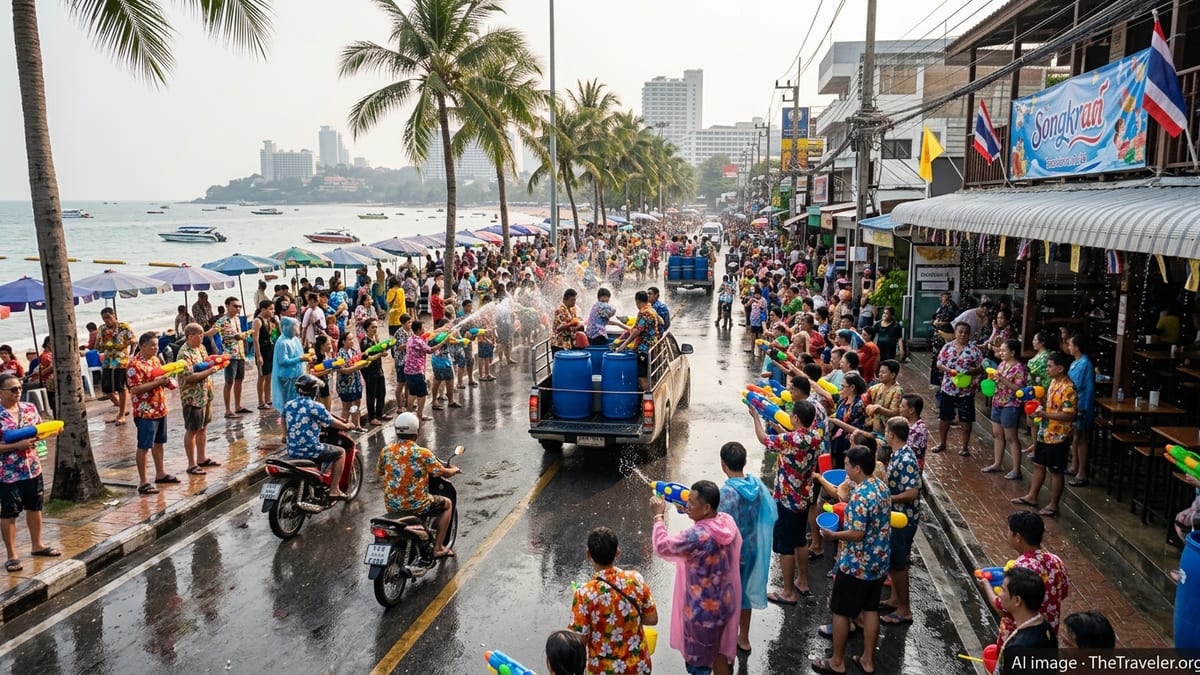
In Pattaya, Wan Lai transforms the resort city into what many visitors describe as a continuous water battlefield. Major arteries such as Beach Road and Second Road are typically lined with pickup trucks carrying giant water barrels, groups of friends armed with high-pressure water guns, and mobile sound systems blasting Thai pop and dance tracks from mid-morning until late evening.
Recent local coverage of past editions highlights that water play along Pattaya Beach has been officially permitted until midnight in key festival zones, with organisers positioning Wan Lai as a showcase for both high-energy fun and family-friendly programming. Visitors can expect a dense crowd along the beachfront, where locals and tourists soak one another from sidewalks, bar terraces, and makeshift water stations in front of hotels, restaurants, and convenience stores.
The city also promotes cultural elements alongside the revelry. Reports from previous years describe parades featuring traditional dance performances, floral floats, and processions carrying Buddha images for gentle water sprinkling, allowing participants to offer respectful blessings in between the more raucous street battles. Community stages commonly host Thai music, beauty pageants, and cultural shows designed to underline that Wan Lai is rooted in New Year customs rather than being only a giant foam and water party.
While exact programming for 2026 continues to be updated closer to the festival, the pattern from recent years indicates that visitors can expect multiple days of organised activities, entertainment stages, and roaming water zones concentrated around the beachfront and central Pattaya.
Bang Saen and Coastal Chon Buri Keep Traditions Close to the Sea
North of Pattaya, the seaside town of Bang Saen in Chon Buri province is preparing its own Wan Lai celebrations, sometimes promoted as “Seaside Songkran.” Information in regional travel magazines and provincial listings points to events scheduled for April 16 and 17, creating a midweek focal point before Pattaya’s peak dates.
Bang Saen’s version of Wan Lai is often described as slightly more traditional than Pattaya’s, with long stretches of the beachfront reserved for building sand pagodas, known locally as chedi sai. Families and youth groups truck in sand or shape it directly on the beach, decorating the miniature stupas with colourful flags, flowers, and incense. The activity is seen as a form of merit-making and a way to symbolically return sand that has been carried away from temple grounds during the year.
Alongside the sand pagodas, temples near the coast typically host ceremonies where locals pour scented water over Buddha statues and gently over the hands of elders, seeking blessings for the coming year. Reports from past years describe processions of Buddha images along the beachfront, allowing both residents and visitors to participate in the more contemplative side of Songkran before or after joining the water play.
Even so, Bang Saen is far from quiet. Publicly shared travel accounts highlight packed roads, open-sided trucks full of revellers, and continuous water splashing along the seafront. Many visitors pair a day of festivities in Bang Saen with later trips to Pattaya, using the two coastal hubs to experience the evolving energy of Wan Lai through the week.
Rules, Safety Measures and Changing Festival Etiquette
As Wan Lai has grown into a major regional attraction, local regulations and recommended conduct have become more prominent parts of festival messaging. Coverage of recent Pattaya editions notes increased signage about what is and is not permitted during water activities, along with dedicated emergency lanes and clearly marked festival zones to keep traffic moving during peak hours.
Restrictions commonly include bans on high-pressure water jets, throwing water from high-rise balconies, or using ice and unsafe colouring agents in water buckets. Some beachfront stretches in Pattaya have also seen alcohol sales restricted or prohibited during the official Wan Lai period, in an effort to maintain a safer and more family-focused environment.
Public information campaigns repeatedly emphasise considerate behaviour: avoiding aggressive water throwing at motorcyclists, small children, and the elderly, steering clear of temples and designated “no-splash” areas, and respecting local dress norms. Light, respectful clothing is encouraged, but festival-goers are reminded that revealing outfits or unwanted physical contact are increasingly frowned upon and may attract legal penalties.
Medical volunteers, mobile first-aid tents, and hydration points are now standard at large Songkran and Wan Lai events. Travellers are advised in many guides to carry waterproof bags for phones and documents, use closed footwear to avoid injuries on wet roads, and plan transport well in advance, as heavy congestion and partial road closures are routine throughout the week.
Travel Planning: How to Navigate Two Weeks of Festivities
For visitors considering Wan Lai Songkran 2026, the extended schedule in Pattaya and Chon Buri creates a wide planning window. Many international travellers are expected to arrive in Thailand in time for the core national holiday around April 13 to 15, celebrate in Bangkok or Chiang Mai, and then move to the eastern seaboard as the focus shifts to coastal Wan Lai events.
Travel and accommodation platforms already flag mid-April as a period of intense demand. Rooms along Pattaya Beach Road, in central Pattaya, and near Bang Saen’s main beachfront are typically among the first to sell out, while bus and van services between Bangkok, Chon Buri, and Pattaya often operate at or near capacity around the key festival dates. Travellers are encouraged by online guides to secure bookings months in advance and to allow generous time for transfers, especially on weekends and on April 16 and 18, which are expected to be heavy travel days.
For those who want to balance celebration with rest, some itineraries recommend staying slightly away from the noisiest streets and using short taxi or songthaew rides to dip in and out of the action. Others suggest splitting time between Bang Saen, with its strong temple and sand pagoda traditions, and Pattaya, where late-running water battles and nighttime entertainment create a markedly different festival atmosphere.
Whether visitors come for the cultural rituals, the non-stop street parties, or a mix of both, the convergence of Songkran and Wan Lai in 2026 is set to turn Pattaya and Chon Buri into one of Southeast Asia’s liveliest coastal corridors for nearly two weeks in April.