

More news on this day
Passengers across China, Qatar, Bahrain and the United Arab Emirates faced mounting frustration on March 7 as at least 40 flights were cancelled and more than 200 delayed, with carriers including Qatar Airways, Sichuan Airlines, China Eastern, Gulf Air and Emirates struggling to restore normal operations amid war-related airspace closures in the Middle East.
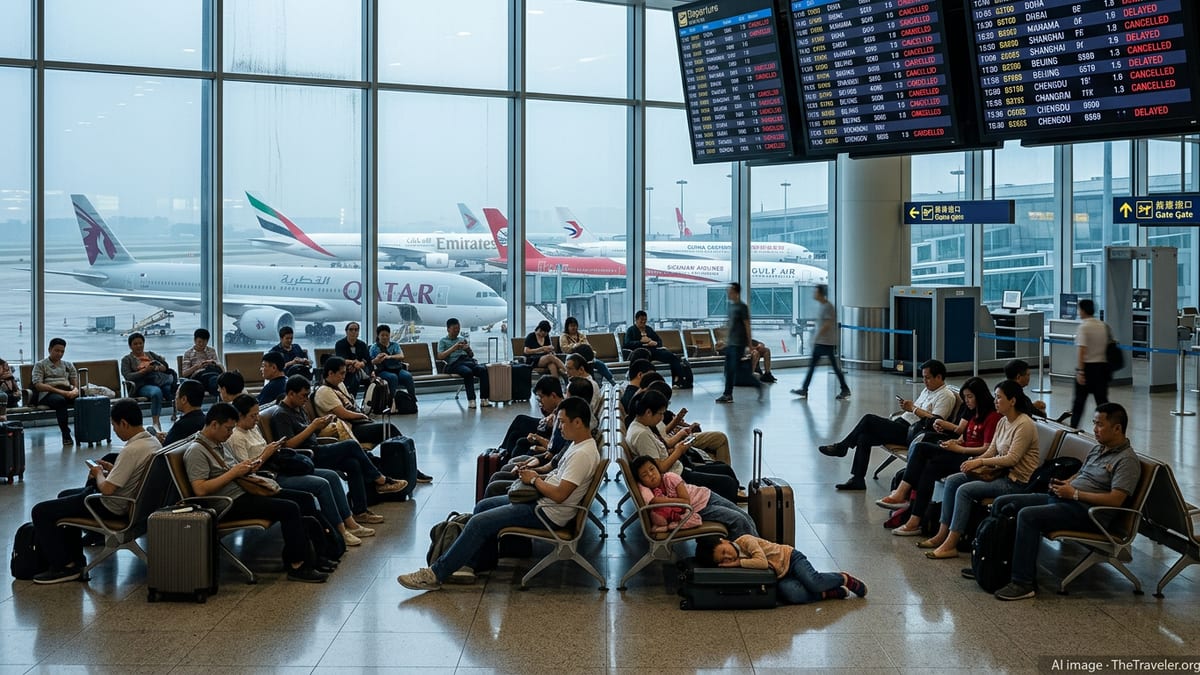
Middle East Conflict Sends Shockwaves Through Global Flight Networks
The latest wave of disruptions comes as regional hostilities tied to the Iran war continue to force governments to close or heavily restrict airspace over Qatar, Bahrain and parts of the UAE, upending one of the world’s busiest aviation corridors. Airlines that rely on Gulf hubs for long-haul connections are being forced to ground aircraft, reroute services or operate limited relief flights, leaving passengers stranded far beyond the immediate conflict zone.
In Qatar, normal commercial operations at Hamad International Airport in Doha remain largely suspended, with Qatar Airways focusing on a patchwork of repatriation flights to Europe while warning travellers not to approach the airport unless they have written confirmation that their flight is operating. Bahrain International Airport has kept commercial traffic halted amid ongoing airspace closures, freezing Gulf Air’s regular schedules and complicating regional connections.
In the UAE, Dubai International and Abu Dhabi’s main airports are cautiously restarting activity after days of near-total shutdown, yet airline schedules remain heavily thinned out. Emirates, which earlier suspended regular services, has begun to restore a reduced timetable, prioritising high-demand routes and relief operations. Even with these steps, operations remain far from normal, with gaps in service creating bottlenecks that ripple across airline networks.
Travel analysts say the scale of disruption rivals the worst days of the pandemic, with hundreds of thousands of travellers in the wider Middle East still struggling to find routes home. The difference this time is that the instability is driven not by public-health measures but by rapidly shifting military and security assessments that can close or reopen airspace with little warning.
Chinese Hubs Feel the Strain as Links to Gulf Remain Fragile
Major Chinese gateway cities have been drawn into the disruption as airspace closures in the Gulf severed or curtailed links to Qatar, Bahrain and the UAE. From March 1, monitoring services reported that direct flights between mainland China and several Gulf states, including Qatar and Bahrain, dropped to almost zero, forcing airlines to cancel departures or leave aircraft and crews out of position.
On March 7, passengers at Shanghai Pudong, Beijing Capital and Chengdu Shuangliu reported mounting queues and rolling delays as Sichuan Airlines and China Eastern adjusted their schedules. While most of the 40 confirmed cancellations and 200-plus delays were concentrated on routes linking Asia, the Middle East and Europe, knock-on effects also hit purely domestic services as aircraft rotations were reworked at short notice.
Chinese carriers have cautiously reintroduced a handful of Middle East flights in recent days, focusing on limited services to Saudi Arabia and the UAE that skirt the most sensitive airspace. However, these flights are operating under tight regulatory oversight, and any deterioration in the regional security picture could trigger further cancellations. Passengers booked to connect onward through Doha, Dubai or Bahrain are being urged to rebook via alternative hubs or delay travel where possible.
For business travellers in Shanghai and Beijing, the disruption is already affecting trade missions, energy-sector meetings and major events that depend on reliable links to the Gulf. Tour operators in Chengdu and other western Chinese cities report a surge in calls from anxious customers trying to reroute long-planned holidays that relied on Gulf stopovers.
Gulf Carriers Balance Safety, Relief Flights and Commercial Pressures
Gulf-based airlines are walking a tightrope as they attempt to resume limited services while maintaining safety in an environment of sporadic missile and drone activity. Qatar Airways has concentrated on operating narrow corridors of repatriation flights from Doha and temporary hubs such as Muscat, offering outbound seats to European cities for stranded passengers but keeping its broader global network effectively on pause.
In Bahrain, Gulf Air continues to feel the impact of an airspace that remains technically closed, with only a small number of special operations allowed. The carrier has prioritised flights needed for government and humanitarian purposes, while commercial passengers face rebookings stretching days into the future. Travellers who were expecting seamless one-stop connections via Manama to Asia or Europe have instead been forced to piece together complex, multi-leg itineraries through alternative hubs.
Emirates, based in Dubai, is gradually reactivating its vast network, but the airline’s recovery remains fragile. Even as some long-haul services resume, routings are longer and more fuel-intensive due to detours around closed or high-risk airspace, putting additional strain on crews and aircraft utilisation. Industry observers note that while Emirates may be among the fastest to restore scale, it is doing so under operational constraints that leave little margin for further shocks.
Executives across the Gulf aviation sector are warning that commercial pressures must take a back seat to safety and governmental directives. Many carriers have relaxed change fees and allowed broader rebooking windows, yet passenger compensation obligations remain limited, as airlines classify the disruption as an extraordinary circumstance outside their control.
Travellers Face Long Waits, Confusing Updates and Patchwork Rights
For passengers in Shanghai, Beijing, Chengdu, Doha, Manama and Dubai, the most immediate realities are extended waits, confusing communication and uncertain timelines. Call centres for Qatar Airways, China Eastern and Emirates have been inundated, with some customers reporting multi-hour hold times and rapidly changing guidance as airlines adjust plans in real time.
At Chinese airports, electronic boards on March 7 showed clusters of delayed or cancelled flights on Middle East and Europe routes, while staff fielded questions about when normal service might resume. In Doha and Dubai, long queues formed at transfer desks as travellers sought rebooking options that often relied on scarce seats on partner airlines or circuitous routings via South Asia, Europe or Africa.
Passenger rights vary sharply depending on where tickets were purchased and where flights originate. Travellers departing from European Union airports generally enjoy stronger protections, including re-routing obligations and, in some cases, compensation, whereas passengers flying from Asian or Gulf airports may only be entitled to refunds or vouchers when a flight is cancelled. Consumer advocates are urging travellers to read the fine print of their tickets, keep receipts for unexpected hotel or meal costs and document all communication with airlines.
With the situation evolving by the hour, both carriers and regulators are advising passengers to rely on official airline apps and direct notifications rather than third-party websites or social media posts, which can lag behind actual operational decisions.
Outlook: Gradual Reopening but Prolonged Uncertainty
Aviation authorities across the Middle East have signalled that airspace restrictions could ease further in the coming days if the security environment stabilises. Limited corridors have already opened over parts of the Gulf, allowing a small but growing number of flights to resume into and out of Dubai and Abu Dhabi, and Qatar’s regulators have begun authorising strictly controlled relief operations from Doha.
Even under optimistic scenarios, however, it will take time for airlines such as Qatar Airways, Emirates, Gulf Air, Sichuan Airlines and China Eastern to restore full schedules and reposition aircraft and crews. Analysts expect rolling cancellations and delays to continue at least through the coming week, particularly on routes that cross or skirt the Gulf region, as carriers balance safety directives with commercial demand.
Travel experts recommend that anyone with upcoming itineraries through Doha, Dubai, Abu Dhabi or Bahrain maintain flexible plans, avoid tight connections and consider alternative routings via Europe or other Asian hubs where possible. For now, the combination of at least 40 cancellations, more than 200 delays and ongoing geopolitical volatility underscores how quickly a regional conflict can disrupt flight networks stretching from Chinese megacities like Shanghai and Beijing to the heart of the Arabian Peninsula.
For the global travel industry, the crisis is a stark reminder that the post-pandemic recovery remains vulnerable to geopolitical shocks. Airlines that have spent years rebuilding networks and restoring profitability must once again navigate a period of uncertainty, while passengers absorb the immediate cost in time, stress and, in many cases, lost journeys.