

More news on this day
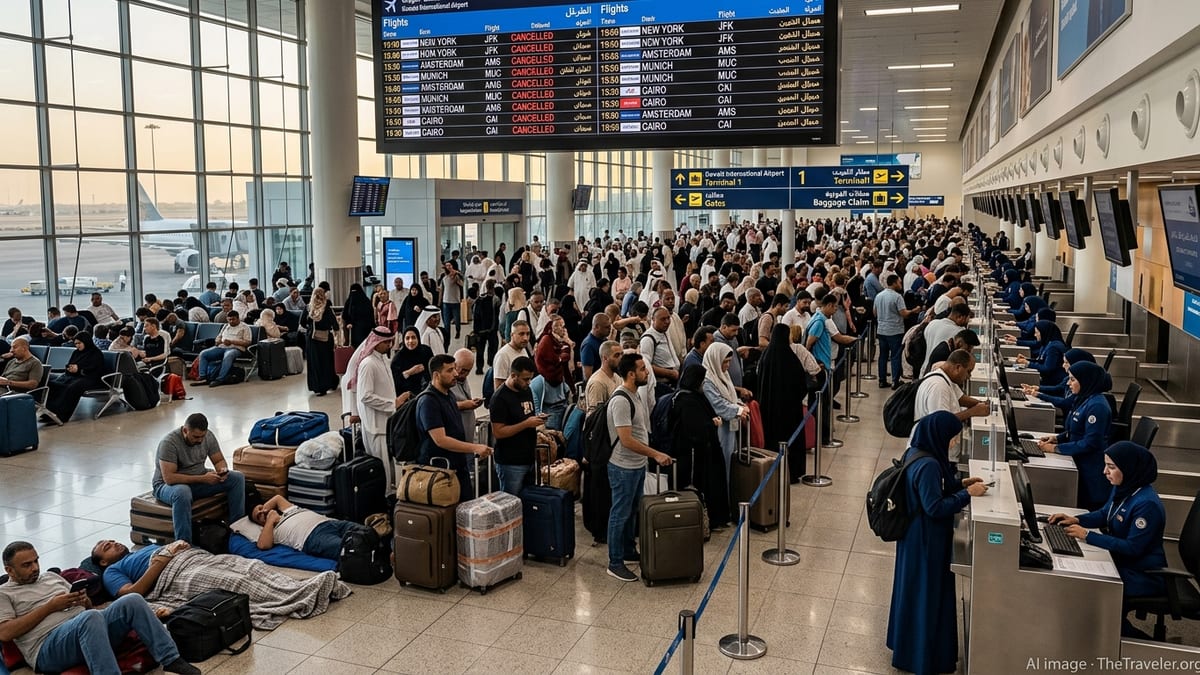
Conflict-related airspace closures across the northern Gulf have triggered sweeping flight cancellations by Gulf Air, Kuwait Airways, EgyptAir and other major carriers, disrupting travel from Kuwait International Airport to New York, Amsterdam, Munich, Cairo and additional global hubs and leaving passengers stranded in growing numbers.
Get the latest news straight to your inbox!
Airspace Closures Ripple Across Kuwait’s Flight Network
Publicly available aviation data and regional media coverage indicate that ongoing hostilities involving Iran and neighboring states have led to partial and full airspace closures across parts of the Middle East, including Kuwait. These restrictions have forced airlines either to suspend services outright or attempt lengthy diversions that are not always operationally or commercially viable.
Reporting on the wider conflict shows that large portions of airspace over Iran, Iraq, Kuwait and adjacent corridors have been periodically shut or heavily restricted since late February 2026, resulting in thousands of daily cancellations across the region. Airlines with routings that usually overfly these areas are among the hardest hit, with Kuwait International Airport facing repeated schedule overhauls as carriers react to evolving risk assessments.
Within this context, departures from Kuwait to long-haul destinations such as New York, Amsterdam and Munich have been especially vulnerable. These routes typically rely on corridors now affected by military activity or air-defense operations, prompting carriers to cancel or consolidate flights with little advance notice and pushing disruption onto passengers already en route or in transit through Kuwait.
Regional analysts note that aviation disruptions of this scale are consistent with broader conflict-driven shocks seen in recent years, where sudden route bans and missile risks have forced airlines to reconfigure schedules overnight. In Kuwait’s case, the combination of proximity to affected airspace and its role as a regional transit point has amplified the impact.
Major Airlines Cancel Routes Linking Kuwait to Global Hubs
According to published airline notices and travel-industry tracking, Gulf Air, Kuwait Airways, EgyptAir and several other regional and international carriers have cancelled multiple services touching Kuwait since the escalation of hostilities. The cancellations span both point-to-point routes and connecting itineraries that use Kuwait as a transfer hub.
Kuwait Airways, the country’s flag carrier, has issued repeated advisories extending its war-related waiver and acknowledging cancellations on services through at least late March 2026. Travelers on routes to and from Europe, North America and South Asia report receiving last-minute messages indicating flights from Kuwait have been scrubbed, with some being offered refunds or rebooking options while others navigate more complex arrangements.
Gulf Air and EgyptAir have also adjusted their Kuwait operations in response to airspace restrictions and operational risk assessments. Services linking Kuwait with Cairo have been repeatedly disrupted, as have itineraries that depend on onward connections from Gulf hubs to New York, Amsterdam and Munich. In parallel, evacuation-style and repatriation flights mounted from other Gulf airports have highlighted the scale of demand from travelers trying to bypass closed or constrained routes through Kuwait.
Travel forums and social media posts from recent days describe a patchwork of airline responses. Some carriers have provided structured rebooking channels and temporary fare waivers, while others appear to rely more heavily on case-by-case decisions, leading to confusion among passengers whose journeys start or end in Kuwait.
Stranded Passengers Crowd Kuwait International Airport
Accounts from stranded travelers, shared across public forums, depict crowded scenes at Kuwait International Airport as cancellations accumulate. Passengers describe long lines at airline counters, scarce seating in departure halls and uncertainty about when, or if, their flights will depart. Many have reported spending multiple nights at or near the airport while attempting to secure alternative itineraries.
Itineraries involving Kuwait as a connecting point to long-haul destinations such as New York, Amsterdam and Munich appear especially affected, since a cancellation of the Kuwait segment can undercut an entire multi-leg trip. Travelers transiting from Asia or the Indian subcontinent via Kuwait report missed onward flights and difficulties securing seats on replacement services operated from other regional hubs.
Some passengers recount being advised that affected flights will be reassessed only 24 to 48 hours before departure, leaving little room to make alternative arrangements without incurring significant extra costs. In several instances shared publicly, travelers have chosen to abandon Kuwait-linked itineraries entirely, booking new tickets on other Gulf carriers that currently route around restricted airspace but may still face delays or capacity constraints.
Airport operations data and on-the-ground reports suggest that while some domestic and short-haul regional flights continue to operate, the overall departure board in Kuwait remains heavily thinned out, with clusters of cancellations around long-haul services and flights that require traversing still-unstable air corridors.
Refunds, Waivers and Uneven Passenger Support
Documentation circulated online by Kuwait Airways and discussed widely in travel communities outlines evolving refund and waiver policies tied to flights cancelled from late February through March 2026. For certain dates, the carrier has offered full refunds for unused tickets and partial refunds for partially flown itineraries, subject to standard tax and fare rules, while also allowing rebooking onto later dates without additional charges.
However, travelers’ experiences with accessing these options appear mixed. Some describe relatively straightforward email-based refund requests, while others report slow responses, limited call-center availability and uncertainty over whether waivers extend to flights beyond specific cutoff dates. Similar patterns are visible among other affected airlines, where policies are periodically updated as the situation develops, but communication sometimes lags behind rapid operational changes.
Passengers on services to and from New York, Amsterdam, Munich and Cairo have voiced particular concern about accommodation and incidental expenses arising from cancellations. Publicly shared correspondence from at least one carrier states that hotel and ground costs fall outside standard compensation policies in the current circumstances, leaving many travelers to absorb unexpected out-of-pocket costs while they wait for new flights.
Consumer advocates following the situation note that the conflict-related nature of the disruption, along with cross-border differences in air-passenger protections, complicates the question of compensation. Some travelers departing from or destined for jurisdictions with stronger passenger rights regimes may have more formal avenues to pursue redress, while those ticketed entirely on routes outside those frameworks often rely on airlines’ discretionary waivers.
Uncertain Timeline for Normalising Kuwait’s Connectivity
Transport analysts caution that there is no clear timeline for a full restoration of pre-crisis schedules through Kuwait International Airport. The pace of recovery is expected to depend on both security assessments along key overflight corridors and broader diplomatic developments surrounding the conflict that triggered the airspace closures.
Even once restrictions ease, airlines are likely to reintroduce capacity in stages, prioritising high-demand trunk routes and repatriation needs before rebuilding the full network of connecting services. For Kuwait, that may mean a gradual return of flights to major hubs such as New York, Amsterdam, Munich and Cairo, with continued volatility in schedules as carriers test new routings and monitor demand.
Industry observers suggest that travelers with upcoming itineraries involving Kuwait should closely monitor airline advisories and reservation systems, remain flexible about routing options and be prepared for last-minute changes. Publicly available guidance further recommends confirming visa rules, transit requirements and refund or voucher conditions before making complex multi-stop bookings through the region in the coming weeks.
While some Gulf carriers based outside Kuwait have begun to stabilise selected long-haul routes by skirting affected airspace, the situation around Kuwait itself remains fluid. Until conflict-related risks to civilian aviation recede more decisively, Kuwait International Airport is expected to operate under a constrained and changeable flight schedule, with passengers continuing to bear much of the uncertainty.