

More news on this day
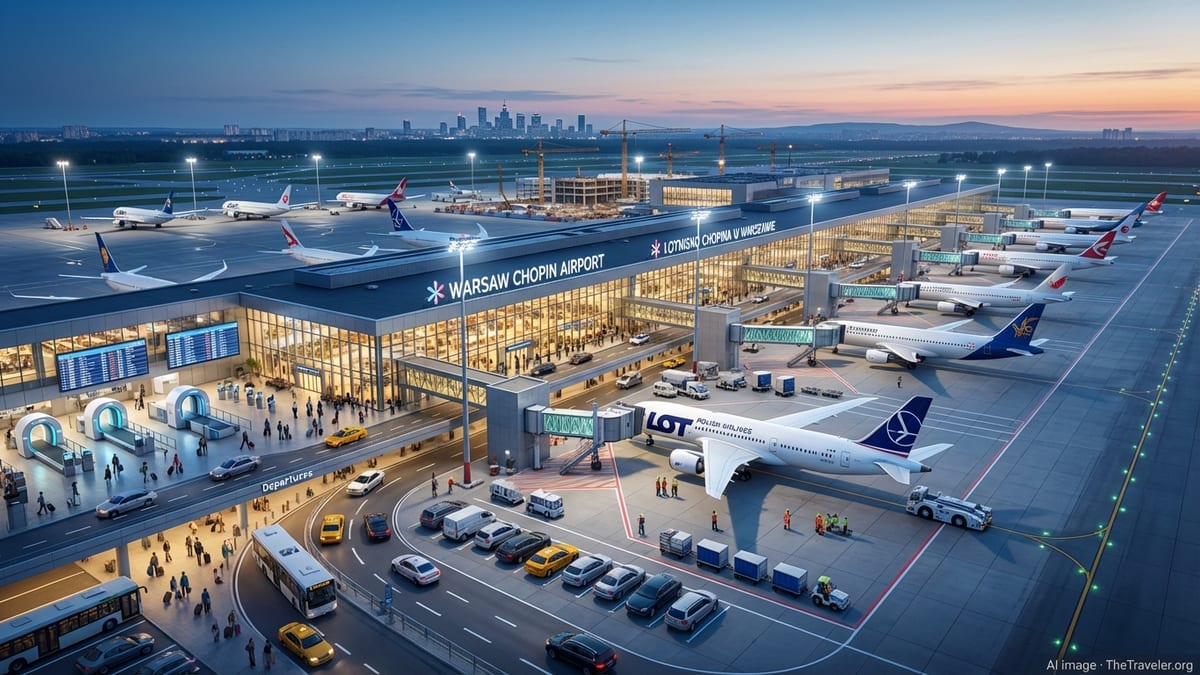
Warsaw Chopin Airport has secured the twenty-sixth spot on the 2026 list of best airports in Europe, a position that reflects not only its surging passenger numbers but also a broader transformation of Poland’s aviation landscape.
The airport, once seen primarily as a regional gateway, has evolved into a competitive European hub combining record traffic growth, a fast-expanding route network, and ambitious investment in infrastructure and technology. Its new ranking underscores how these changes are reshaping both Warsaw’s role on the continent and the travel experience for millions of passengers.
More News
- TSA Rolls Out $45 ConfirmID Fee for Travelers Without REAL ID at Security
- Flying Blue Launches February 25% Promo Rewards on Transatlantic and Regional Routes
- United Fast-Tracks Starlink Wi‑Fi Across Fleet, Free for MileagePlus Members
A Record-Breaking Hub in Central Europe
The most visible driver behind Warsaw Chopin Airport’s elevated standing is its remarkable traffic growth. After a strong post-pandemic rebound in 2022 and 2023, the airport moved decisively into record territory. By late 2024 it had served around 21.3 million passengers, an increase of about 15 percent on the previous year and a historic first for the Polish capital’s main gateway. Those numbers confirmed Chopin’s position as the central pillar of Poland’s aviation sector, accounting for more than a third of all passenger traffic in the country.
The upward trajectory continued into 2025. Data released in early 2026 show that the airport handled more than 24 million passengers in 2025, the best result in its history and nearly 3 million more travelers than in 2024. Airport operator Polskie Porty Lotnicze highlighted that this growth was achieved without sacrificing operational stability, a critical factor for any hub aspiring to climb European rankings. Steady increases in both scheduled and charter services, as well as consistently high load factors, signal that the expansion is structural rather than a temporary spike.
For ranking organizations that weigh traffic volume, punctuality, and operational reliability together, Chopin’s figures tell a compelling story. While some Western European hubs have been struggling with capacity constraints and periodic disruption, Warsaw has quietly moved into a higher league, proving that a mid-sized capital can manage sustained growth while maintaining a largely predictable travel experience.
Infrastructure Investment Aimed at 30 Million Passengers
Passenger numbers alone do not secure a place among Europe’s top airports; the underlying infrastructure must keep pace. In that respect, Warsaw Chopin Airport has launched one of the most ambitious upgrade programs in Central and Eastern Europe. The current investment plan, running through 2029 and estimated at roughly 1.6 billion Polish zloty, is designed to lift the airport’s annual capacity to more than 30 million passengers.
Central to this program is the planned enlargement of terminal facilities and the reconfiguration of key operational areas. Airport management has signaled that expansion will allow an increase in aircraft movements from about 600 to as many as 800 takeoffs and landings per day. That change is critical to sustaining the airport’s role as a growing hub for long-haul and connecting traffic, without the delays and congestion that often erode passenger satisfaction scores.
Modernization also extends to the passenger journey itself, from check-in to security and boarding. The airport is gradually introducing new-generation CT security scanners and related technology aimed at shortening queues while maintaining rigorous safety standards. Alongside this, improvements in non-Schengen facilities and arrivals areas are intended to make the airport more welcoming for intercontinental travelers who may be passing through Warsaw for the first time.
These investments are being made with an eye on the broader evolution of Poland’s transport infrastructure, including the planned Port Polska mega-hub slated to open around 2032. For now, they allow Chopin Airport to bridge the gap between current demand and the more distant promise of a new airport, demonstrating to ranking bodies that Warsaw is not standing still in the face of regional competition.
Route Network Expansion and the Rise of LOT’s Home Hub
Another key factor behind Warsaw Chopin Airport’s improved reputation in Europe is the strength and diversity of its route network. As the main base of LOT Polish Airlines, the airport has benefited from the national carrier’s strategy of building Warsaw into a viable alternative to Western European hubs for both transatlantic and Asian connections. Direct long-haul flights now link the Polish capital with major cities in the United States, Canada, China, Japan, South Korea and a wide range of European capitals.
In recent seasons, Chopin Airport has also seen an acceleration of new routes from both LOT and foreign carriers. Connections to destinations such as Riyadh and Addis Ababa have broadened the airport’s reach into the Middle East and Africa, while expanding charter operations have deepened its footprint in leisure markets from the Mediterranean to the Red Sea. Record charter volumes in 2023 and 2024 demonstrated a growing appetite among Polish travelers for overseas holidays, a trend that supports year-round route viability.
This expansion is reinforced by a robust short- and medium-haul network. London, Paris, Amsterdam and Frankfurt continue to rank among the most popular destinations, while smaller European cities have gained new direct links. Low-cost carriers and charter airlines have helped turn Warsaw into a more competitive origin point for budget travelers within Europe, complementing LOT’s full-service long-haul offering.
From the perspective of airports rankings, a broad and well-balanced route network enhances an airport’s utility for both local passengers and transfer traffic. Warsaw Chopin’s growing ability to serve as a one-stop connection point between secondary markets in Europe and long-haul destinations in North America and Asia strengthens its position against more established hubs and helps explain why it has climbed into the top tier for 2026.
Passenger Experience: From Daily Records to Digital Upgrades
Growth and infrastructure alone do not guarantee favorable reviews. For travelers, the day-to-day experience on the ground remains the defining measure of an airport’s quality. In recent years, Warsaw Chopin Airport has focused on making that experience more seamless, combining incremental physical improvements with digital tools and operational fine-tuning.
Passenger records set during the peak months of 2024 provided a real-world stress test. Over the summer season, the airport served more than 6.5 million passengers between June and September, setting monthly and daily records, including days with more than 75,000 travelers passing through the terminal. At the same time, cargo volumes hit new highs, increasing the overall complexity of operations. Yet the airport managed to maintain smooth functioning without widely reported breakdowns, a point that weighs in its favor when industry analysts evaluate resilience under pressure.
Behind the scenes, a series of technology upgrades are contributing to that resilience. Enhanced security screening systems, improved baggage handling processes, and investments in digital information displays are designed to reduce bottlenecks and enhance clarity for passengers. Many travelers now expect real-time updates and intuitive wayfinding as standard, and Warsaw’s efforts to meet those expectations help close the gap with larger European competitors.
Retail, food and beverage offerings have also expanded in response to rising passenger numbers. While Chopin Airport may not yet match the shopping scale of global mega-hubs, the addition of new dining concepts and refreshed retail outlets has increased choice, particularly in non-Schengen areas where long-haul passengers spend more time. Ranking methodologies that incorporate surveys and on-the-ground assessments are sensitive to exactly this kind of incremental but visible improvement.
Poland’s Aviation Boom and Warsaw’s Strategic Role
Warsaw Chopin Airport’s improved standing cannot be separated from the rapid expansion of Poland’s aviation market as a whole. Nationally, Polish airports handled close to 60 million passengers in 2024, one of the fastest growth rates in Europe and a clear sign that air travel has not only recovered from the pandemic but moved decisively into a new phase of demand. This surge has been fueled by rising incomes, a dynamic outbound tourism sector and Poland’s growing role as a business and logistics hub in Central Europe.
Within that environment, Chopin Airport functions as both a national gateway and a central node in a diversified airport system. While regional airports now handle the majority of Poland’s passenger traffic, Warsaw remains the key hub for long-haul and connecting flights. Its share of the national market, at around one-third of total passengers, gives it critical mass without the extremes of saturation that hamper some Western hubs.
The government’s broader transport strategy also reinforces Warsaw’s position. Investments in air traffic management by the Polish Air Navigation Agency, improvements to rail and road links, and the long-term development of Port Polska all point to a coordinated effort to elevate Poland’s connectivity. As long as Chopin remains the primary international gateway ahead of the new airport’s opening, these policies effectively enhance its attractiveness and operational reliability.
For ranking bodies and industry observers, this context matters. Airports do not operate in isolation; they are deeply influenced by the strength of their home markets and national infrastructure planning. Warsaw’s emergence as a stronger regional hub is therefore both a cause and a consequence of Poland’s wider aviation boom, which helps explain the airport’s ascent into the top thirty in Europe.
Balancing Present Growth with a Future Mega-Hub
One of the more distinctive aspects of Warsaw Chopin Airport’s story is that its rise in the rankings comes at a time when plans are advancing for a much larger, brand-new hub outside the capital. The future Port Polska airport, intended to open around 2032, is designed to handle tens of millions of passengers per year and eventually supersede Chopin as Poland’s main intercontinental gateway.
This could have created a strategic dilemma for policymakers and the airport’s operator: whether to limit investment in an airport that may ultimately be replaced. Instead, Poland has chosen a dual-track approach. While Port Polska moves through planning and design, Chopin is being upgraded to ensure it can handle sustained growth through the late 2020s and early 2030s. That decision sends an important signal to airlines and passengers that the existing hub will remain fully capable and competitive for the foreseeable future.
The relationship between Chopin and the planned mega-hub has also been reframed in recent policy discussions. Rather than a straightforward replacement, there is now greater emphasis on complementarity, with the possibility that Chopin will continue to play a role alongside Port Polska once the new airport opens. For current rankings and investment decisions, this reduces uncertainty and supports long-term commitments by carriers, particularly LOT, which continues to build its network around Warsaw.
In practical terms, the airport’s 2026 ranking reflects this strategic clarity. Far from being a facility in managed decline ahead of closure, Warsaw Chopin is projected to handle more passengers, offer more routes and deliver a more refined experience over the rest of the decade. That forward-looking posture is a significant factor in how industry experts and passengers perceive its place in the European hierarchy.
FAQ
Q1. What does it mean that Warsaw Chopin Airport is the twenty-sixth best airport in Europe for 2026?
It means that according to recent comparative assessments of European airports, Warsaw Chopin has been ranked twenty-sixth based on factors such as passenger experience, operational performance, connectivity and infrastructure quality, placing it firmly within the continent’s upper tier of airports.
Q2. What are the main reasons Warsaw Chopin Airport improved its ranking?
The airport’s rise is largely due to record passenger growth, a broader and more diverse route network, substantial investment in terminals and security technology, and improved operational stability during peak travel periods.
Q3. How many passengers did Warsaw Chopin Airport handle recently?
In 2024 the airport handled around 21.3 million passengers, and in 2025 that figure rose to more than 24 million, marking the highest annual total in its history and underscoring strong and sustained demand.
Q4. What infrastructure projects are underway at the airport?
Current projects include terminal expansion to raise capacity toward 30 million passengers per year, upgrades to non-Schengen facilities, introduction of new CT security scanners, and broader modernization of operational systems to handle more flights per day.
Q5. How important is LOT Polish Airlines to Chopin Airport’s status?
LOT Polish Airlines is central to the airport’s success, using Warsaw as its main hub for an expanding network of long-haul and regional routes. LOT’s growth strategy helps attract transfer traffic and supports new destinations, increasing the airport’s connectivity and appeal.
Q6. Is Warsaw Chopin Airport mainly for local travelers or for transfers?
Chopin serves both large volumes of local origin and destination passengers and a significant share of transfer traffic. Its role as a connecting hub between secondary European cities and long-haul markets has grown, which is an important element in its higher ranking.
Q7. How does the airport manage rising passenger numbers without major disruption?
The airport combines incremental capacity increases, process optimization and technology investment. By expanding terminal space, improving security and baggage systems, and carefully managing schedules, it has accommodated record traffic while limiting congestion and delays.
Q8. What role does Poland’s overall aviation growth play in the airport’s performance?
Poland’s booming aviation market provides the demand that underpins Chopin’s expansion. Rising incomes, strong outbound tourism, and increased business travel all contribute to higher passenger volumes and more routes, enhancing the airport’s standing relative to other European hubs.
Q9. How will the planned Port Polska mega-hub affect Warsaw Chopin Airport?
Port Polska is intended to become Poland’s primary intercontinental gateway around the early 2030s, but current plans envisage Chopin continuing to operate and complement the new hub. Until Port Polska opens, Warsaw Chopin remains the country’s main airport and continues to receive significant investment.
Q10. What can passengers expect from Warsaw Chopin Airport over the next few years?
Travelers can expect continued growth in destination choices, further improvements in terminal facilities and security processes, and ongoing efforts to enhance retail and dining options. As investment programs progress, the airport aims to offer a more efficient and comfortable experience while handling more passengers each year.