

More news on this day
Travelers at Warsaw Frederic Chopin Airport faced another day of mounting frustration on March 9, as Qatar Airways, Emirates and Wizz Air racked up 61 delays and 5 cancellations on routes linking Warsaw with London and Frankfurt, amid a wider wave of disruption triggered by Middle East airspace closures and weather knock-ons across Europe.
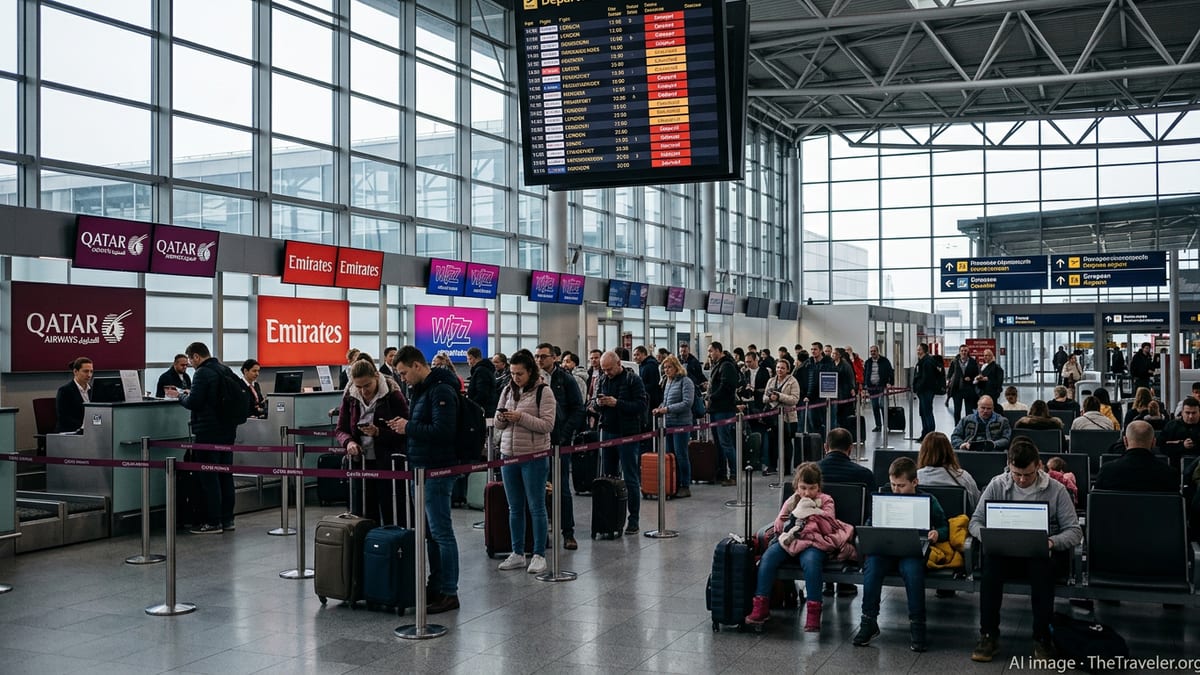
Knock-on Effects From Middle East Crisis Reach Warsaw
Airport operations staff at Warsaw Frederic Chopin reported that the bulk of today’s disruption could be traced back to aircraft and crew stuck in the Gulf region after a week of rolling airspace closures and reduced schedules for major Middle Eastern carriers. Qatar Airways and Emirates, both heavily dependent on their hubs in Doha and Dubai, have been forced into day-by-day scheduling, leaving European outstations such as Warsaw exposed to last-minute changes.
While Warsaw itself has seen no local weather or technical incident severe enough to explain the scale of delays, the airport’s departure boards on Monday morning told a different story. Long-haul and feeder flights operated by Qatar Airways and Emirates, along with several Wizz Air services linking Poland with London and Frankfurt, showed delays stretching well beyond two hours, with some passengers warned of potential overnight disruption.
European traffic data for March indicates that Warsaw is part of a wider pattern. Major hubs including London Heathrow and Frankfurt have been grappling with their own queues of delayed and rerouted aircraft, as Gulf carriers attempt to rebuild skeleton schedules and position planes and crews back onto regular routes. Each late arrival into Europe has a cascading effect, pushing back the next round of departures and straining airport resources.
Operational planners say the current situation is especially volatile because every new airspace advisory or weather constraint can ripple across already fragile schedules. The result, visible in Warsaw on March 9, is a concentration of delays and a handful of outright cancellations for flights that rely on Middle Eastern hubs for onward connectivity.
Qatar Airways, Emirates and Wizz Air Struggle to Rebuild Networks
Qatar Airways has been operating under some of the tightest constraints, after days of near-total suspension of its regular network. The airline has begun mounting limited repatriation flights to key European cities such as London and Frankfurt, but those services remain highly contingent on temporary operating corridors and last-minute clearances. In Warsaw, a Qatar Airways rotation scheduled to feed into this reduced long-haul network was among the most heavily affected, contributing to both delays and cancellations on Monday’s board.
Emirates, which has restored only part of its network, is also using Warsaw, London and Frankfurt as critical spokes for its Dubai hub while it works through a substantial backlog of passengers. Industry briefings suggest that Emirates is prioritizing long-haul connectivity and repatriation traffic, which can leave secondary sectors under greater risk of re-timing or cancellation if aircraft are needed elsewhere. Warsaw’s passengers saw that reality firsthand, with an Emirates service pushed back repeatedly before ultimately departing late.
For Wizz Air, the challenges are different but related. The low-cost carrier, which relies heavily on high aircraft utilization and rapid turnarounds at airports such as London and Frankfurt, has been caught in the congestion at those hubs and in the broader European air traffic system. Delayed inbound aircraft arriving from disrupted airspace or from congested Western European airports left Wizz Air with limited flexibility to protect its Warsaw schedule, leading to a cluster of late departures and at least one cancellation on regional routes.
Analysts note that all three carriers are also managing crew duty-time limits after days of irregular flying and diversion. Every extended delay makes it harder to keep pilots and cabin crew within legal working hours, and last-minute crew shortages can transform a manageable delay into a cancellation, particularly at outstations with fewer standby staff.
Passengers Face Long Queues, Sparse Information and Tight Connections
The human impact of Monday’s disruption was evident in the departures hall at Warsaw Chopin, where queues snaked from airline check-in counters toward the main concourse for much of the morning. Passengers bound for London and Frankfurt on Qatar Airways and Emirates reported waiting in line for rebooking assistance, while Wizz Air customers clustered around self-service kiosks and customer service desks.
Many travelers faced the added complication of tight onward connections beyond London and Frankfurt. With Gulf carriers still running reduced schedules into their hubs, a delayed departure from Warsaw often meant a missed onward flight to Asia, Africa or Australia. Airline agents at Chopin were fielding requests for rerouting via alternative European gateways or entirely different carriers, options that were constrained by limited seat availability across the region.
A number of passengers also expressed frustration about inconsistent communication. While some received app notifications or email alerts as delays lengthened, others said they learned of cancellations only on arrival at the airport. With flight status changing hour by hour, travelers relied heavily on airport displays and gate announcements, which struggled to keep pace with rapid operational decisions being made at airline control centers.
Consumer advocates warn that such chaotic conditions can leave travelers unsure of their rights to care, refunds or compensation. The mix of causes behind Monday’s disruption, from airspace closures to downstream congestion, makes it harder for passengers to understand whether they fall under standard European protections or fall into categories that may be exempt from compensation but still entitle them to rerouting and assistance.
London and Frankfurt Hubs Under Pressure as Delays Cascade
The pressure on Warsaw’s schedule is closely linked to conditions at London and Frankfurt, two of Europe’s busiest hubs and key points in the route networks of Qatar Airways, Emirates and Wizz Air. As those airports absorb late-running long-haul flights and a compressed wave of repatriation services from the Gulf, their ability to handle on-time departures for feeder flights has been sharply reduced.
Arrivals data from across Europe for March 9 show high levels of delays and cancellations at major hubs in the United Kingdom and Germany. Frankfurt, which has also contended with bouts of adverse weather in recent days, has been juggling late arrivals from the Middle East alongside a busy intra-European schedule, creating bottlenecks at stands and in air traffic flows that inevitably knock back departure times.
London’s main airports, especially Heathrow, remain a focal point for reduced but still significant operations by Gulf carriers. With airlines prioritizing long-haul sectors and repatriation efforts, shorter European legs are vulnerable to short-notice re-timings if aircraft or slots need to be reassigned. That dynamic is being felt in Warsaw, where services to and from London are often the first to reflect shifts in the wider global network.
Air traffic management authorities have warned that, even as Gulf airspace gradually reopens, the process of rebalancing schedules will take days rather than hours. Aircraft and crews are still out of position after a week of diversions and groundings, and every disrupted rotation at a hub like London or Frankfurt has the potential to reverberate back to secondary airports such as Warsaw.
What Travelers Through Warsaw Should Expect Next
With conditions still evolving across the Middle East and Europe, aviation officials caution that disruption at Warsaw Frederic Chopin and its key partner hubs may persist through the coming days. Airlines are adjusting schedules incrementally as new operating windows and airspace permissions are confirmed, which means further changes remain possible for passengers booked on Qatar Airways, Emirates and Wizz Air routes via London and Frankfurt.
Operational notices from Gulf carriers indicate a gradual ramp-up of services rather than an immediate return to full timetables. Even if airspace restrictions ease, airlines will likely prioritize clearing existing backlogs and operating essential long-haul flights before restoring every short-haul connection. That suggests Warsaw travelers could continue to see irregular timings and occasional cancellations, particularly on routes that depend on tight connections through Doha or Dubai.
Travel industry experts advise passengers to build extra time into their journeys, avoid same-day self-made connections, and check flight status repeatedly in the 24 hours before departure. Given how fast operating conditions continue to change, booking channels and mobile apps may lag behind operational decisions, making it important for travelers to monitor both airline and airport information throughout the day.
For now, Warsaw Chopin remains fully open and functioning, but the sight of crowded departure lounges and fluctuating departure boards underscores how deeply interconnected global aviation has become. Disruption originating thousands of kilometers away is still dictating the fortunes of passengers standing in line at Polish check-in counters, as airlines and airports across three continents work to restore something close to normal.