

More news on this day
Washington is rushing to assemble a patchwork of charter and military flights to help Americans leave the Middle East, as spreading conflict with Iran shuts down major airports and strands thousands of U.S. citizens across the region.
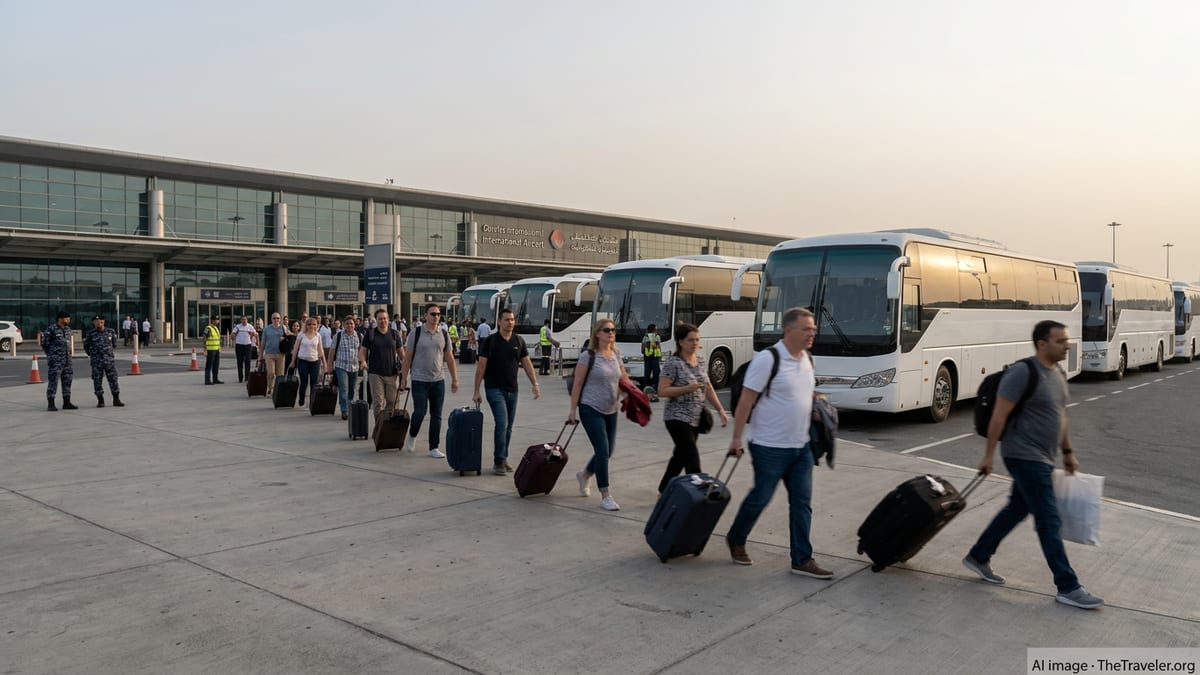
State Department Shifts From Warnings to Organizing Flights
After days of urging Americans to depart the Middle East on any remaining commercial routes, the State Department has begun coordinating charter and military aircraft to move U.S. citizens out of the region, officials in Washington said on Tuesday. The move marks a rapid escalation in U.S. consular efforts as airspace closures and missile strikes make ordinary travel increasingly difficult.
U.S. officials say they are now in direct contact with roughly 3,000 Americans who have either requested assistance or asked for guidance on how to leave. Many are in countries where airports are operating only intermittently, if at all, and where embassy staff have been reduced or evacuated for security reasons.
In statements posted on social media, senior consular officials stressed that commercial seats remain the preferred option where available, but acknowledged that the government is “actively securing military aircraft and charter flights” to provide alternatives. The shift effectively opens the door to large-scale organized departures reminiscent of past crises in the region.
Even as planning accelerates in Washington, officials caution that the timing and scale of any charter operations will depend on rapidly changing security and aviation conditions in each country.
Airspace Closures Complicate Evacuation Logistics
The search for viable evacuation routes is being complicated by sweeping airspace restrictions that now cover large swaths of the Middle East. At least several Gulf and Levant states have closed their skies to most traffic, while others have imposed tight curbs on overflights and arrivals, creating bottlenecks for outbound passengers.
In some cases, airports remain physically undamaged but largely unusable because international carriers have suspended service or cannot obtain safe corridors in and out of the region. Flight-tracking data show hundreds of cancellations and diversions since the latest round of U.S. and Israeli strikes on Iran and allied groups began over the weekend.
As a result, Washington’s emerging evacuation plan leans heavily on countries whose airports and airspace are still partially open, including some hubs on the Arabian Peninsula and in North Africa. From there, chartered widebody jets are expected to operate shuttles to European destinations, where Americans can connect onward to the United States on regular commercial flights.
Diplomats and aviation officials are simultaneously negotiating with regional governments over potential humanitarian or emergency flight corridors, hoping to carve out narrow windows in which evacuation aircraft can operate even as broader restrictions remain in place.
Embassy Drawdowns Strain Support for Citizens Abroad
The effort to move Americans out of the Middle East comes as U.S. diplomatic posts across the region scale back operations under mounting security threats. Several embassies have closed their public consular sections, and nonessential staff and family members have been ordered to depart from multiple countries, according to officials.
The drawdowns are intended to reduce risk to U.S. personnel after drone and missile attacks near diplomatic compounds and military facilities. But the reduced staffing also limits the State Department’s ability to provide in-person assistance to the very citizens it is now trying to evacuate, creating what one former diplomat described as a “race against bandwidth” in crisis response.
With walk-in services curtailed, much of the coordination is happening remotely from Washington and from a handful of regional hubs, relying on email, emergency hotlines and an online crisis intake form. Americans still in the region are being urged to enroll in the Smart Traveler Enrollment Program so that officials can quickly identify their locations and needs.
The strain is drawing comparisons to previous large-scale evacuations, including the 2006 Lebanon crisis and the 2021 operation in Afghanistan, though current efforts are more geographically dispersed and complicated by overlapping conflicts.
Americans Face Difficult Choices on the Ground
For U.S. citizens scattered across the Middle East, the promise of forthcoming charter flights offers some hope, but it has not eliminated anxiety. Many Americans are weighing whether to wait for an organized evacuation or attempt to reach neighboring countries by land or on rare commercial flights that still operate.
Reports from major hubs describe scenes of confusion as travelers queue for hours in departure halls, only to see flights canceled at the last minute or overbooked well beyond capacity. Hotels near airports in cities such as Doha, Amman and Dubai are filling with stranded passengers, including families with young children and elderly travelers who had been on vacation or business trips when the crisis erupted.
Security considerations further complicate decisions. In some countries, U.S. officials are advising citizens to avoid large gatherings and to minimize movements, even as those same citizens look for ways to reach departure points that may be several hours away by road.
Travel experts say that, for now, the safest option for most Americans is to maintain close contact with the nearest U.S. embassy or consulate by phone or online, closely monitor local news and official alerts, and be prepared to move quickly if a seat on a charter flight or safe overland convoy becomes available.
Questions Over Preparedness as Crisis Deepens
The scramble to arrange charter flights has already triggered political debate in Washington, where lawmakers from both parties are demanding clarity on how and when the State Department will get Americans out. Some have criticized what they see as a lag between the initial travel warnings and the launch of concrete evacuation options.
Administration officials counter that the speed and scale of the regional escalation, along with the unprecedented patchwork of airspace closures, left little room for pre-planned airlifts. They argue that urging Americans to “depart now” on commercial carriers was appropriate in the early hours of the crisis, when more flights were still operating.
Policy analysts note that the emerging charter program will be a critical test of Washington’s ability to protect its citizens in a conflict zone that spans multiple countries, each with different alliances and security conditions. How swiftly those flights materialize, and how many people they can move, may shape public perceptions of the U.S. response long after the immediate fighting subsides.
For now, Americans still in the Middle East face an uneasy wait, watching departure boards, monitoring mobile alerts and hoping that the promised planes materialize before the region’s limited travel options close even further.