

More news on this day
Domestic air travel across Brazil has faced fresh disruption as more than a dozen flights operated by Azul, Gol and TAM were cancelled on key routes linking São Paulo, Rio de Janeiro, Belo Horizonte, Brasília, Recife and other major cities, according to multiple airport boards and media reports.
Get the latest news straight to your inbox!
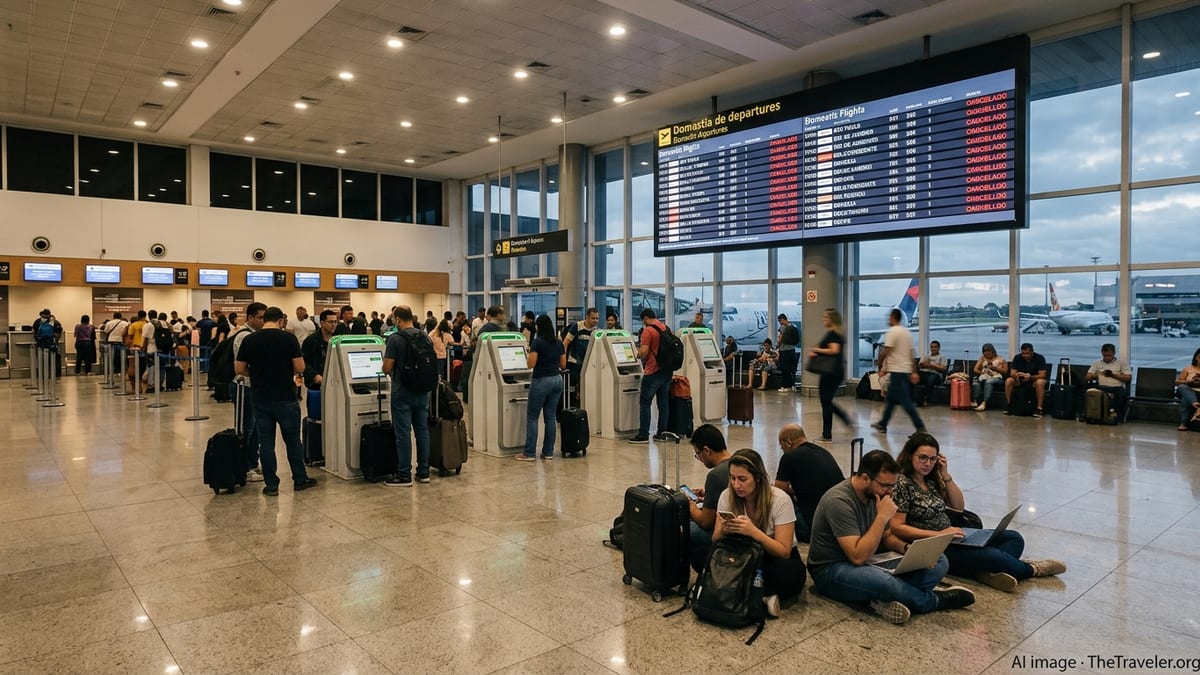
Key Routes Hit Across Brazil’s Busiest Corridors
The latest wave of cancellations has concentrated on Brazil’s densest air corridors, where Azul, Gol and TAM collectively carry a large share of domestic passengers. Routes into São Paulo’s Guarulhos and Congonhas airports, Rio de Janeiro’s Santos Dumont and Galeão, and Belo Horizonte’s Confins have reported multiple cancellations within a short window, shrinking capacity during already busy travel periods.
Publicly available airport data and published coverage indicate that services linking São Paulo with Brasília, Recife, Salvador and other major Northeast hubs have been among the most affected. Travelers on these trunk routes increasingly rely on frequent daily departures, so the removal of several frequencies in a single day can quickly ripple through onward connections.
Regional links feeding these hubs have also been impacted. Azul’s network of smaller city connections into São Paulo and Belo Horizonte, along with Gol and TAM’s shuttle-style flights between Rio de Janeiro and São Paulo, form the backbone of domestic connectivity. When even a handful of these legs are cancelled, same-day business trips and tight domestic connections become far more difficult to sustain.
Passengers have reported last-minute changes showing up on airline apps and airport departure boards, with some flights first marked as delayed and later reclassified as cancelled. As a result, travelers are facing longer layovers, unexpected overnight stays, and in some cases the need to completely re-route via alternative cities.
Operational Strain, Weather and Network Adjustments Cited
While the precise cause of each cancellation differs, a combination of factors appears to be exerting pressure on Brazil’s domestic networks. Seasonal thunderstorms around São Paulo and Rio de Janeiro, routine air traffic congestion, and ongoing aircraft rotations have all been identified in public reporting as common triggers for schedule disruptions in the country’s busiest airspace.
Azul, Gol and TAM operate complex domestic networks in which a single delayed aircraft can affect several subsequent legs. When knock-on delays become too great, airlines frequently cancel later sectors in order to reset schedules and avoid overnight crew and aircraft dislocations. This pattern is particularly visible on high-frequency routes, where carriers may remove one or two flights while maintaining others on the same city pair.
Network and fleet optimization decisions are also shaping the current disruption. Brazil’s carriers have been fine-tuning their domestic capacity in response to shifting demand, fuel prices and aircraft availability. In practice, this sometimes means consolidating lightly booked flights onto a smaller number of departures, leading to cancellations announced within days or hours of departure and leaving travelers to be re-accommodated.
Technical checks and routine maintenance can add further constraints. With aircraft utilization high on peak days, even minor mechanical issues can cascade into cancellations if spare aircraft are not readily available. Publicly available information shows that Brazil’s airlines have been working with relatively tight fleets on certain routes, leaving less margin to absorb unexpected problems.
Impact on Travelers and Popular Tourist Itineraries
The disruption has been felt not only by domestic business travelers but also by international visitors using São Paulo, Rio de Janeiro, Brasília and Recife as gateways to Brazil’s interior and coastal resorts. Many typical itineraries rely on same-day domestic connections from long-haul flights, and cancellations on connecting legs can leave visitors stranded far from their final destination.
Routes into Recife and Salvador from São Paulo and Rio de Janeiro, which are frequently used by leisure travelers heading to Northeastern beaches, have seen particular strain when flights are pulled from the schedule. Travelers connecting onward to smaller destinations via Belo Horizonte or Brasília have also faced challenges, as missed domestic links often mean waiting until the next day for an available seat.
Reports from passengers suggest that rebooking options can vary significantly depending on the airline, fare type and time of day. Some travelers have secured same-day alternatives on different airlines or via longer routings through intermediate hubs, while others have had to accept hotel vouchers or refunds and reorganize their trips at short notice.
For those planning multi-city journeys inside Brazil, the current pattern of cancellations underscores the importance of longer connection windows, flexible accommodation bookings and travel insurance that specifically covers schedule disruption. Even on routes typically served by several daily flights, last-minute cancellations can sharply narrow the list of workable alternatives.
Major Hubs Under Pressure as Airlines Manage Capacity
Brazil’s largest hubs are bearing the brunt of the adjustments as Azul, Gol and TAM juggle capacity and punctuality. São Paulo’s Guarulhos, the country’s primary international gateway, and Congonhas, the busy in-city airport favored by business travelers, have both seen clusters of cancellations in short time frames, affecting departures to Belo Horizonte, Brasília, Rio de Janeiro and various regional centers.
Rio de Janeiro’s Santos Dumont, known for its shuttle flights to São Paulo, is especially sensitive to operational disruptions. The airport’s short runway, dense schedule and frequent weather-related constraints leave limited room to recover when multiple departures are delayed or cancelled. On days with significant schedule changes, passengers can encounter crowded customer service desks and scarce open seats on remaining flights.
Further inland, Brasília and Belo Horizonte act as important redistribution points for passengers heading to smaller cities. When cancellations occur on feeder services into these hubs, travelers risk missing onward flights that may operate only once or twice a day. In some cases, airlines have shifted passengers to alternative routings through São Paulo or Rio de Janeiro, lengthening total travel time but preserving same-day arrival.
Recife has also emerged as a focal point in the recent disruption, due to its role as a gateway to Brazil’s Northeast and nearby island destinations. The cancellation of even a few São Paulo or Rio de Janeiro services can lead to backlogs, as seats on remaining flights quickly sell out and travelers compete for limited rebooking options.
What Passengers Can Do Before and During Their Trip
Frequent travelers within Brazil have long advised building extra time into itineraries that rely on critical domestic connections, and the latest wave of cancellations reinforces that guidance. Allowing several hours between a long-haul arrival and a domestic departure can reduce the risk of misconnection if the onward flight is delayed or cancelled.
Checking flight status regularly in the 24 hours before departure is another practical step, as cancellations sometimes appear first on airline apps or airport websites. If a disruption is flagged early, travelers may be able to contact the airline, adjust their route or modify hotel and transfer arrangements with fewer penalties.
Public consumer guidance in Brazil also emphasizes the value of keeping all documentation related to disrupted journeys, including boarding passes, receipts and written notices of cancellations. These records can be important when seeking refunds, compensation or reimbursement for additional expenses such as meals and accommodation incurred as a result of schedule changes.
Finally, travel planners recommend that passengers with essential same-day commitments, such as cruises, tours or events, consider arriving in the departure city at least one day early. Given the current pattern of cancellations affecting routes into São Paulo, Rio de Janeiro, Belo Horizonte, Brasília and Recife, building in this buffer can provide crucial resilience when Brazil’s domestic air network comes under strain.