

More news on this day
As war-driven airspace closures strand more than a million travelers across the Gulf, wealthy tourists and expatriates in Dubai, Abu Dhabi and Doha are paying unprecedented sums for last-minute private jets and overland escape routes out of the region.
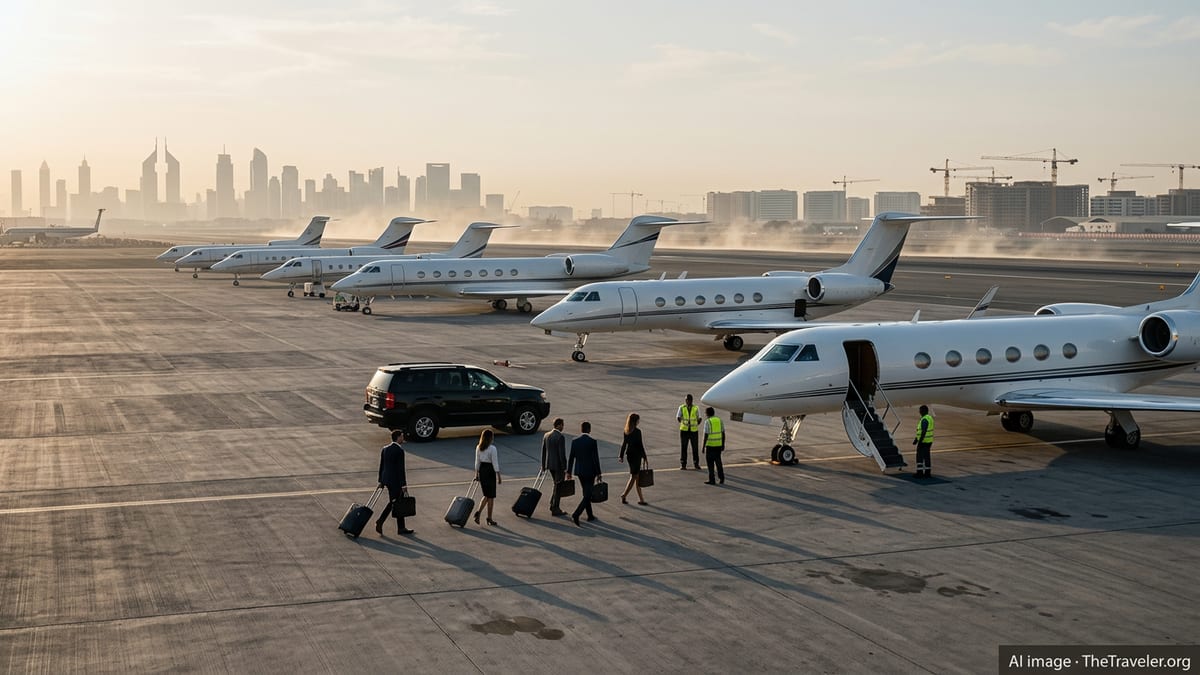
Airspace Shutdown Turns Gulf Hubs Into Gridlocked Islands
Since February 28, cascading airspace restrictions across the Middle East have choked off commercial traffic at three of the world’s most important transit hubs: Dubai, Abu Dhabi and Doha. Data from aviation analysts shows thousands of flights canceled or diverted in just a few days, with overall cancellation rates in the region spiking as airlines scramble to reroute planes and crews.
Dubai International Airport, normally one of the busiest gateways on the planet, has been operating at a fraction of its capacity after Iranian missile and drone strikes damaged infrastructure and triggered sweeping safety reviews. Abu Dhabi has seen its national carrier suspend all regular passenger flights until at least March 5, while Qatar’s airspace has largely remained closed to commercial traffic, effectively isolating Doha’s flagship airport.
The shock to these interconnected hubs has rippled far beyond the Gulf. Long-haul services between Europe, Asia and Africa that rely on Dubai, Abu Dhabi and Doha as key stopover points have been disrupted, leaving travelers stranded mid-journey or marooned in resort hotels and on cruise ships anchored off the Emirati coast.
Airlines from Europe and Asia have issued rolling suspensions and detours as military activity continues, warning that the process of repositioning aircraft and crews will take days, if not weeks, even under the best-case security scenario.
Six-Figure Evacuation: Private Jet Prices Break Records
Against this backdrop of shuttered terminals and packed airport parking lots, demand for private aviation has exploded. Charter brokers report an avalanche of inquiries from high-net-worth individuals, corporate executives and luxury travelers desperate to secure a guaranteed way out of Dubai, Abu Dhabi and Doha.
Industry executives say that what might once have been a $40,000 to $60,000 charter from the Gulf to Europe is now being quoted at two or three times that price. Brokers describe light jet evacuations from secondary airports such as Muscat or Riyadh to Istanbul selling for close to $100,000, while larger “heavy” jets on similar routes have climbed to about $140,000 or more.
On the most in-demand sectors, prices have soared even higher. Some routes from Riyadh and other relatively unaffected airports to major European capitals are reportedly trading at up to $200,000 to $350,000 per flight, particularly when operators must reposition aircraft from outside the region and absorb higher insurance and risk premiums.
The spike is being driven by a brutal mismatch between supply and demand. Many locally based business jets are trapped at closed or damaged airports, leaving brokers reliant on aircraft flying in from Europe, Central Asia or North Africa. With operators wary of the volatile security environment and insurers tightening conditions, only a limited number of crews are willing to accept last-minute evacuation missions into or near the Gulf.
From Dubai to Muscat and Riyadh: Long Drives to Open Runways
For those able to pay, the emergency private jet exodus often begins not on the tarmac but on the highway. With Dubai and Abu Dhabi offering only a handful of tightly controlled departures, affluent travelers are hiring chauffeured SUVs and private security convoys to cross borders into Oman and Saudi Arabia, where airspace has been less disrupted.
Muscat, around four and a half hours’ drive from Dubai under normal conditions, has emerged as a critical pressure valve. Its airport remains open, though heavily congested, with commercial flights to Europe frequently sold out for days. Private jet operators are funneling clients through the Omani capital, even as road journeys lengthen due to security checkpoints and long queues at border crossings.
Riyadh has become another key escape route. Travelers report 8 to 10 hour overnight drives across the desert from the United Arab Emirates to the Saudi capital, often arranged by risk-management firms accustomed to moving executives in conflict zones. From there, clients board charters to London, Istanbul, Rome and other European gateways, or connect onward via whatever commercial services remain operational.
These overland journeys bring their own complications. Travelers describe hours of idling at crowded border posts, rapidly shifting entry rules and the need for visas or visa-on-arrival eligibility that not all nationalities possess. Yet for those with the right passports and deep enough pockets, reaching an open foreign runway has become the only realistic path out in the short term.
Stranded Majority Versus the Private Jet Minority
While images of Gulf skylines dotted with business jets attract global attention, private aviation remains a lifeline for only a tiny fraction of those affected by the crisis. Aviation data suggests more than a million passengers have had their flights canceled or severely disrupted since strikes began, with British, European and Asian holidaymakers, migrant workers and business travelers all caught up in the turmoil.
Most of those people are not chartering private aircraft. Instead, they are queuing at airline service desks, rebooking repeatedly as schedules shift, or waiting in hotel rooms paid for by carriers and local authorities. Some cruise passengers remain stuck offshore as port and air connectivity fluctuate, while backpackers and budget travelers find themselves in the same holding pattern as luxury tourists whose itineraries have abruptly collapsed.
Travel insurers and consumer-rights organizations are fielding rising complaints from those who fear being left behind as the wealthy book their way out. Analysts point out that while airlines are responsible for passenger care in many jurisdictions, large-scale geopolitical crises can strain those obligations, especially when governments are simultaneously organizing their own repatriation flights.
The sharp divide between those who can buy an emergency exit and those who cannot has become a defining image of this Gulf travel crisis: airport lounges where economy passengers huddle over phone chargers while, a few floors away, brokers finalize six-figure contracts for private jets that will leave within hours.
What Comes Next for Gulf Travel and Global Aviation
Aviation experts warn that even once airspace restrictions ease, the recovery of normal schedules at Dubai, Abu Dhabi and Doha will not be instantaneous. Airlines must inspect aircraft, reposition fleets and crew, and absorb an immense backlog of stranded passengers. Slots at alternative airports in Oman, Saudi Arabia and beyond are already stretched, complicating efforts to add rescue flights.
The crisis is likely to trigger a broader reassessment of risk among both airlines and travelers. Carriers may diversify routings to reduce reliance on single hubs, while corporate travel managers revisit contingency plans for executives based in or frequently transiting through the Gulf. For the private aviation sector, the surge in demand has highlighted its role as an emergency escape valve, but also its vulnerability when frontline airports are suddenly taken offline.
For now, the sight of convoys heading out of Dubai, Abu Dhabi and Doha toward open runways in neighboring countries captures the mood of a region on edge. In the skies above, each departing private jet underscores the same message: in a conflict-driven travel crisis, the ability to leave quickly has become a luxury few can afford.