

More news on this day
Domestic air travel across Japan faced renewed disruption today as publicly available flight status data showed at least 27 cancellations and more than 200 delays affecting services operated by ANA Wings, All Nippon Airways, Solaseed, Ibex Airlines, Jetstar Japan and other carriers at airports in Tokyo, Naha, Sapporo, Kagoshima and Sendai.
Get the latest news straight to your inbox!
Multiple Carriers Curb Operations Across Key Japanese Hubs
According to published coverage drawing on live airport and flight-tracking information, the latest wave of disruption has rippled through much of Japan’s domestic airline network, impacting both full-service and low-cost operators. Private and public data sources indicate that regional specialist ANA Wings, its parent All Nippon Airways, Solaseed, Ibex Airlines and Jetstar Japan are among the most heavily affected airlines, alongside several smaller domestic partners.
Services have been curtailed on some of the country’s busiest routes, including high-frequency shuttles linking Tokyo with Sapporo, Kagoshima and other regional centers. Airports in Naha and Sendai have also reported thinning departure boards as airlines consolidate schedules in response to tighter operational margins and intermittent weather issues.
Reports indicate that the 27 flight cancellations are spread across a mix of trunk and regional routes, reducing connectivity between major hubs and secondary cities. While the total represents a small fraction of Japan’s daily flight program, the clustering of cancellations around peak travel periods has magnified the impact on passengers.
The more than 200 delays recorded today add a further layer of strain, with knock-on effects for aircraft rotations and crew scheduling. Even modest initial delays on early-morning departures have, in some cases, cascaded into extended hold-ups for services operating later in the day.
Tokyo, Naha, Sapporo, Kagoshima And Sendai See Strained Schedules
Tokyo’s Haneda and Narita airports, which together anchor Japan’s domestic and international connectivity, remain central to the pattern of disruption. Publicly available departure boards show gaps in usual shuttle frequencies, particularly on sectors to and from Sapporo’s New Chitose Airport and Kagoshima, where ANA-affiliated airlines and their competitors typically operate tightly timed waves of flights.
In Okinawa, Naha Airport has recorded both cancellations and rolling delays that affect links to the main islands as well as inter-island services. Airline timetable data for recent seasons highlights how carriers like All Nippon Airways, ANA Wings and Solaseed rely on Naha as a key southern hub, meaning any instability there can rapidly spread through their domestic networks.
Further north, Sapporo’s New Chitose and the regional gateway of Sendai have reported disrupted operations that affect not only direct services to Tokyo but also onward domestic connections. Kagoshima, a vital access point for southern Kyushu and nearby islands, has experienced a notable share of delays relative to its usual daily schedule, amplifying the effect on local tourism and business travel.
The simultaneous involvement of these geographically dispersed airports underscores how sensitive Japan’s high-density domestic network can be to operational shocks, even when the absolute number of cancellations remains limited.
Weather, Congestion And Operational Challenges Combine
Recent coverage from aviation-focused outlets across Asia points to weather fluctuations, airspace congestion and routine operational challenges as contributing factors behind the latest disruptions. Poor visibility, wind shifts and localized storms periodically constrain runway capacity at key hubs, prompting air traffic management measures that slow arrivals and departures.
Once morning traffic banks are disrupted, airlines are often left juggling aircraft and crew assignments for the remainder of the day. In a country where many domestic routes operate on tight turnarounds and rely heavily on shared fleets between mainline and regional subsidiaries, even brief interruptions can lead to longer-than-expected delays later in the schedule.
Japan’s carriers have also been navigating a period of high demand set against the gradual rebuilding of staffing and fleet resources. Publicly available operational statistics over recent months show elevated levels of delays across parts of the domestic market, suggesting that networks are still operating with limited slack. This leaves operators more vulnerable when confronted with sudden bouts of adverse weather or technical issues.
In some recent cases, published incident reports have described aircraft requiring additional inspections after technical alerts, which can temporarily remove aircraft from rotation. When these events coincide with congested travel days, the consequences can extend beyond the immediate route to impact a chain of subsequent flights.
Impact On Travellers And How Passengers Are Adapting
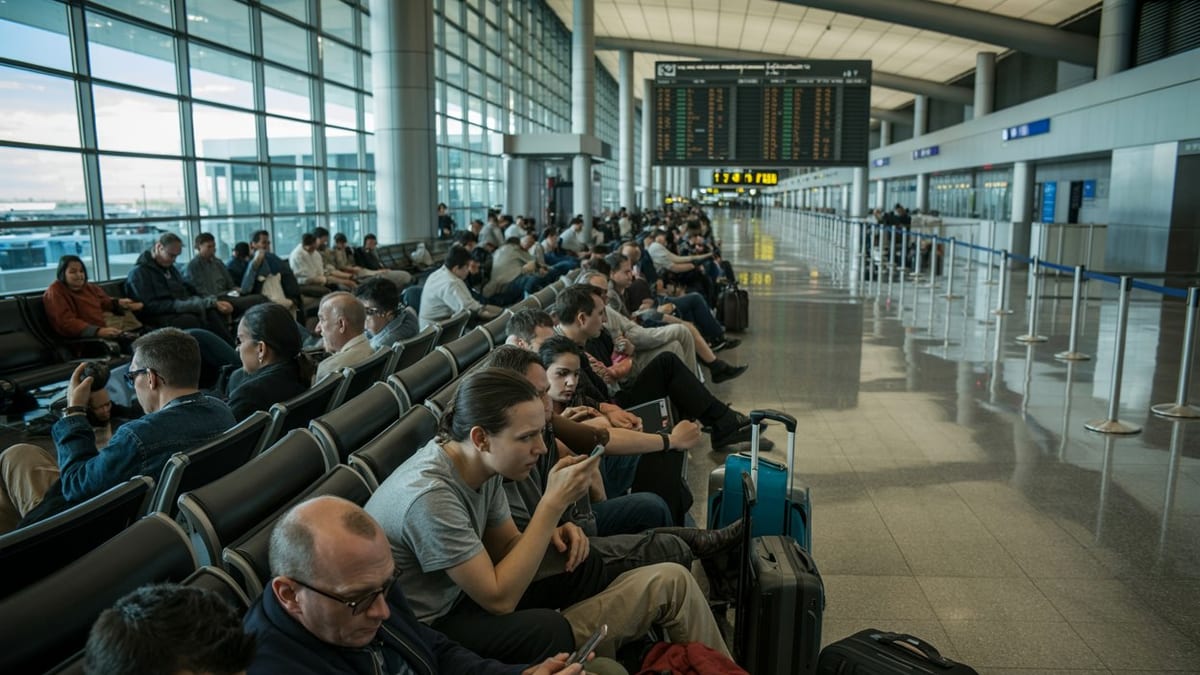
The immediate effect for travellers has been longer queues at check in, security and customer service desks, as well as crowded departure lounges at the affected airports. Passengers whose flights were cancelled have in many cases been rebooked onto later services or routed via alternative hubs, but limited remaining seat capacity has meant that same-day options are not always available.
Publicly accessible guidance from airlines and Japanese aviation information portals consistently encourages passengers to monitor flight-status tools closely on the day of travel. Mobile applications, airport information screens and third-party tracking platforms have become central resources for travellers seeking to understand whether their service is likely to operate on time or face rolling delays.
Some travellers are adjusting plans by building longer connection times into itineraries that involve transfers between domestic and international flights, particularly through major hubs such as Tokyo and Sapporo. Others are opting for earlier departures in an effort to reduce the risk of missing later commitments if disruptions accumulate through the day.
Travel forums and consumer reports over recent months reflect a growing awareness that even in a market known for punctuality, domestic flight operations can be vulnerable to bouts of large-scale disruption. Passengers are increasingly factoring this into decisions about whether to fly, take rail alternatives on certain corridors, or adjust the timing of important meetings and events.
What Travellers Should Watch In The Coming Days
As airlines work to normalize their schedules, observers expect that the bulk of today’s disruption will be absorbed within one to two operational days, provided there are no further major weather systems or technical issues. However, public data from earlier episodes of irregular operations across Asia indicates that residual delays can linger if fleets and crews are left out of position.
For passengers planning domestic trips within Japan over the coming days, travel industry coverage suggests several practical steps. These include checking reservation details repeatedly in the 24 hours before departure, confirming the operating carrier on codeshare flights and monitoring airport-specific announcements for any emerging patterns of delay.
Travellers connecting through Tokyo, Naha, Sapporo, Kagoshima or Sendai may wish to consider longer buffer times, particularly when onward international flights are involved. Given the concentration of disruptions at these hubs, schedule changes on one leg can quickly affect subsequent segments, especially on itineraries involving multiple domestic hops.
While overall cancellation numbers remain relatively low compared with the total volume of flights across Japan, the involvement of major brands such as ANA Wings, All Nippon, Solaseed, Ibex and Jetstar Japan underlines how even modest network interruptions can create a challenging travel day for thousands of passengers spread across the country.