

More news on this day
Travelers passing through Newark Liberty International Airport faced another bout of disruption as eight flights were cancelled and 93 delayed, snarling itineraries for Spirit, JetBlue, Delta, and United passengers across New York, New Jersey, and a web of connecting US cities.
Get the latest news straight to your inbox!
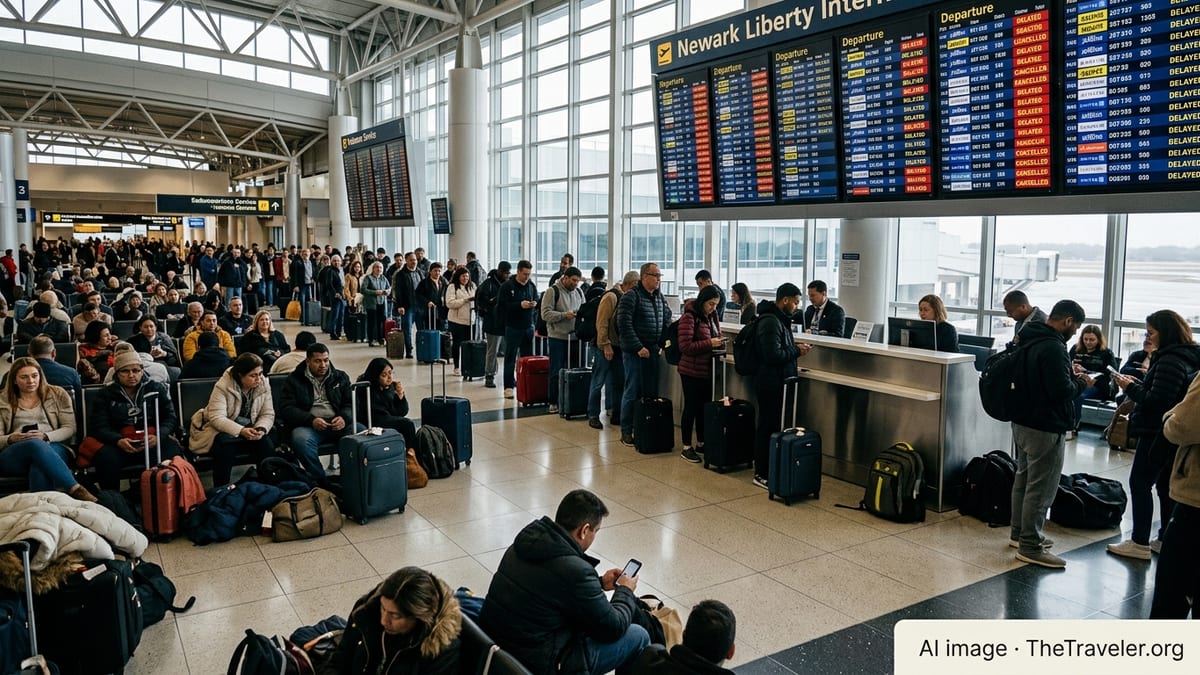
Wave of Disruptions Hits a Major Northeast Gateway
Newark Liberty International Airport, one of the primary air gateways for the New York metropolitan area, experienced a concentrated burst of disruption as multiple carriers reported cancellations and significant delays. Publicly available flight-tracking data indicated that a total of eight flights were cancelled and 93 delayed, affecting operations across Spirit, JetBlue, Delta, and United.
The disruption cluster at Newark came as the airport continued to grapple with its reputation for congestion and operational strain. In recent years, government performance reports and consumer aviation data have consistently placed Newark among the more delay-prone major US hubs, particularly during peak travel periods and in adverse weather conditions.
While large-scale meltdowns at individual carriers often draw national attention, these smaller waves of cancellations and delays can be just as frustrating for travelers. With four prominent airlines affected, the impact spread quickly through regional and national networks, leading to missed connections and overnight rebookings as passengers tried to reach destinations from Florida and the Midwest to the West Coast.
Reports from flight data services suggested that the disruptions were not confined to a single airline or route pattern, underscoring how quickly bottlenecks at Newark can ripple through multiple carriers that share the same constrained airspace and runway capacity.
Weather, Airspace Congestion, and Staffing Pressures
Newark’s operational challenges are frequently tied to a combination of weather, airspace congestion, and controller staffing issues in the busy Northeast corridor. Published coverage in recent months has highlighted how the Federal Aviation Administration’s traffic management programs, designed to keep aircraft safely spaced in crowded skies, can quickly translate into ground stops and extended delays at Newark when storms or low visibility move through the region.
Industry analyses and prior transportation department reports describe how even modest disruptions in the New York area can force airlines to slow arrivals into Newark, triggering cascading delays. When schedules are already tight and aircraft utilization is high, a few hours of reduced arrival rates can leave carriers with limited flexibility to absorb the shock, resulting in rolling delays and targeted cancellations like the eight Newark flights that did not operate.
Staffing in key air traffic control facilities serving the New York region has also been a recurring concern. Public reporting has noted that lower staffing levels at some centers can intensify the impact of difficult weather days, prompting more aggressive flow-control measures that directly affect airports such as Newark. Although the specific trigger for this latest wave of disruptions was not immediately isolated in public sources, the pattern closely resembled prior episodes where adverse weather and constrained controller capacity combined to slow the system.
For travelers, the underlying cause often matters less than the practical outcome. Extended waits on the tarmac, repeated schedule revisions on mobile apps, and last-minute cancellations remain familiar experiences at Newark, especially for those who transit the airport regularly for business or family travel.
Multi-Airline Impact Across Spirit, JetBlue, Delta, and United
The disruptions were notable for spanning four prominent airlines that all maintain a significant presence at Newark. United operates a major hub at the airport, while Spirit, JetBlue, and Delta use Newark as an important spoke in their broader domestic and international networks. Publicly accessible operations data and recent coverage of Newark’s performance show that, on difficult days, all of these carriers can see their reliability metrics strained simultaneously.
Spirit and JetBlue, both known for dense leisure-focused schedules along the East Coast and to Florida, are particularly vulnerable when the New York area encounters convective storms or low ceilings. Historical records from transportation authorities list several routes involving Newark where these carriers have previously recorded high percentages of delayed arrivals and occasional cancellations, illustrating how repeated weather patterns can leave the same city pairs exposed.
Delta, which runs a more limited schedule from Newark compared with its operations at LaGuardia and John F. Kennedy, can nonetheless be drawn into the turbulence when regional aircraft and connecting flights route through the airport during irregular operations. Even a small number of cancellations at Newark can disrupt passengers traveling onward to the carrier’s hubs in cities such as Atlanta, Detroit, or Minneapolis.
United often carries the largest share of the burden during Newark disruptions because of its hub status and high daily frequency. Past reporting on major delay events has documented how United has, at times, responded by trimming schedules from Newark to relieve congestion. When a disruption wave hits, passengers on shorter regional hops, including flights within the Northeast and Mid-Atlantic, can be among the first to feel the impact as airlines prioritize longer-haul operations and international departures.
New York, New Jersey, and Beyond: Travelers Scramble
The latest cancellations and delays at Newark affected not only local travelers from New Jersey, but also large numbers of passengers originating in New York City and neighboring states who rely on the airport as an alternative to LaGuardia and John F. Kennedy. With the New York metropolitan area serving as one of the country’s most important domestic and international transfer points, disruptions at Newark can quickly extend to fliers who never intended to set foot in the region.
According to publicly available flight-tracking information, the mix of impacted flights included both origin-and-destination routes and connections that form part of longer itineraries across the United States. Travelers heading to or from cities such as Chicago, Orlando, Dallas, and Las Vegas can experience knock-on effects when Newark-based aircraft and crews are out of position, forcing last-minute aircraft swaps or schedule changes elsewhere in the network.
As cancellation and delay counts climbed, passengers reported on social platforms that they were seeking alternate routes via other New York area airports, rebooking through hubs like Philadelphia or Boston, or, in some cases, abandoning travel plans altogether. Such reactions are consistent with patterns seen in earlier irregular-operation periods at Newark, where travelers often pivot quickly to rail or intercity bus services along the busy Northeast Corridor when flights become unreliable.
The timing of disruptions can be particularly painful for travelers trying to reach major events, family gatherings, or tight business commitments. When flights are cancelled late in the day and rebooking options are limited, overnight stays at airport hotels and lengthy customer service lines are common features of the Newark experience, as documented repeatedly in consumer accounts and travel-industry reporting.
What Disrupted Passengers Can Do Next
For those affected by the eight cancellations and dozens of delays, next steps typically involve understanding airline policies and exploring alternative routes. Consumer guidance published by the US Department of Transportation and various traveler advocacy groups recommends that passengers first confirm whether their disruption is classified as within the airline’s control, such as a crew or maintenance issue, or the result of factors like weather or air traffic control programs.
When a cancellation or severe delay is deemed within the airline’s control, flyers on Spirit, JetBlue, Delta, and United may have access to specific forms of assistance that can include meal vouchers, hotel accommodations, or rebooking on the next available flight at no additional fare. Publicly posted customer service commitments and airline dashboards, referenced in recent coverage, outline what each carrier voluntarily provides in different scenarios.
In weather or airspace-related cases, compensation may be more limited, but travelers are often still entitled to a refund if a flight is cancelled and they choose not to travel. Passenger-rights resources emphasize the importance of documenting disruption details, monitoring real-time flight status tools, and, when possible, proactively searching for alternative routings while in contact with an airline’s app, call center, or airport agents.
For regular users of Newark Liberty, many seasoned travelers have adjusted their strategies: building in longer connection times, opting for earlier departures when possible, and closely watching forecast and operational updates before heading to the airport. As eight cancellations and 93 delays again demonstrated, even a relatively modest disruption event at Newark can quickly reshape travel plans for passengers across New York, New Jersey, and far beyond.