

More news on this day
Winter weather and operational knock-on effects caused a fresh wave of air travel disruption across Europe on Friday, with airports in Switzerland, Denmark and Germany reporting 214 delayed and 12 cancelled flights, snarling operations for Wizz Air, KLM, Eurowings and several other carriers at hubs including Geneva and Hamburg.
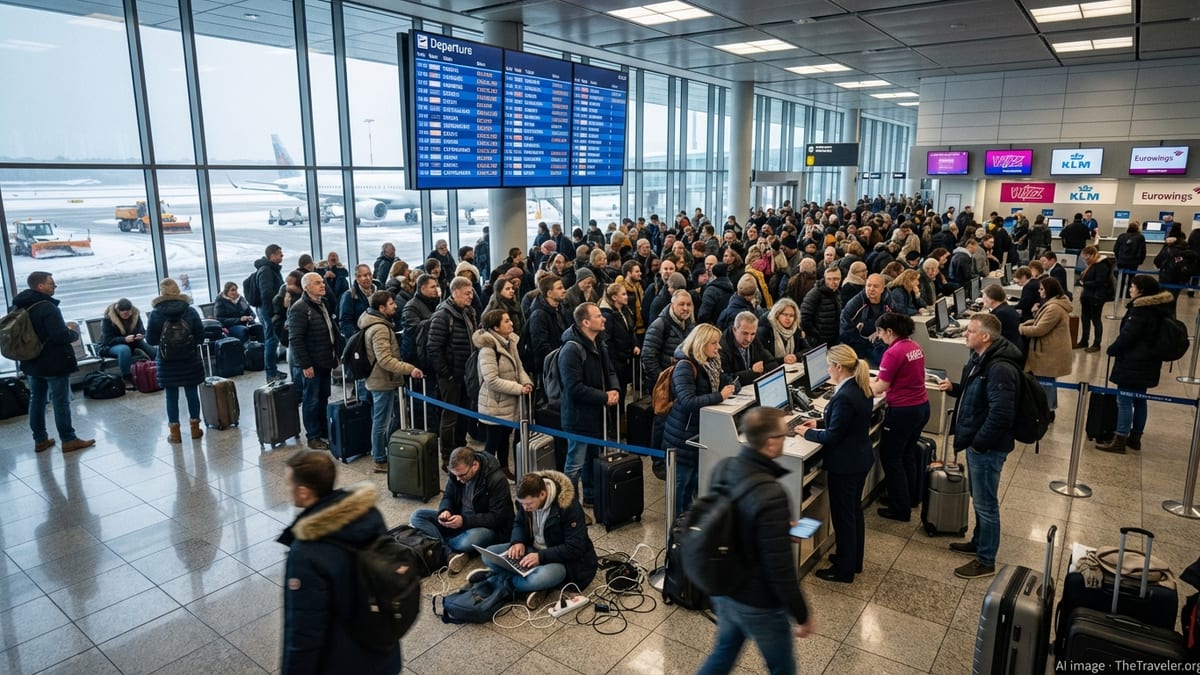
Stormy Conditions Add Fresh Strain to Europe’s Winter Schedules
Friday’s disruption capped a difficult stretch for European aviation as snow, freezing rain and low cloud again hampered flight operations across parts of central and northern Europe. Aviation data from regional monitoring services indicated that airports in Switzerland, Denmark and Germany saw a higher-than-normal rate of delays through the morning and early afternoon, with late-arriving aircraft and de-icing queues rippling through schedules.
While the overall number of affected flights was modest compared with larger region-wide shutdowns earlier this winter, the impact was acute at several busy mid-sized hubs. Geneva and Hamburg, in particular, experienced tightly bunched departure banks that were pushed back by weather-related ground handling constraints, slot restrictions and reduced arrival rates imposed by air traffic control.
The latest wave of disruption follows a severe storm pattern earlier in February that brought widespread delays and cancellations to major airports across the Netherlands, Germany and the United Kingdom. Airlines and airport authorities have warned that volatile winter systems are likely to continue intermittently through late February, keeping operations fragile and subject to sudden schedule changes.
Passengers travelling through affected countries on Friday were urged to arrive earlier at airports, be prepared for long queues at check in and security, and rely heavily on airline apps for real-time updates as departure boards changed rapidly through the day.
Geneva and Hamburg Among Hardest-Hit Airports
Geneva Airport once again found itself at the centre of weather-related travel headaches, with early snow showers and low visibility compounding existing congestion from the morning rush. De-icing backlogs narrowed departure slots for outbound traffic, while arriving flights were absorbed more slowly than normal, with some aircraft entering holding patterns or being forced to wait on the ground before docking.
Hamburg, meanwhile, wrestled with a different but related set of challenges. While visibility remained adequate for operations, a combination of earlier weather disruptions elsewhere in Germany and northern Europe resulted in late inbound aircraft, compressing the afternoon schedule. Ground crews faced a tight turnaround window as short-haul flights arrived behind schedule from hubs such as Frankfurt, Amsterdam and Copenhagen.
Airport statistics from Hamburg show that on a typical day the facility manages around 214 flights, with roughly one third of them running late during periods of winter weather. On Friday, the proportion of flights pushed back from their scheduled departure times climbed again, and while the number of outright cancellations remained limited, passengers faced lengthy waits as aircraft were repositioned and crews reached their duty-time limits.
Similar scenes were reported at other regional airports in Germany and Switzerland, where smaller fields with limited runway capacity were forced to slow operations, building queues that took much of the day to unwind. In Denmark, Copenhagen’s role as a connecting hub meant even minor delays created knock-on effects across Scandinavia and the Baltic region.
Wizz Air, KLM, Eurowings and Others Face Operational Headaches
Among the carriers most visibly affected on Friday were Wizz Air, KLM and Eurowings, all of which have dense short-haul networks across Europe that are particularly vulnerable to cascading delays. Low-cost and hybrid airlines that depend on quick turnarounds are often hit hardest when weather conditions require extended de-icing procedures or when air traffic control reduces arrival and departure rates.
For Wizz Air, which has built significant operations linking central and eastern Europe with hubs like Geneva and secondary German cities, schedule planners were forced to juggle aircraft and crews as early-morning disruptions in one part of the network knocked subsequent rotations out of sync. Some flights were held on the ground while others were rerouted or combined, leaving passengers facing uncertainty at departure gates.
KLM, already managing an intense winter at Amsterdam Schiphol, saw connecting itineraries stretched as delays radiated outward from the Dutch hub into Germany and Switzerland. Passengers booked on multi-leg journeys via Amsterdam faced missed connections and were frequently rebooked onto later services, often with overnight stays or lengthy layovers.
Eurowings, a key player in Germany’s point-to-point market, also grappled with unsettled schedules. The airline has recently experienced a series of weather and operational disruptions across its network, and Friday’s events added pressure as it worked to keep domestic and regional services running on time between cities such as Hamburg, Cologne and Düsseldorf.
Passengers Confront Long Queues, Missed Connections and Limited Information
For travellers on the ground, the practical impact of 214 delays and 12 cancellations went far beyond statistics. At airports from Geneva to Hamburg, passengers reported long queues at airline service desks, limited seating in boarding areas and crowded security checkpoints as departure times shifted repeatedly.
Many European airports have encouraged passengers to rely more heavily on mobile notifications and self-service tools rather than lining up at counters, but in times of severe disruption, digital channels often struggle to keep pace with fast-changing operational decisions. In some cases, apps refreshed with new departure times only minutes before boarding, giving travellers little chance to reorganise their onward plans.
Families and business travellers alike faced missed connections to long-haul flights, particularly where tight transfer windows through major hubs were part of their itineraries. Some passengers arriving late into Amsterdam or Frankfurt from Switzerland and Denmark discovered that their onward flights to North America, Asia or Africa had already departed, forcing them to wait for the next available service.
Hotels near major hubs quickly filled with stranded passengers, while rail alternatives were limited in areas where winter conditions also affected ground transportation. In parts of Germany, icy tracks and weather-related speed restrictions slowed trains, reducing the viability of last-minute switches from air to rail.
Airlines Activate Rebooking Options and EU261 Rights Come Into Focus
As delays mounted on Friday, airlines across Europe escalated their rebooking and disruption-management procedures. Wizz Air, KLM, Eurowings and other affected carriers issued travel alerts encouraging passengers to check flight status before leaving for the airport, use self-service platforms to change their travel dates where possible, and consider accepting travel vouchers if their plans were flexible.
Travel agents and passenger-rights advocates reported an uptick in queries from travellers seeking clarification on their entitlements under European Union Regulation 261, the framework that governs compensation and assistance for flight disruptions in Europe. Under EU261, passengers may be eligible for meals, accommodation and, in some circumstances, financial compensation when their flights are significantly delayed or cancelled, depending on the cause of the disruption and the distance of the journey.
However, when disruption is directly linked to extraordinary circumstances such as severe weather that is genuinely beyond an airline’s control, compensation payments are often not required, even though airlines must still provide care and assistance. That grey area can be confusing for passengers, particularly when operational decisions or crew-availability issues compound an initial weather delay.
Several independent claim services reported growing interest from passengers on recent Eurowings and other European flights who experienced cancellations or long delays earlier in February. Friday’s events are likely to add to that trend as travellers look for ways to recoup at least some of the costs stemming from last-minute hotel stays, missed events and lost working time.
Broader Pattern of Winter Disruptions Across the Continent
The latest disruption in Switzerland, Denmark and Germany fits into a broader pattern of weather-related instability that has marked the European winter travel season. Since early January, a series of storms has brought heavy snow, strong winds and freezing temperatures to large parts of the continent, affecting not only aviation but also rail and road networks.
Earlier in the season, a major snowstorm caused more than 2,000 flight delays and around 90 cancellations across key hubs including Zurich, Athens, Amsterdam and Frankfurt, straining airline resources and leaving airports crowded with stranded passengers. Each subsequent system has added fresh stress to airlines’ operational resilience and to travellers’ confidence that schedules will hold.
Industry analysts note that European carriers have become more adept at handling winter storms than in past decades, investing in better forecasting, more flexible crew rosters and improved de-icing capacity. Even so, the combination of tight staffing, high aircraft utilisation and busy hub airports means that when weather does strike, recovery can be slow, particularly for low-cost carriers that have less spare capacity in their fleets.
For travellers, the persistent pattern has made advance planning more complicated. Travel insurers have seen heightened demand for policies that include disruption coverage, while corporate travel managers are advising employees to build in greater buffers for critical business trips and to avoid last departures of the day on routes prone to winter weather issues.
What Travellers Through Affected Hubs Should Do Next
With forecasts indicating that unsettled winter weather could continue over parts of Europe in the coming days, travellers booked to fly through Geneva, Hamburg or other regional hubs are being advised to adopt a more defensive strategy for their journeys. That starts, experts say, with monitoring the weather and flight status closely from at least 24 hours before departure and being ready to adjust plans quickly if airlines offer voluntary rebooking options in advance of storms.
Passengers are encouraged to keep their airline’s app installed and logged in, ensure contact details on bookings are up to date, and consider travelling with carry-on baggage only on short trips to allow more flexibility if flights are rerouted or aircraft types are changed at short notice. Where possible, building longer connection times into itineraries can help mitigate the risk of missed onward flights when small delays accumulate.
At the airport, arriving early remains crucial on days when disruption is likely, both to clear security and to secure limited rebooking options if cancellations become necessary. Travellers should also keep receipts for meals, ground transportation and accommodation in case they are later able to claim reimbursement or compensation from airlines or their travel insurer.
Ultimately, while Friday’s 214 delays and 12 cancellations represent only a fraction of Europe’s overall daily flight volume, the disruption illustrates how quickly winter weather can unsettle even well-planned operations. For passengers moving through Geneva, Hamburg and other key European gateways this season, a combination of vigilance, flexibility and preparation remains the best defence against a suddenly derailed itinerary.