

More news on this day
Severe weather sweeping across parts of China, Malaysia and Indonesia has triggered a fresh wave of flight disruption, with 54 cancellations and 551 delays hitting key regional routes and stranding thousands of passengers traveling on AirAsia, Batik Air, Chengdu Airlines and China Eastern.
Storm Systems Snarl Air Traffic Across Three Countries
The latest disruption unfolded between February 27 and 28, 2026, as fast-moving storm systems and persistent low cloud rolled across major aviation corridors in East and Southeast Asia. Meteorologists reported bands of heavy rain, localized thunderstorms and unstable winds, prompting air traffic controllers and airlines to slow arrivals, stretch departure intervals and, in many cases, ground aircraft for safety checks.
In China, the worst effects were felt around key hubs such as Beijing, Shanghai and Chengdu, where reduced visibility and crosswinds forced crews to hold aircraft on the ground or divert en route flights. These weather patterns quickly cascaded across domestic and regional networks, disrupting connections to and from Malaysia and Indonesia as carriers struggled to reposition aircraft and crews.
At the same time, tropical downpours and low cloud bases around Kuala Lumpur and Jakarta added another layer of complexity, particularly on evening and overnight rotations when congestion is normally at its peak. The combined impact of these weather cells, occurring within a tightly packed post-holiday schedule, magnified the operational strain on already busy airports and airlines.
By early Saturday local time, operational data compiled from airport boards and airline schedules across the three countries pointed to a total of 54 weather-related cancellations and 551 delays on affected routes, with many of the delays stretching well beyond two hours.
Key Airports and Routes Bearing the Brunt
Among Malaysian gateways, Kuala Lumpur International Airport again emerged as a critical pressure point, with a high volume of delayed departures on short-haul links to Chinese and Indonesian cities. Popular leisure and business routes to Beijing, Shanghai and Chengdu saw rolling delays as incoming aircraft arrived late, then required additional ground time before turning around.
In China, disruption radiated outward from Beijing Capital, Shanghai Pudong and Chengdu Shuangliu, where tightly banked waves of domestic flights connect onward to secondary cities. Short-haul services operated by Chengdu Airlines and China Eastern on corridors such as Yantai to Chengdu and other central and western routes were particularly exposed, with aircraft frequently held at origin or slowed by en route flow restrictions.
Indonesia’s main international gateways, led by Jakarta Soekarno-Hatta and Denpasar’s I Gusti Ngurah Rai Airport, faced intermittent operational slowdowns as storm bands swept through Java and Bali. While conditions at Bali had largely normalized after earlier extreme weather this week, knock-on effects were still visible in stretched turnarounds and late-evening departures on domestic and regional sectors.
Across the three countries, the majority of affected flights were short- and medium-haul services of two to four hours, the backbone of intra-Asian connectivity. These routes are particularly vulnerable to cascading disruption; a single delayed morning departure can ripple through multiple rotations, compounding delays for passengers boarding later in the day.
How the Disruptions Hit AirAsia, Batik Air, Chengdu Airlines and China Eastern
Low-cost giant AirAsia, with dense networks radiating out of Kuala Lumpur and across Indonesia and southern China, reported clusters of delays on high-frequency routes linking Malaysia to Jakarta, Bali and secondary Chinese cities. The airline’s point-to-point model, which relies on quick turnarounds, left crews and aircraft exposed to rolling knock-on effects once early flights slipped behind schedule.
Indonesia’s Batik Air, which operates a mix of domestic trunk routes and regional services, also suffered weather-related disruption, particularly on itineraries connecting Jakarta with secondary Indonesian cities and onward regional connections into Malaysia and China. Several rotations were canceled when aircraft and crew could not be moved into place in time for scheduled departures.
In China, Chengdu Airlines and China Eastern faced repeated holds and extended ground times at western and central Chinese airports impacted by low cloud and rain. China Eastern’s extensive domestic network, including services feeding hubs such as Kunming and Chengdu, meant that localized storms had outsized effects as delays propagated through tightly timed connection banks.
While full tallies continued to evolve into the afternoon, operational summaries reviewed by The Traveler indicated that these four carriers together accounted for a significant share of the 54 cancellations and 551 delays recorded across the three-country corridor, underscoring how vulnerable dense regional networks remain when severe weather hits multiple hubs at once.
Passenger Impact: Long Queues, Missed Connections and Limited Options
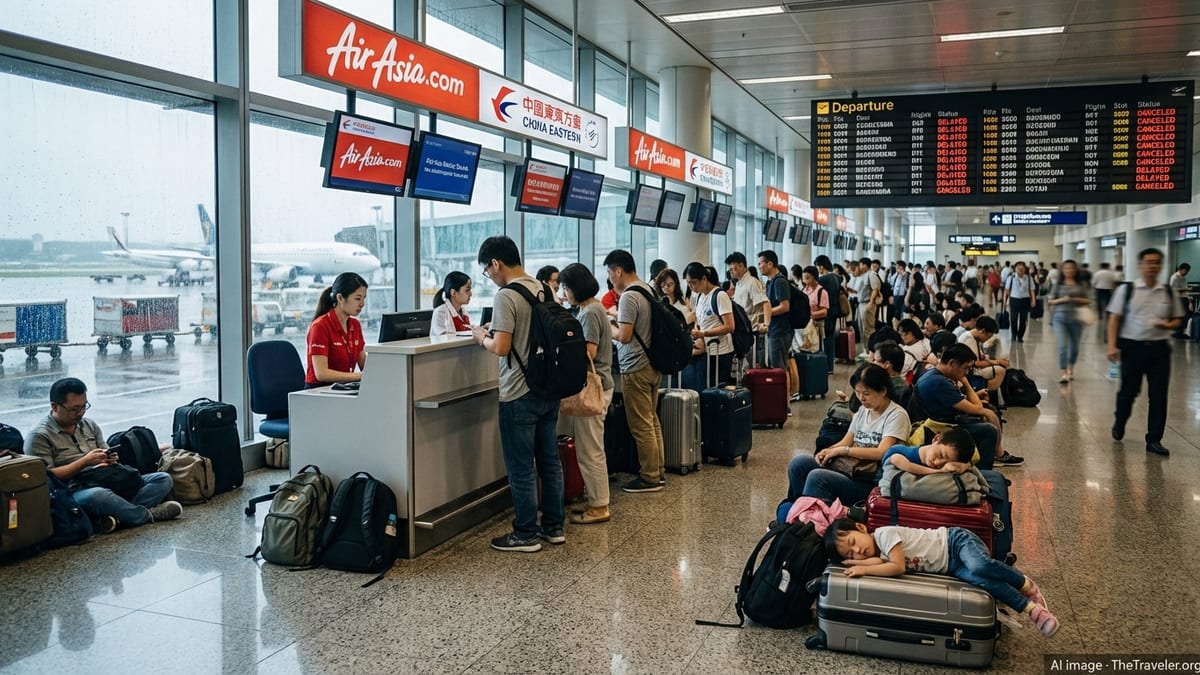
For travelers on the ground, the statistics translated into hours of uncertainty. At Kuala Lumpur, Jakarta and Chengdu, terminal departure boards were dominated by amber and red status updates as delays mounted. Long lines formed at check-in counters and airline service desks as passengers sought rerouting options, meal vouchers and hotel accommodation for missed connections and overnight layovers.
Families heading to school holidays in Bali, business travelers shuttling between Chinese manufacturing centers and Southeast Asian capitals, and migrant workers returning to job sites were all caught up in the disruption. Many faced multiple rebookings in a single day as aircraft missed their operating windows or were reassigned to higher-priority sectors.
With seats tight at the tail end of the Lunar New Year travel period, alternative options were limited. Some travelers opted to switch to slower ground or rail connections on domestic legs in China and Indonesia, while others chose to stay overnight near the airport in hopes of securing a confirmed seat the following morning.
Consumer advocates reiterated that passengers should keep boarding passes, booking confirmations and receipts for meals and hotels, noting that while weather is typically categorized as an extraordinary circumstance for compensation, many airlines still provide care and assistance in the form of refreshments, accommodation and rebooking support.
What Travelers Should Do If They Are Flying This Weekend
With weather systems forecast to remain unsettled in several of the affected regions, airlines and airports in Malaysia, China and Indonesia are urging passengers to build extra time into their travel plans over the weekend. Travelers are being advised to monitor their flight status closely via airline apps or contact centers and to arrive at the airport earlier than usual in case of longer security and check-in queues.
AirAsia and Batik Air have both encouraged customers on selected routes to consider voluntary free changes onto earlier or later flights where spare capacity exists, in an effort to spread demand more evenly across the schedule. China Eastern and Chengdu Airlines, meanwhile, have been working to swap in larger aircraft on certain trunk routes to clear backlogs of stranded passengers once weather windows open.
Experts note that travelers booked on tight self-connecting itineraries, particularly where separate tickets link low-cost and full-service carriers, face the greatest risk of missed onward connections. They recommend allowing generous buffers between flights and, where possible, consolidating bookings with a single carrier that can take responsibility for rebooking through itineraries when things go wrong.
Although the number of affected flights remains a small fraction of total daily departures across Asia, the latest wave of weather-related disruption serves as a reminder of how quickly conditions can deteriorate and how long it can take complex regional networks to recover once the storm clouds clear.