

More news on this day
Air travel across key regions of mainland China faced fresh disruption today as adverse weather in Guangdong, Sichuan, Xinjiang and Zhejiang triggered at least 45 flight cancellations and 441 delays, with publicly available aviation data indicating that China Southern Airlines, China Eastern Airlines and Shenzhen Airlines were among the most affected carriers.
Get the latest news straight to your inbox!
Storm Systems Hit Coastal and Inland Hubs Simultaneously
Meteorological reports for early April point to a combination of strong convective storms in southern China and late-season snow and sleet in the northwest, creating a difficult operating environment for airlines serving Guangdong, Sichuan, Xinjiang and Zhejiang. Heavy rainfall, thunderstorms and localized hail have been reported in parts of Guangdong and neighboring provinces, while low cloud and poor visibility continue to affect coastal corridors including sections of Zhejiang.
In parallel, forecasts highlight ongoing wintry conditions across parts of Xinjiang, with snow and mixed precipitation reducing runway friction and complicating de-icing operations. These regional contrasts have forced carriers to balance weather-related safety margins at both departure and arrival airports, often resulting in extended ground holds, go-arounds and diversion risks that ripple through already congested domestic schedules.
Operational summaries compiled from airport punctuality trackers and aviation analytics platforms suggest that the cumulative impact of these conditions has been particularly acute over the past 24 hours, feeding into a broader pattern of disruption that has affected dozens of hubs across China since late March.
China Southern, China Eastern and Shenzhen Airlines Bear the Brunt
China Southern Airlines, China Eastern Airlines and Shenzhen Airlines feature prominently in the latest disruption figures, reflecting their dense domestic networks and strong presence in the affected provinces. Aggregated flight-status data for today show at least 45 cancellations and 441 delays associated with services touching Guangdong, Sichuan, Xinjiang and Zhejiang, with these three carriers accounting for a significant share due to their hub structures and route portfolios.
China Southern’s operations are heavily concentrated in southern China, with Guangzhou and Shenzhen functioning as core hubs that link coastal cities with the country’s inland west. When thunderstorms and low-visibility conditions build over the Pearl River Delta, turnarounds slow and aircraft rotations into Sichuan and further northwest toward Xinjiang are quickly affected, pushing knock-on delays deep into the evening wave of departures.
China Eastern, meanwhile, maintains major bases at Shanghai’s airports and serves large volumes of traffic into Zhejiang and Sichuan. Congested airspace along the Yangtze River Delta and periodic restrictions tied to convective weather frequently force the airline to implement flow-control measures, including ground delays at outstations that have limited infrastructure to absorb long on-the-ground waits.
Shenzhen Airlines, which uses Shenzhen Bao’an as a primary hub, has also been impacted by the current pattern. Industry observers have long noted that even localized storms along central east-west corridors can cause extensive disruption for Shenzhen-based flights, as rerouting options are constrained and aircraft arrive late from earlier sectors that were slowed by weather or traffic management initiatives.
Passenger Challenges: Long Queues, Missed Connections and Uncertain Timing
The immediate consequence for passengers across Guangdong, Sichuan, Xinjiang and Zhejiang has been a familiar mix of long check-in and security lines, crowded boarding gates and uncertainty around revised departure times. With weather cited as a primary factor in many of today’s irregular operations, travelers have faced rolling estimates for takeoff that shift as air traffic control units update departure slots and as storms intensify or ease.
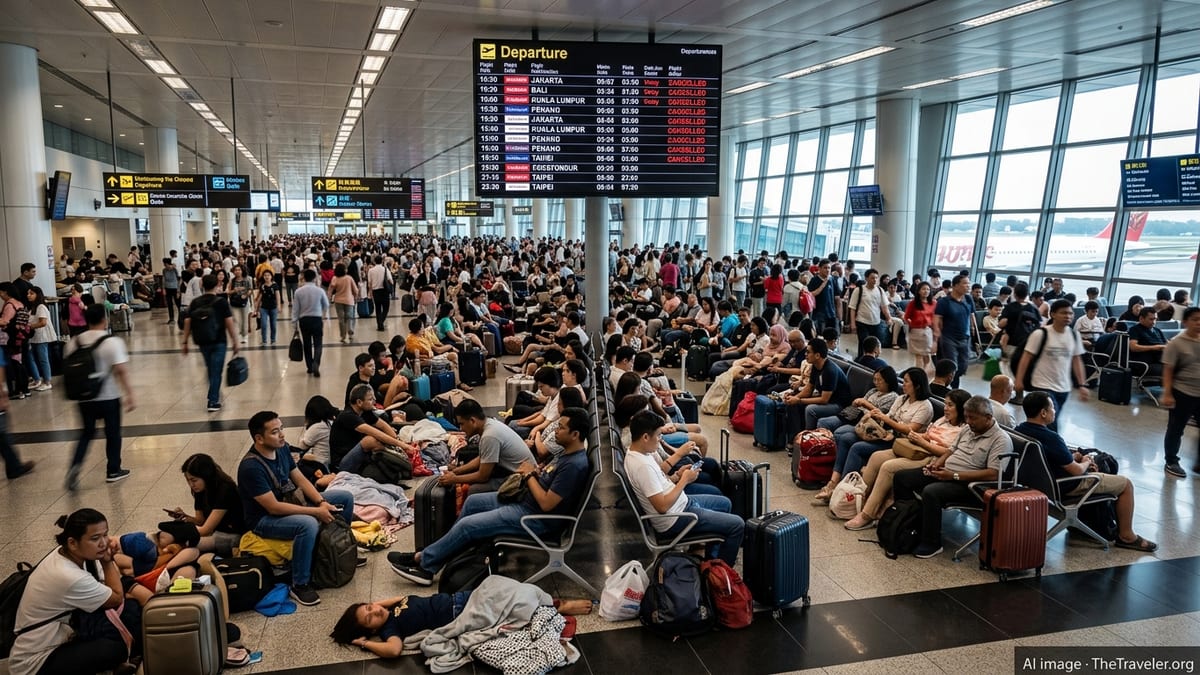
At larger hubs, including Guangzhou, Shenzhen and Chengdu, publicly available images and posts from social media and local outlets describe departure halls filled with stranded travelers waiting for updated gate information or rebooking options. Some passengers connecting from domestic to international flights report particular stress, as relatively modest initial delays of one to two hours have been enough to jeopardize onward journeys routed through coastal gateways.
Travel advisories published by several aviation-focused platforms in recent days emphasize that compensation rules inside China remain more limited than in some other regions, especially when disruptions are attributed to weather. Passengers have therefore been urged to seek practical assistance such as meal vouchers, hotel arrangements or seat changes where available, rather than relying on formal cash payouts, which may not apply under local regulations for meteorological events.
Why Weather Disruptions Escalate Quickly in China’s Domestic Network
Analysts note that the scale and structure of China’s domestic aviation network make it particularly vulnerable to cascading delays once weather interferes with a few major hubs. High traffic density along east coast and central corridors leaves limited spare capacity in the system, so a single thunderstorm cluster over the Pearl River Delta or the Yangtze River Delta can trigger rolling airspace restrictions that affect flights hundreds or even thousands of kilometers away.
In provinces such as Guangdong and Zhejiang, coastal airports are routinely exposed to strong convective activity in spring, while inland centers serving Sichuan must contend with complex terrain and variable conditions over the Sichuan Basin. Xinjiang adds another layer of complexity, as winter and early spring often bring snow, crosswinds and dust events that slow ground handling, increase de-icing time and require wider spacing between arrivals and departures.
Publicly available industry research also points to a heightened sensitivity to extreme weather as climate variability increases the frequency of intense rainfall, heat waves and severe storms in parts of China. Airlines have responded by adjusting schedules, boosting use of real-time meteorological data and investing in operational control centers, but these measures can only mitigate, rather than eliminate, the knock-on effects of powerful regional weather systems.
What Affected Travelers Can Do Today
With disruption levels elevated across multiple regions, travel experts recommend that passengers booked on flights involving Guangdong, Sichuan, Xinjiang or Zhejiang today adopt a proactive approach. The most consistent advice from passenger-rights organizations and aviation information services is to monitor flight status through official airline and airport channels and to enable app notifications so that schedule changes are received as early as possible.
When severe weather is forecast or already present, same-day schedule flexibility becomes crucial. Travelers are encouraged to consider earlier departures, longer connection times or even date changes where change fees and fare rules permit, particularly for itineraries that rely on tight domestic-international transfers through busy hubs in southern and eastern China.
For those already at the airport and facing cancellation or lengthy delay, patience combined with documentation remains important. Keeping records of boarding passes, delay notifications and any expenses incurred can help in later discussions with airlines or travel insurers, even when local compensation frameworks are limited for weather-related events. As the current pattern of storms and wintry conditions continues to sweep across Guangdong, Sichuan, Xinjiang and Zhejiang, aviation observers expect further day-to-day volatility in schedules, and advise travelers to treat any itinerary through these regions in the coming days as subject to change at short notice.