

More news on this day
Travel across the Gulf has been thrown into disarray as poor weather and wider airspace restrictions disrupt operations in Bahrain, Dubai and Doha, with around 60 flights affected and at least 16 services postponed for Gulf Air, flydubai and Qatar Airways passengers.
Get the latest news straight to your inbox!
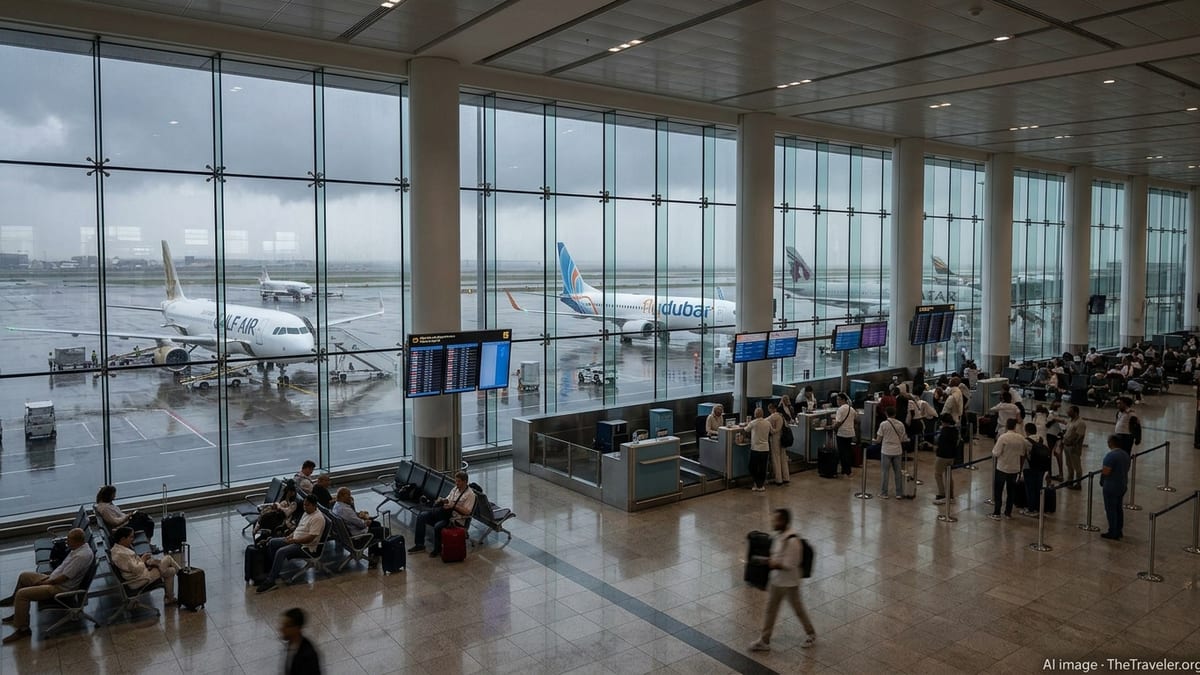
Severe Weather and Airspace Limits Hit Key Gulf Hubs
Publicly available aviation updates indicate that a combination of unstable weather systems and temporary regional airspace closures has severely disrupted flight operations at three of the Middle East’s most important hubs: Bahrain International Airport, Dubai International Airport and Hamad International Airport in Doha. Heavy rain, low visibility and thunderstorms have been reported across parts of the Persian Gulf in recent days, creating challenging conditions for takeoffs and landings.
Assessment notes from regional transport and risk consultancies describe a knock-on effect across the network, with arriving aircraft delayed, departing flights held on the ground and some services diverted to secondary airports in Saudi Arabia and elsewhere. These disruptions have converged with existing temporary restrictions on overflight corridors, compounding the operational challenges for airlines already operating on reduced or revised schedules.
In Bahrain, flight operations have been especially constrained when weather has coincided with partial airspace closures, resulting in a higher proportion of outright cancellations compared with delays. At the same time, Dubai and Doha have reported waves of delays and postponements as ground handling teams work through backlogs caused by earlier suspensions and weather holds.
Regional media coverage and airline status boards reviewed on Saturday suggest that, within a 24-hour period, around 60 flights touching Bahrain, Dubai and Doha were either cancelled, significantly delayed or rerouted, with at least 16 departures formally rescheduled or postponed as carriers sought better operating windows.
Gulf Air, flydubai and Qatar Airways Adjust Schedules
The latest operational information shows that Gulf Air, flydubai and Qatar Airways have all made short-notice adjustments to their schedules to and from the affected hubs. These changes range from outright cancellations to rolling delays that push departures back by several hours, as airlines wait for weather and airspace conditions to stabilise.
Reports on regional aviation forums and in local press indicate that Gulf Air has been heavily impacted by both conditions around Bahrain and constraints on nearby airspace, prompting a series of cancellations on routes that normally rely on smooth connectivity through its Bahrain hub. Some Gulf Air passengers have been advised through public notices and booking platforms that they may be reprotected via alternative routings where seats are available.
Flydubai, which operates a dense regional network from Dubai, has been running a reduced schedule during windows of poor weather, prioritising flights where crew and aircraft positioning can be maintained. According to published updates, the airline has implemented multiple postponements rather than mass cancellations, with flights pushed into later slots once ground operations can resume at normal pace.
Qatar Airways, meanwhile, has been operating a limited and frequently revised program to and from Doha. Publicly accessible travel alerts describe a pattern of rolling schedule changes, with some services from Hamad International Airport suspended or retimed at short notice when thunderstorms or visibility issues coincide with constrained approach and departure paths.
Impact on Passengers: Long Queues, Missed Connections and Rebookings
Passengers transiting the three hubs have reported, through social media posts and travel discussion boards, long queues at rebooking desks, congested terminal areas and difficulty securing near-term alternatives on popular routes. With three major carriers affected at the same time, spare capacity on unaffected flights has been limited, especially on long-haul connections to Europe, Asia and North America.
Travel blogs tracking the situation describe a familiar pattern from past Gulf weather disruptions: travellers missing onward connections as inbound flights arrive hours late, overnight stays becoming necessary due to curfew restrictions or crew duty-time limits, and families separated across different flights in order to make use of the few remaining available seats.
In several instances, passengers have shared screenshots of itineraries showing multiple reissues in a single day, as departure times shift repeatedly in response to evolving weather radar and air traffic flow management decisions. While some travellers have managed to depart via alternative hubs such as Dammam, Muscat or Riyadh, many others remain in holding patterns, waiting for confirmation of new departure times from their airlines.
Publicly available airport departure boards from Bahrain, Dubai and Doha display clusters of services marked as cancelled, delayed or “rescheduled,” underscoring the scale of the disruption even as some flights continue to operate during brief windows of improved conditions.
What Affected Travelers Need to Know
For passengers booked on Gulf Air, flydubai or Qatar Airways in the coming days, airline and airport notices stress the importance of checking flight status before leaving for the airport. Because schedules are being updated frequently, sometimes several times per day, travel advisories recommend using official airline apps or booking management tools to confirm departure times and any rebooking options.
Public guidance from consumer travel advocates in the region notes that, when a flight is cancelled, travelers are generally entitled to choose between a refund and rebooking on a later service, though the specifics differ by ticket type and jurisdiction. In cases of long delays or overnight disruptions, airlines often provide hotel accommodation, meal vouchers or ground transport, particularly when passengers are stranded away from their home airport, but such support is typically subject to capacity and local regulations.
Travel experts commenting in regional media recommend that passengers keep all receipts for out-of-pocket expenses incurred during the disruption, such as meals, local transport and emergency accommodation, in case these can later be claimed through travel insurance. Many policies list severe weather and airspace closures as covered events, but require documentation including cancellation notices, boarding passes and proof of delay.
For those yet to begin their trips, agents and comparison platforms advise building additional time into itineraries that rely on tight connections through Bahrain, Dubai or Doha, at least until operations stabilise. Where possible, selecting longer connection windows or routings that avoid multiple at-risk hubs can reduce the chance of missed onward flights if delays continue.
Looking Ahead: Gradual Normalisation but Continued Volatility
Risk briefings by global mobility and aviation analysts suggest that while weather systems currently affecting the Gulf region are expected to ease, the interplay between meteorological conditions and periodic airspace restrictions could keep schedules fragile in the short term. Even as airlines restart more services, crews and aircraft remain out of position, meaning knock-on effects may linger for several days after the most severe weather has passed.
Past events in the region show that major hubs such as Dubai and Doha can take time to fully clear backlogs once large numbers of flights have been grounded. Recovery typically requires a carefully phased return to normal operations, with carriers prioritising high-demand trunk routes and critical long-haul connections, then gradually restoring secondary services as resources allow.
For Gulf Air, flydubai and Qatar Airways, the current episode highlights the growing operational challenge of serving as connective bridges between continents in a period of heightened climate volatility. Analysts quoted in recent climate and aviation studies focusing on the Persian Gulf note that extreme rainfall events and sudden storms are becoming more frequent, raising pressure on infrastructure and contingency planning at airports that already operate near capacity during peak travel seasons.
In the meantime, travelers with upcoming journeys through Bahrain, Dubai or Doha are being urged in public-facing advisories to remain flexible, monitor communications from airlines closely and be prepared for last-minute changes, as the region’s carriers and airports work to restore reliable schedules after a turbulent spell of weather.