

More news on this day
Bad weather linked to Winter Storm Hernando brought fresh disruption to U.S. air travel on Sunday, stranding scores of passengers at Hartsfield-Jackson Atlanta International Airport as Delta, Southwest, Frontier, JetBlue, Republic and other carriers reported 122 cancellations and 649 delays on routes connecting Atlanta with major East Coast hubs from Philadelphia and Newark Liberty to Boston, Nashville and Charleston.
Winter Storm Hernando Adds New Strain to U.S. Flight Networks
The latest wave of disruptions comes as Winter Storm Hernando sweeps across the Mid-Atlantic and Northeast, bringing a volatile mix of heavy snow, strong winds and poor visibility to some of the country’s busiest air corridors. While conditions in Atlanta itself remained mostly flyable for much of the day, the storm’s knock-on effects at airports in the storm’s direct path rippled through schedules nationwide.
Airlines including Delta Air Lines, Southwest Airlines, Frontier Airlines, JetBlue Airways and regional operator Republic Airways reported significant operational challenges as they adjusted schedules to keep aircraft, crews and passengers safe. The majority of the 122 cancellations and 649 delays affecting Hartsfield-Jackson on Sunday involved flights to and from storm-affected cities such as Philadelphia, Newark, Boston, Nashville and Charleston, where deteriorating conditions made flying increasingly difficult.
Carriers had already begun thinning schedules at key East Coast hubs over the weekend, after meteorologists warned that Hernando’s snow bands and wind gusts could make runway operations and deicing efforts more complex and time-consuming. By Sunday afternoon, those forecasts had materialized into real-world gridlock at airports up and down the I-95 corridor, with Atlanta feeling the strain through its role as a primary connecting hub.
Atlanta Hub Feels the Ripple Effect From East Coast Shutdowns
Hartsfield-Jackson, which regularly handles more passengers than any other airport in the United States, found itself at the center of a weather crisis that was technically unfolding hundreds of miles away. As operations slowed or halted in northeastern cities, aircraft due to arrive in Atlanta were held on the ground, re-routed, or canceled outright, leaving gates occupied for longer than planned and turning what began as a manageable delay scenario into a daylong challenge.
Despite relatively calm skies reported over Atlanta for much of Sunday, the airport’s departure boards told a different story, with long columns of delayed flights and pockets of cancellations reflecting the chaos engulfing destination airports. Airlines prioritized safety and operational stability over maintaining normal frequencies, proactively canceling some flights in order to avoid last-minute scrambles and prolonged tarmac holds.
Ground crews at Hartsfield-Jackson worked to reposition aircraft, manage tight gate space and guide passengers through rebooking options, even as updated weather information from the Northeast forced further adjustments. Delta, which operates its largest hub in Atlanta, and Southwest, which maintains a substantial schedule at the airport, both reported cascading impacts as aircraft and crew rotations were disrupted by Hernando’s march up the coast.
Major East Coast Hubs Bear the Brunt of Cancellations
On Sunday, the airports reporting the heaviest concentration of weather-related cancellations included New York’s John F. Kennedy, LaGuardia and Newark Liberty, along with Boston Logan and Philadelphia International. These hubs, all within Hernando’s main impact zone, saw extensive schedule reductions as airlines confronted runway contamination from snow, low visibility and gusty crosswinds that complicated both takeoffs and landings.
Newark Liberty, a key connecting point for routes linking Atlanta to cities across the Northeast and Mid-Atlantic, experienced periodic ground stops and significant arrival metering as air traffic controllers spaced flights farther apart for safety. Similar restrictions at Philadelphia and Boston slowed the rate at which inbound flights could be accepted, forcing airlines to hold departures in Atlanta and, in many cases, cancel segments outright.
Boston’s Logan Airport, already identified by carriers as one of the most vulnerable nodes in Hernando’s footprint, saw multiple airlines issue broad travel advisories and flexible rebooking policies. JetBlue and Delta, which both operate large networks from Boston, trimmed operations in anticipation of the storm’s heaviest bands arriving, effectively throttling the flow of aircraft that would normally cycle through Atlanta and other southern hubs.
Secondary Cities Like Nashville and Charleston Also Disrupted
Beyond the large coastal hubs, Hernando’s reach was felt keenly in secondary markets such as Nashville and Charleston, which serve as important regional connectors and popular leisure gateways. In Nashville, bursts of wintry precipitation and changing visibility prompted airlines to slow operations, build longer buffers between flights and, in some cases, suspend services during periods of heavier bands.
Charleston, positioned along the Southeast coast and frequently affected by coastal storm systems, saw a mix of weather complications and traffic-management initiatives that contributed to delays on flights to and from Atlanta. Even when local conditions at Charleston’s airport briefly improved, the broader constraints on airspace and runway capacity along the East Coast limited how many flights could be dispatched at once.
For passengers in Atlanta with tickets to these smaller but strategically vital cities, the result was often the same as for those bound for major hubs: rolling departure times, gate changes and a scramble for the small number of flights that did manage to depart. Families heading to weekend getaways, business travelers with tightly planned meetings, and students returning to campus all mingled in terminal lines, waiting for updated information.
Airlines Activate Waivers, Rebooking and Recovery Plans
As conditions deteriorated across the storm’s path, airlines moved to expand travel waivers and give customers more flexibility to adjust plans. Delta, JetBlue, Southwest and others encouraged passengers whose itineraries touched affected airports to rebook for dates outside the storm window, often waiving change fees and, in some cases, fare differences when customers kept the same origin, destination and cabin.
These proactive measures were designed to smooth the recovery process by reducing the number of travelers showing up at airports only to face slim chances of same-day departure. By spreading demand over a wider range of days, carriers hoped to keep call centers, digital channels and airport service desks from becoming overwhelmed as cancellations mounted.
Operationally, airlines also began planning for the complex task of resuming normal schedules once Hernando moves offshore. That process will require repositioning aircraft stranded at outstations, re-aligning crew schedules thrown off by duty-time limits and ensuring that maintenance checks remain on track despite the disruption. Travelers can expect some residual delays and schedule changes to persist even after the last snow bands exit the Northeast.
Passengers Confront Long Waits, Crowded Terminals and Limited Options
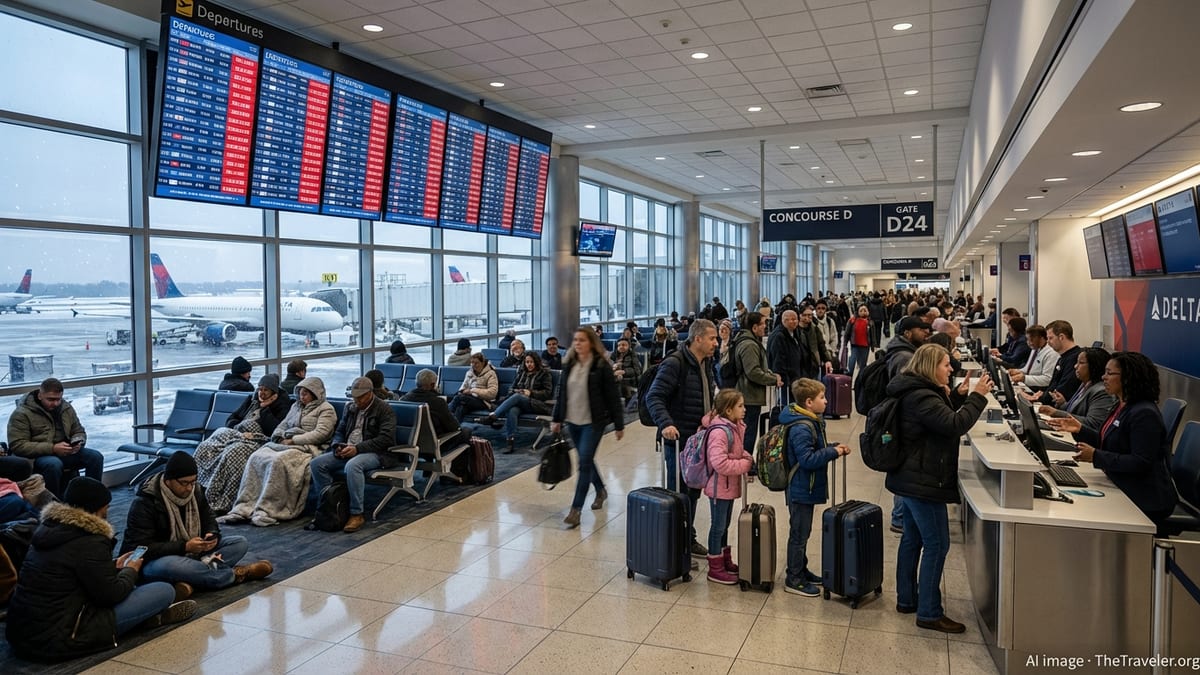
At Hartsfield-Jackson, the human cost of the disruption was visible in crowded gate areas, lines stretching from customer service counters into concourses and clusters of travelers camped near power outlets scrolling for updates on airline apps. Many passengers who arrived early in the day expecting routine travel found themselves searching for alternative itineraries that would get them even part of the way toward their destinations.
Families traveling with children sought out quieter corners of the terminal, while solo travelers formed ad hoc information networks, trading updates on boarding times, gate changes and rumored seat availability. With hotels near the airport quickly filling as cancellations accumulated, some passengers faced the prospect of spending the night in the terminal if their flights were pushed into the next day.
Food outlets and retail shops inside the airport reported brisk business as travelers tried to turn unexpected layovers into manageable waiting periods. Meanwhile, airport staff and airline representatives moved through the concourses answering questions, distributing snack vouchers where policies allowed, and directing travelers to quieter checkpoints or less congested rebooking desks.
How Weather and Air Traffic Management Combine to Slow the System
While passengers often experience delays as isolated, flight-specific problems, the situation surrounding Winter Storm Hernando highlights how intertwined weather and air traffic management are across the national aviation system. When snow and wind reduce the number of arrivals and departures that an airport can safely handle each hour, the Federal Aviation Administration typically introduces programs that meter traffic into busy airspace and onto constrained runways.
Those measures, which can include ground delay programs and temporary ground stops, effectively slow the entire network, forcing flights to depart later from their origins in order to avoid congestion or unsafe conditions at their destinations. As a result, even airports with relatively mild weather, like Atlanta on Sunday, can experience significant schedule disruptions because they feed aircraft into or receive aircraft from storm-affected regions.
Airlines plan their networks with tight utilization of aircraft and crews, which normally increases efficiency but leaves limited slack when weather disrupts a key node. Once a series of flights is delayed or canceled, the aircraft and crew that were supposed to operate subsequent legs of that schedule may no longer be available, compounding delays and leading to further cancellations down the line.
What Travelers Should Do if Their Flights Are Affected
For travelers with upcoming plans through Atlanta or any of the storm-affected cities, airline and airport officials advise acting early and staying flexible. Passengers are urged to monitor their airline’s website or mobile app frequently for real-time updates on flight status, gate assignments and any expanded travel waivers that could make rebooking easier and less costly.
Where possible, travelers whose trips are not time-sensitive may want to proactively move journeys to later in the week, when Hernando is expected to have cleared the East Coast and flight operations begin to normalize. Shifting travel away from the peak disruption window can improve the odds of an on-time departure and free up limited same-day seats for passengers with urgent needs.
Those who must travel during the storm’s peak impacts are encouraged to allow extra time at the airport, prepare for extended waits and consider carrying essential items in hand luggage in case of an unplanned overnight stay. Keeping boarding passes, identification and key confirmations easily accessible can also speed the process if multiple rebookings are required as conditions evolve.