

More news on this day
Severe winter weather across central and eastern China has disrupted operations at major airports in Chengdu, Wuhan and Shanghai, grounding more than 11 flights and delaying around 440 services operated by Air China, China Eastern and China Express Airlines, and forcing thousands of travelers to rearrange their plans at the height of the busy post–Spring Festival travel period.
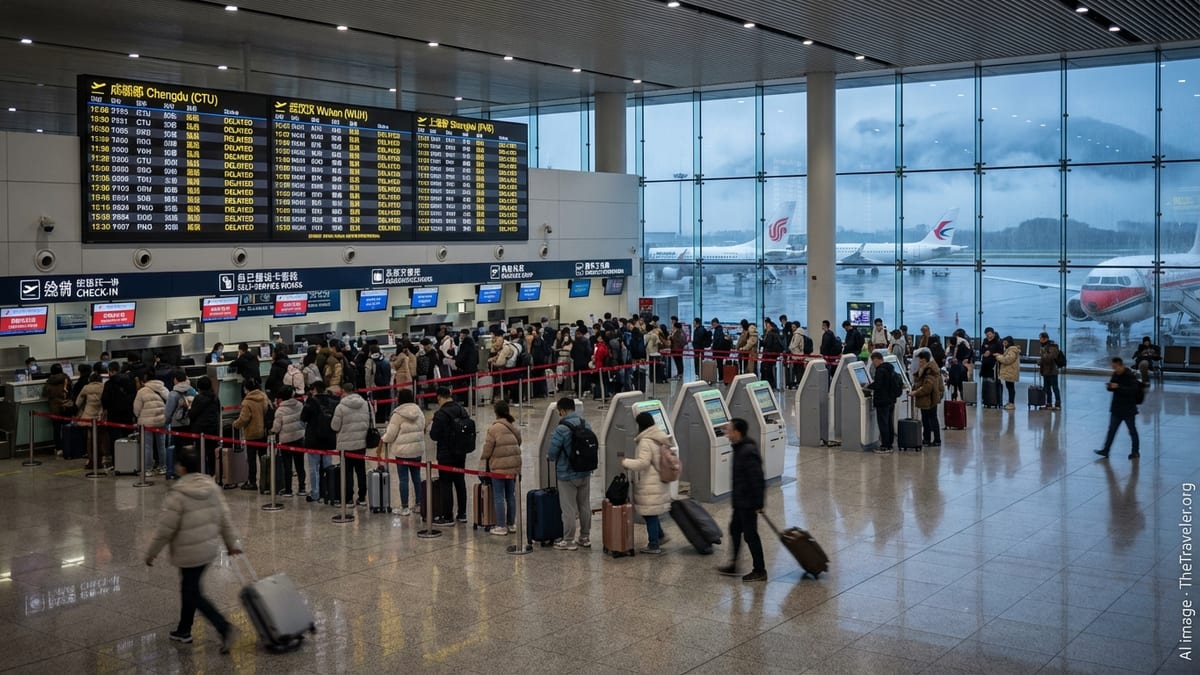
Chengdu, Wuhan and Shanghai Struggle to Keep Schedules on Track
According to operational data compiled from airport monitoring platforms and carrier schedules, the latest wave of adverse weather has translated into over 11 outright flight cancellations and roughly 440 delays concentrated at Chengdu’s airports, Wuhan Tianhe International Airport and Shanghai’s dual hubs at Pudong and Hongqiao. While the numbers are modest compared with some of the larger nationwide disruption days seen earlier this winter, the clustering of cancellations and late departures at three key connective hubs has magnified the impact for domestic and regional travelers.
At Chengdu, low clouds and intermittent precipitation have compounded existing congestion associated with heavy Spring Festival demand. Turnaround times have stretched and some aircraft have been held on the ground while crews wait for acceptable visibility and updated routing slots. In Wuhan, gusty winds and bouts of poor visibility have periodically pushed operations below normal thresholds, slowing arrivals and departures and creating rolling delays as aircraft and crews fall out of position.
Shanghai’s role as an international and domestic gateway has made even a limited number of weather-related disruptions particularly consequential. Minor ground holds and spacing requirements imposed by air traffic control to manage cloud cover and reduced visibility have created a ripple effect on tightly timed departures, especially on services that cycle aircraft through multiple legs in a single day. As a result, what might appear as a localized weather issue has cascaded into a web of missed connections and rebookings for travelers across China’s aviation network.
Airport authorities in all three cities have stressed that safety remains the primary consideration in determining whether flights can depart or land. Runway and taxiway inspections, de-icing where necessary, and staggered arrival sequences have been deployed to manage risk. These measures, while essential, inevitably slow throughput and contribute to the growing tally of delays and cancellations for the affected carriers.
Flagship Carriers Bear the Brunt of the Disruptions
Air China, China Eastern and regional carrier China Express have emerged as the most visible victims of the latest weather-related interruptions. As primary operators on many of the trunk routes linking Chengdu, Wuhan and Shanghai with the rest of the country, they have little choice but to operate in the very airspace and time windows most affected by winter systems currently sweeping across central and eastern China.
Air China in particular has a major presence at both Chengdu and Shanghai, with a mix of domestic trunk services and select international routes that rely on high aircraft utilization. When low clouds, wind shear or visibility constraints slow the rate at which flights can land and depart, aircraft cycle times lengthen and crews can hit duty limits sooner than planned. That combination has contributed to a small but significant cluster of cancellations, and a much larger pool of delays that passengers are now experiencing across multiple legs.
China Eastern, which counts Shanghai Pudong and Hongqiao as its primary hubs, faces an even more complex challenge. The carrier must absorb weather impacts not only on flights operating into and out of Shanghai itself, but also on a network of connecting services that depend on punctual arrivals from secondary cities such as Chengdu and Wuhan. When inbound flights are delayed, outbound connections often require retiming or consolidation, sometimes resulting in cancellations on lower-demand legs in order to preserve capacity on core routes.
China Express, a regional specialist that feeds traffic from smaller cities into major hubs, has seen several of its rotations into Chengdu and Wuhan disrupted as crews and aircraft find themselves out of sync with the planned schedule. Even a single grounded sector can unsettle an entire day’s worth of operations for a smaller airline, leaving passengers in outlying markets facing longer waits for re-accommodation compared with those traveling between major hubs.
Winter Weather and Seasonal Travel Surge Create a Volatile Mix
The latest disruptions come against the backdrop of a broader pattern of weather-related turbulence that has dogged Chinese aviation through the winter. In recent weeks, a succession of cold fronts and moisture-laden systems has triggered waves of cancellations and delays across multiple hubs, with Chengdu, Wuhan and Shanghai repeatedly appearing among the most affected cities. These atmospheric conditions have combined with the annual Spring Festival travel rush to create a particularly fragile operating environment.
China’s official Spring Festival travel period, which stretches roughly from early February through mid-March in 2026, is traditionally the busiest season of the year for domestic mobility. Airlines have responded by loading significant additional capacity, particularly on trunk routes linking interior hubs like Chengdu and Wuhan with coastal gateways such as Shanghai. When the weather cooperates, the system operates near its limits but remains manageable. When low cloud ceilings or strong winds sweep across multiple key airports at once, however, there is very little slack to absorb delays.
The result is a complex web of knock-on effects. A departure held on the tarmac at Chengdu because of reduced visibility may arrive late into Shanghai, where it is scheduled to operate a subsequent leg to another city. That next departure may then either leave late or be consolidated with another flight, inconveniencing passengers booked on each segment along the way. As aircraft and crew positioning diverges from the original plan, airline operations centers must make rapid decisions about which flights to prioritize and which to cancel in order to gradually restore order to the network.
This volatility has been growing more visible to passengers as real-time flight tracking and social media amplify reports of delays and cancellations. While the underlying cause in this instance is clearly weather-related, many travelers perceive only the end result: crowded terminals, long queues at service counters and shifting departure times. For business travelers and tourists alike, the current conditions underscore how sensitive even a sophisticated aviation system remains to meteorological swings during the cold season.
What Today’s Numbers Mean for Travelers on the Ground
For those already at the airport or preparing to travel through Chengdu, Wuhan or Shanghai in the coming days, the headline figures of more than 11 grounded flights and around 440 delays translate into very tangible inconveniences. In terminals across the three cities, passengers have reported longer security and check-in lines as airlines process a higher volume of rebookings and special service requests. Information desks are busy fielding inquiries about changing itineraries, while departure boards flicker with revised timings and gate changes.
The experience can vary significantly depending on the nature of each traveler’s journey. Those flying point to point on a single short domestic sector, for example between Chengdu and Shanghai, are more likely to see a delay of one or two hours than a full cancellation. For passengers relying on tight connections, especially to international services or onward flights to smaller cities, the risks are higher. A modest delay on the first leg may erode their connection window, forcing unplanned overnight stays or rerouting through alternative hubs.
Airlines have been deploying additional staff at customer service counters and attempting to redistribute passengers across available seats on later flights. However, with Spring Festival demand still elevated, spare capacity is limited on many routes. Some travelers are opting to switch to high-speed rail for medium-distance journeys, especially on well-served corridors between Wuhan, Shanghai and other eastern cities, where train services are less vulnerable to the specific weather conditions that constrain aviation.
Hotels near airports in all three cities have reported a modest uptick in last-minute bookings from stranded passengers. Travel insurers and corporate travel managers are also monitoring the situation closely, as delays and missed connections trigger claims and require adjustments to business itineraries. For leisure travelers, particularly those on tightly planned multi-city trips, the disruptions serve as a reminder of the need to build buffer time into schedules during the winter peak.
How Air China, China Eastern and China Express Are Responding
Operational teams at Air China, China Eastern and China Express have been working to stabilize their schedules as weather conditions evolve. The first priority has been to maintain safety margins, which means respecting visibility and wind thresholds for takeoff and landing, and ensuring that aircraft are adequately prepared and inspected before departure. Where conditions improve even marginally, airlines have attempted to clear backlogs by turning aircraft quickly at the gate and securing favorable departure slots from air traffic control.
Carriers are also using standard tools such as schedule thinning and aircraft swaps to manage the disruption. In some cases, smaller aircraft have been replaced by larger models on high-demand routes so that more affected passengers can be accommodated on fewer flights. Conversely, lower-demand services may be temporarily suspended or combined, a strategy that helps restore crew and aircraft rotation patterns but can increase wait times for those booked on the affected legs.
On the customer side, airlines are waiving certain change fees and fare differences for passengers whose flights are directly impacted by the disruptions. Call centers and mobile apps are playing an important role in pushing out real-time updates, though heavy usage can sometimes slow response times. At the airport, ground staff remain the primary point of contact for those needing same-day solutions, from rebooking and reissuance of tickets to the provision of meal vouchers and accommodation in cases of long delays or overnight cancellations.
Industry observers note that the current situation provides another test of how well China’s rapidly scaled-up domestic aviation sector can manage irregular operations. Lessons learned from this and previous weather episodes will likely feed into future adjustments in scheduling, crew planning and communication strategies, particularly during high-demand periods such as the Spring Festival travel season.
Rights, Refunds and Practical Steps for Affected Passengers
Travelers whose flights have been canceled or heavily delayed by the latest weather systems should be aware of the options typically available in such circumstances. Chinese airlines, including Air China, China Eastern and China Express, generally offer passengers on canceled services the choice of a full refund or a change to a later date or alternative routing, subject to seat availability. Because the underlying cause is adverse weather rather than an airline-controlled technical issue, additional cash compensation is not usually provided under local regulations.
At the same time, carriers may provide practical assistance when disruptions force passengers to remain at the airport longer than expected. Depending on the length and timing of the delay, this can include meal vouchers, bottled water or hotel arrangements for overnight stays. Such support is most often extended when travelers are stranded away from their home city and lack an easy alternative. Passengers are advised to keep boarding passes and receipts for any out-of-pocket expenses, and to check the specific conditions of their ticket and any travel insurance policies they hold.
Those with international connections should pay special attention to minimum connection times and immigration or security procedures at transfer airports. When a domestic leg into Shanghai or another gateway is delayed, it may be necessary to rebook the onward international flight, even if it is operated by a different airline. In these cases, contacting the carrier or booking agent as soon as a significant delay becomes apparent improves the chances of securing a workable alternative. Many travel management companies and online agencies have set up dedicated support lines during the peak season to handle exactly these situations.
For future trips, frequent travelers recommend building a wider buffer between key domestic and international segments during winter months, especially when connecting through weather-sensitive hubs. Booking earlier flights in the day, avoiding the last departure on critical routes, and considering flexible fare types can also provide additional resilience against the sort of rolling delays now affecting Chengdu, Wuhan and Shanghai.
Planning Ahead: How to Navigate China’s Winter Flight Risks
While the current wave of cancellations and delays will eventually ease as weather patterns shift and schedules are reset, the underlying dynamics that make China’s aviation network vulnerable in winter are unlikely to disappear. Dense traffic at a relatively small number of super-hubs, coupled with ambitious scheduling designed to meet surging demand, means that even incremental weather-related restrictions can generate outsized effects for passengers.
For travelers planning journeys over the remaining weeks of the Spring Festival period and into late winter, a few practical strategies can help mitigate risk. Checking weather forecasts not only for the origin and destination but also for key transit hubs such as Chengdu, Wuhan and Shanghai provides early warning of potential disruption days. Where feasible, travelers may wish to choose routings that avoid multiple tight domestic connections, or to favor larger hubs with more frequent services in case a rebooking becomes necessary.
Coordinating flight choices with accommodation and ground transport plans is equally important. Booking hotels with flexible cancellation policies near major airports, and allowing extra time before critical events such as business meetings or cruise departures, reduces the stress that comes with last-minute changes. Many experienced travelers in China also maintain backup rail or coach options for mid-range routes, particularly in regions where high-speed rail offers competitive journey times and is less vulnerable to the specific weather factors that affect aviation.
Ultimately, the present disruptions at Chengdu, Wuhan and Shanghai underscore a broader reality for travel in China during winter and early spring. Even as airlines invest in more modern fleets and airports expand capacity, the country’s vast geography and dynamic climate will continue to pose challenges. For passengers, staying informed, building flexibility into itineraries and understanding their rights and options when flights are canceled or delayed remain the most effective tools for navigating an increasingly busy and weather-sensitive sky.