

More news on this day
Hundreds of passengers traveling through Yampa Valley Regional Airport in northwest Colorado faced significant disruptions on Saturday as roughly 20 flights were delayed, though no cancellations were reported, affecting major U.S. carriers and key winter routes to and from the Rockies.
Delays Mount but Cancellations Averted
Operations at Yampa Valley Regional Airport, the main commercial gateway for Steamboat Springs and surrounding ski resorts, slowed sharply on Saturday as a wave of delays rippled across the schedule. Airport tracking data and federal airspace alerts indicated that around 20 departures and arrivals were running behind schedule at the Hayden facility, with average delays running around half an hour and some stretching much longer.
Despite the disruptions, airlines serving the airport maintained their schedules without canceling flights, a notable outcome during a peak winter weekend when even modest weather or air traffic issues can quickly lead to scrubbed services. Carriers including American Airlines, Delta Air Lines, Southwest Airlines, United Airlines and regional operator SkyWest all reported delayed movements but kept aircraft and crews in position to complete their rotations.
The delays affected heavily used winter routes linking the Yampa Valley to Denver, Dallas, Atlanta, Chicago, Los Angeles and Seattle. Those connections are critical for funneling visitors to Steamboat’s slopes and returning residents and seasonal workers to major hubs across the country.
Airport officials did not immediately release a total passenger count, but with most of the airport’s narrow-body flights operating near capacity during the ski season, the disrupted services are estimated to have impacted several hundred travelers over the course of the day.
Denver Ground Delay Program Reverberates in the High Country
The primary trigger for the slowdown appeared to lie not in Hayden but 150 miles to the east, with air traffic constraints at Denver International Airport. Earlier this week, the Federal Aviation Administration implemented a ground delay program at Denver due to strong winds along the Front Range, reducing the rate at which flights could arrive and depart and creating knock-on effects across Colorado’s air network.
By Saturday, FAA traffic management data showed Yampa Valley under a ground delay designation, with average holds of roughly half an hour assigned to affected flights. While weather at the airport itself remained generally fair and seasonably cold, the constraints at Denver, a primary hub and connection point for many passengers traveling to and from northwest Colorado, meant aircraft and crews were often held in place until airspace capacity opened.
Because Yampa Valley Regional Airport relies on a limited number of daily frequencies, even small adjustments at Denver can create outsized challenges in Hayden. A delayed arrival from Denver or another hub can cascade into a late departure for the next leg, pushing back boarding times and forcing passengers into longer waits at a terminal that was built for lower volumes than those seen in recent ski seasons.
Industry analysts note that the combination of high demand for mountain destinations, tight aircraft utilization and episodic weather constraints along the Front Range has made Colorado’s winter air traffic particularly susceptible to ripple-effect delays in recent years.
Passengers Endure Long Waits During Peak Ski Travel
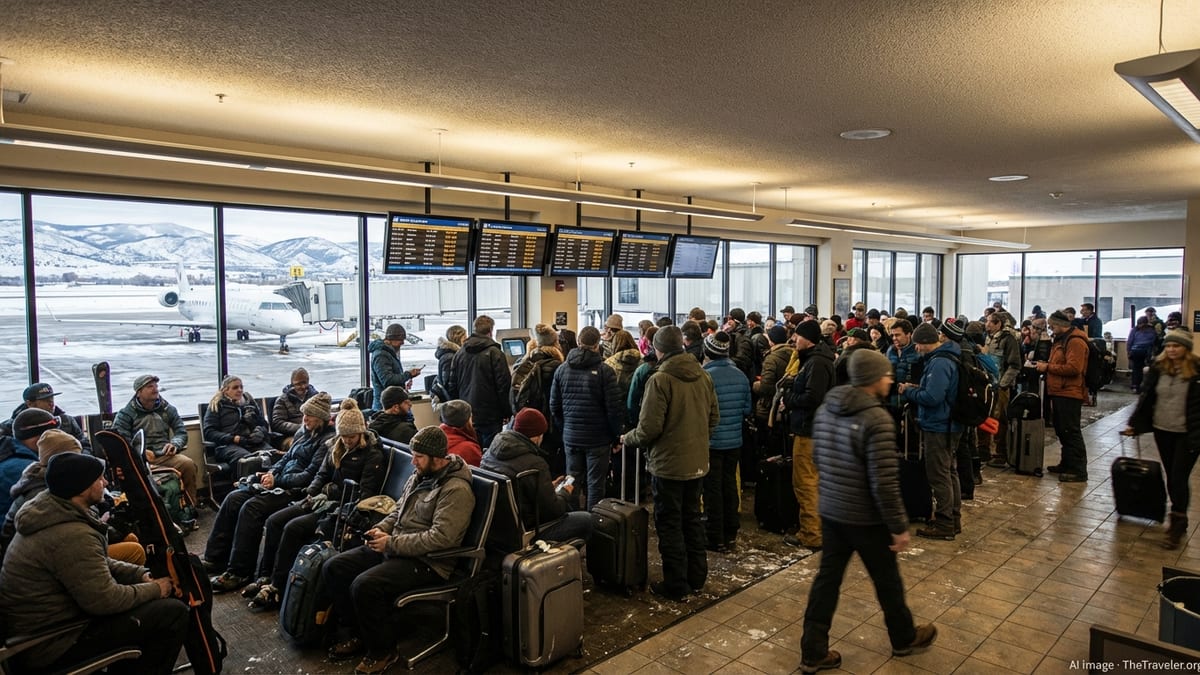
Inside the Yampa Valley terminal, travelers reported crowded gate areas and slow-moving departure boards as airlines worked to re-time flights. Families returning from week-long ski vacations, seasonal workers commuting to major cities and residents connecting onward from regional services all found themselves navigating shifting departure estimates.
With no cancellations on Saturday, most passengers were ultimately expected to reach their destinations the same day, but many faced missed connections at larger hubs. Travelers bound for East Coast and international flights out of Denver and Chicago were particularly vulnerable to onward disruptions, given the tight connection windows often used to link small-market flights with long-haul services.
Airlines encouraged passengers to use mobile apps and customer service counters to rebook missed connections in real time, while urging those yet to depart for the airport to check flight status frequently. Some travelers opted to remain in local lodging near Steamboat Springs rather than wait at the terminal, hoping that delays would ease later in the day as the backlog cleared.
Airport staff and airline ground crews, already stretched by the seasonal influx of ski traffic, were tasked with managing passenger expectations while juggling gate changes, revised boarding times and deicing requirements typical of late February operations at high-elevation airports.
Mountain Weather and Infrastructure Add to Operational Strain
Although skies over Yampa Valley were largely fair through much of Saturday, recent mountain weather has complicated aviation planning in northwest Colorado. A succession of winter systems and an avalanche warning earlier in the week for portions of the state’s high country underscored the volatility that airlines must account for when scheduling flights into and out of mountain communities.
Yampa Valley Regional Airport, situated at an elevation of more than 6,600 feet near Hayden, has one primary runway that accommodates both commercial jets and general aviation. That configuration places a premium on precise timing, as simultaneous arrivals and departures cannot be handled with the same flexibility as at larger multi-runway hubs. Any upstream delay can quickly occupy the runway and ramp space longer than planned, slowing the day’s flow.
Ground access can also become a factor for travelers. While major highways into Steamboat Springs remained mostly clear on Saturday, intermittent snow and construction-related slowdowns on U.S. Highway 40 in recent days have made journeys to and from the airport less predictable. Local transportation officials have repeatedly urged drivers to allow extra time for mountain travel, especially when roadwork and changing weather coincide with weekend ski traffic.
For airlines, these layered constraints mean that winter operations into Hayden and similar resorts across the Rockies demand careful coordination between dispatchers, pilots, ground staff and air traffic controllers. Even on days without severe local weather, the system can be fragile, with delays at a distant hub translating into missed departure slots and tight turnarounds in the mountains.
Airlines and Airport Urge Travelers to Plan Ahead
In the wake of Saturday’s disruptions, both airline representatives and local officials reiterated familiar advice for those planning to travel through Yampa Valley during the closing weeks of the ski season. Passengers are being urged to arrive early, monitor flight status closely and build generous buffers into connections through Denver, Dallas, Chicago, Los Angeles, Seattle and other major hubs.
Travel planners note that early-morning departures from Hayden are often less exposed to cascading delays from elsewhere in the national airspace system, though they can be more vulnerable to overnight weather and deicing requirements. Afternoon flights, by contrast, may benefit from clearer conditions but are more likely to be affected by upstream congestion.
Local tourism officials stressed that, despite the day’s setbacks, Yampa Valley Regional Airport continues to operate all scheduled flights and remains a vital lifeline for the region’s tourism-driven economy. With no cancellations reported, airlines are expected to work through the backlog and return the operation to a more typical pattern by late weekend, barring any sudden weather changes.
As winter winds down and spring break travel looms, the episode serves as a reminder that flying into high-country destinations often involves a margin of uncertainty. For hundreds of travelers on Saturday, that meant a longer day in the terminal, even as every scheduled aircraft ultimately remained on the board.