

More news on this day
Severe spring storms sweeping across eastern and southern China have grounded 60 flights and delayed a further 197 services across major airports, with Beijing and Shenzhen among the hardest hit hubs as passengers confront rolling disruption and limited clarity on when operations will normalize.
Get the latest news straight to your inbox!
Storm Systems Batter Key Chinese Air Corridors
Publicly available aviation data for early April 2026 indicate that a series of fast-moving storm fronts over eastern and southern China have sharply reduced capacity on several of the country’s busiest air corridors. Heavy rain, strong crosswinds and periods of low visibility have combined with air-traffic flow restrictions to trigger at least 60 flight cancellations and 197 delays across multiple hubs, including Beijing Capital, Beijing Daxing and Shenzhen Bao’an.
Weather maps and regional media coverage point to a band of thunderstorms stretching from the Beijing–Tianjin region down through the Yangtze River Delta and into the Pearl River Delta. This corridor overlaps with some of China’s densest domestic routes, notably links between Beijing, Shanghai, Guangzhou and Shenzhen. When storms sit over these bottlenecks, even brief ground stops can cascade into hours of disruption as aircraft and crews fall out of position.
Analysis of recent operations shows that Shenzhen Bao’an has repeatedly appeared among the most disrupted airports in Asia in recent days, with elevated levels of both cancellations and delays tied to convective weather and congestion. Beijing’s two airports have also seen growing knock-on effects as traffic managers slow arrival and departure rates to maintain safety margins in challenging conditions.
While the total number of affected flights is modest compared with some previous nationwide events, the concentration on high-demand routes and major hubs means thousands of passengers have experienced missed connections, overnight holds and last-minute schedule changes.
Beijing and Shenzhen Routes Among the Worst Affected
Flight-tracking snapshots for the latest disruption period show that services into and out of Beijing and Shenzhen have borne a disproportionate share of the impact. Routes linking Shenzhen with Beijing, Shanghai and Guangzhou have recorded clusters of cancellations and multi-hour delays, reflecting both local storms and restrictions along shared airspace corridors.
At Beijing Capital and Beijing Daxing, delays have been most acute on trunk routes to coastal business centers and fast-growing inland cities. Aircraft scheduled to operate high-frequency shuttles between Beijing and hubs such as Shanghai, Shenzhen and Guangzhou have been forced into extended ground holds, compressing already tight turnarounds and limiting airlines’ ability to recover their schedules later in the day.
Regional coverage and aviation analytics suggest that some flights have been rerouted to avoid the most intense storm cells or to accommodate temporary airspace closures, adding further time in the air and complicating downstream schedules. In a network as tightly tuned as China’s domestic system, even small deviations can resonate through evening departure banks and early-morning rotations.
Passengers connecting through these hubs to secondary destinations have faced particular uncertainty. With limited spare capacity on popular routes, rebooked itineraries are often pushed to the following day or routed via alternative cities, extending travel times and increasing pressure on airport infrastructure and local accommodation.
Passenger Experience: Long Queues and Patchy Information
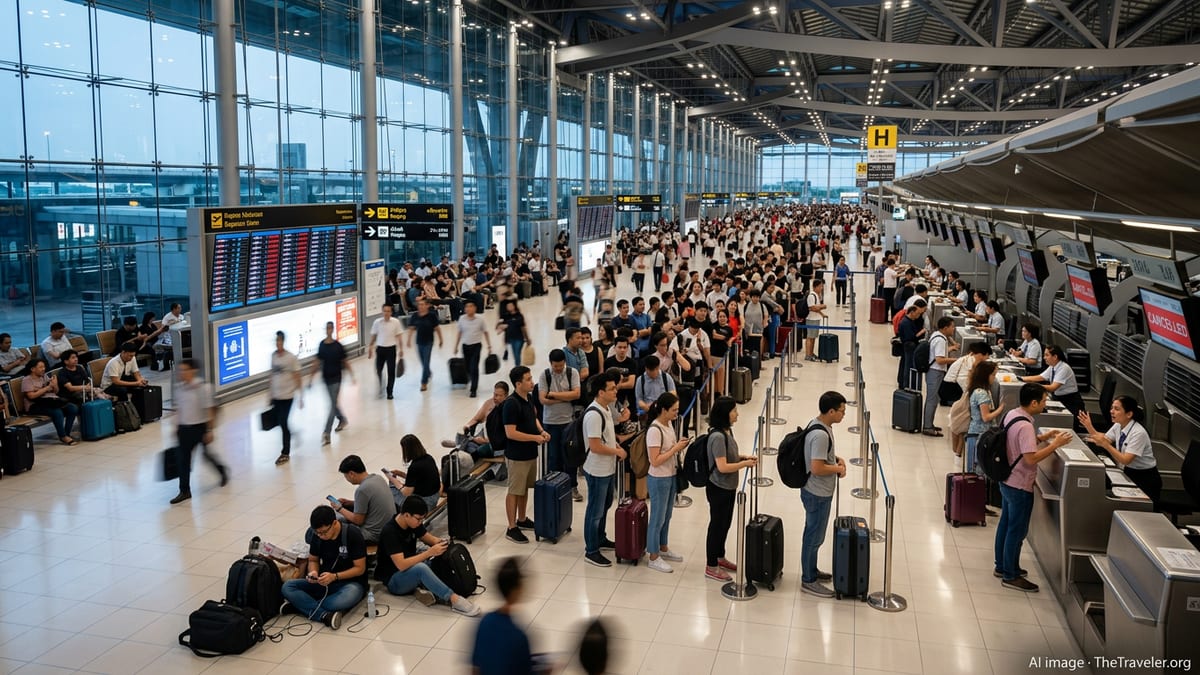
Reports from Chinese and regional media, alongside social media posts, describe crowded terminals, long queues at check in and transfer counters, and sporadic updates on departure timing as airlines and airport operators work to digest evolving weather forecasts. Many passengers caught in Beijing and Shenzhen express frustration at receiving only rolling short-term delay notices as storms repeatedly trigger fresh flow-control measures.
Domestic passengers with flexible travel dates have in some cases chosen to abandon same-day travel, seeking refunds or open-date vouchers instead of waiting for overbooked later flights. International travelers and those with onward connections, however, have had fewer options, especially when their journeys involve separate tickets or different carriers on each leg.
Observers note that China’s larger hubs have invested heavily in terminal infrastructure and digital displays, which can help keep travelers informed during irregular operations. Nonetheless, the pace at which conditions change during severe weather can outstrip update cycles on departure boards and mobile apps, leaving individuals uncertain whether to remain at the gate, queue for rebooking or arrange overnight stays.
The latest round of disruption has also revived debate among consumer advocates and travel commentators about how clearly airlines communicate passengers’ rights to refunds, rebooking and care, particularly when delays extend deep into the night and when families or elderly travelers are involved.
Rebooking Options and What Stranded Travelers Can Do
For affected passengers, publicly available airline policies and recent practice around similar Chinese weather events point to several main avenues for relief. Most major Chinese carriers typically offer free rebooking to the next available flight when delays or cancellations are classified as weather related, though exact rules and fare-class eligibility differ by airline and route.
Travel analysts recommend that passengers first confirm the real-time status of their flight using official airline apps or airport departure boards before heading to the airport or joining long queues. If a flight is already marked as canceled, online and app-based self-service tools may allow same-day or next-day rebooking without waiting at a service desk, especially for simple point-to-point itineraries within China.
Those who booked through online travel agencies or third-party platforms may need to work through those intermediaries for changes, which can add complexity when phone lines are busy during mass disruptions. In such cases, travelers are often advised to document all delay notifications, boarding passes and receipts for meals or hotels, in case airlines or travel insurers later request proof of disruption.
Where schedules are heavily constrained, some passengers may find it faster to rebook via alternative hubs, such as Guangzhou or Shanghai, even if that introduces additional connections. However, this strategy depends on seat availability and can increase the risk of further missed connections if weather conditions continue to shift.
Outlook: More Spring Weather Volatility Ahead
Meteorological agencies and climatology research highlight April as a transitional month for much of China, when lingering cool air masses from the north can clash with warmer, moisture-laden systems from the south. This pattern often produces the kind of thunderstorms, turbulence and low cloud that disrupt aviation corridors over the North China Plain and along the east coast.
Recent history shows that there have been days with far higher nationwide disruption, with some April and early summer storm episodes generating several hundred cancellations and thousands of delays across dozens of airports. Against that backdrop, the latest figure of 60 grounded flights and 197 delays appears moderate but still significant for travelers whose plans hinge on a single departure.
Industry commentary suggests that operational ripples from the current weather-related disruptions may continue over the next 24 to 48 hours, especially if aircraft and crew rotations remain out of sync. Early-morning departures following an evening of heavy delays are often vulnerable to further slippage, as maintenance checks and crew duty-time limits constrain how quickly airlines can reset the system.
For now, passengers scheduled to travel via Beijing, Shenzhen or other major Chinese hubs over the coming days are being urged by travel advisers and frequent-flyer communities to monitor forecasts closely, keep contact details updated in airline profiles, and build extra time into tight connections, particularly on itineraries combining domestic and international sectors.