

More news on this day
Stormy spring weather across the Mid-Atlantic and Northeast on Sunday brought fresh disruption to U.S. air travel, with Ronald Reagan Washington National Airport in Washington, D.C., reporting 96 delayed flights and five cancellations that rippled through major corridors linking New York, Chicago, Boston and Atlanta.
Get the latest news straight to your inbox!
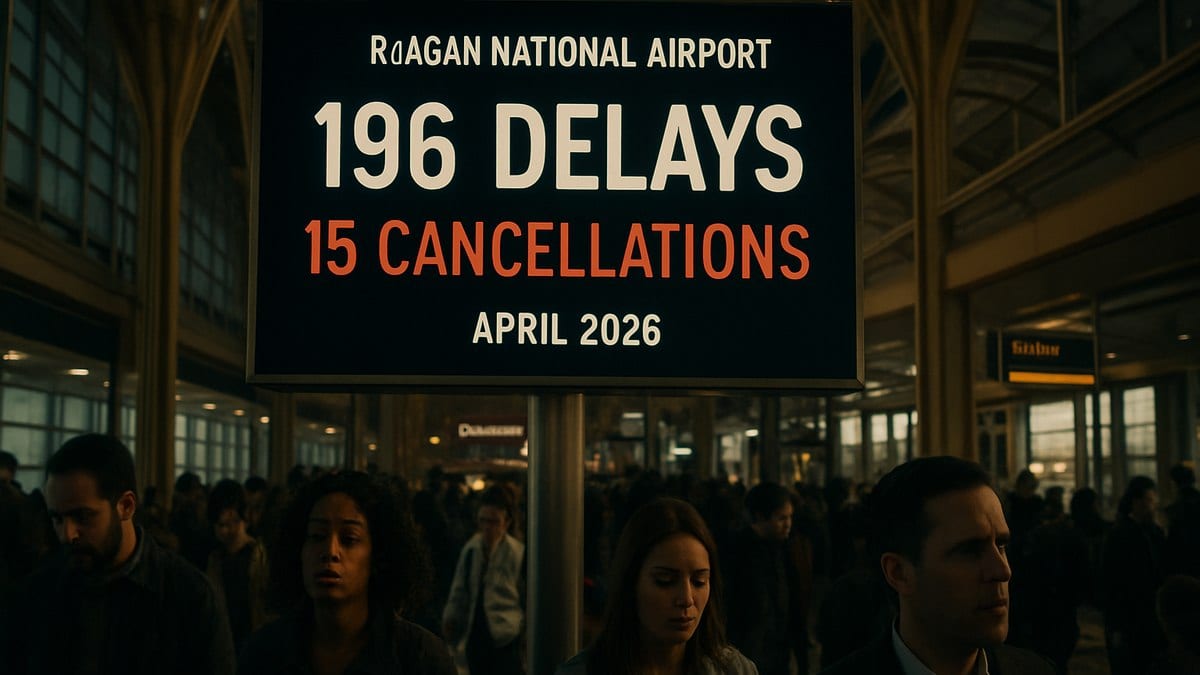
Weather Systems Snarl a Key East Coast Gateway
Reagan National, one of the country’s most slot constrained and weather sensitive airports, again found itself at the center of operational turbulence as unsettled conditions slowed departures and arrivals. Publicly available flight tracking data for April 5 showed delays mounting steadily through the morning and early afternoon as low clouds, gusty winds and passing showers forced tighter spacing between aircraft and occasional holding patterns.
Reports indicate that the disruptions were concentrated during peak travel periods, when airlines schedule dense banks of regional and mainline flights to connect Washington with major business and political centers. When weather reduces runway capacity in these windows, even modest schedule interruptions can quickly translate into a wave of late departures and missed connections.
The latest difficulties follow several weeks of elevated delay levels across the eastern United States as spring storm systems have repeatedly swept through the Mid-Atlantic and New England. Industry analysts note that with passenger volumes at or above pre-pandemic levels, there is little slack in the system when weather trims capacity at multiple airports simultaneously.
American, Delta and JetBlue Among Most Affected
American Airlines, the dominant carrier at Reagan National, bore a significant share of Sunday’s schedule strain as weather impacted both its Washington operations and key connecting markets such as New York and Chicago. Delays on shuttle-style routes between Washington and New York, which rely on quick turns and tight schedules, were particularly vulnerable once the first departures fell behind.
Delta Air Lines also experienced timing setbacks on flights linking Reagan National with its hub in Atlanta and with Boston, where unsettled conditions have lingered through early April. Because these services often operate in coordinated banks designed to feed onward connections, an initial pushback delay in Washington can cascade into late arrivals in Georgia or New England and additional adjustments later in the day.
JetBlue, which maintains a presence at both Reagan National and major Northeast airports, faced similar challenges on services into New York and Boston. Publicly available information shows that congestion at those airports, combined with weather-driven flow restrictions, contributed to longer taxi times and airborne holding, compounding schedule pressure across the network.
Other carriers operating at Reagan National reported more limited disruptions, but the concentration of delays among the three large operators underscored how tightly interconnected Washington’s air links are with nearby hubs along the East Coast.
Ripple Effects Across New York, Chicago, Boston and Atlanta
The 96 delays and five cancellations recorded at Reagan National did not remain confined to the Washington region. As aircraft and crews cycled through their daily rotations, bottlenecks in the nation’s capital fed into broader slowdowns at other high volume airports including New York area fields, Chicago, Boston and Atlanta.
In New York, where runway configurations and airspace complexity already leave little room for error on busy weekends, weather related metering programs contributed to longer intervals between arrivals and departures. When combined with inbound delays from Washington and other cities, this led to extended gate holds and revised departure times on several shuttle and corridor routes.
Chicago and Atlanta, both central hubs for their respective airlines, also felt the knock-on effects as late arriving aircraft from the East Coast forced daylong schedule reshuffles. Published coverage on recent travel patterns indicates that even a handful of late inbound flights can require crew reassignments, aircraft swaps and revised departure slots across multiple cities.
Boston, which has contended with its own bouts of unsettled spring weather this year, saw additional pressure on Sunday as delayed flights from Washington and New York arrived during already busy afternoon peaks. Aviation observers point out that when several of these airports experience weather at the same time, the entire eastern corridor becomes more susceptible to rolling delays.
Travelers Confront Lines, Missed Connections and Rebookings
For passengers at Reagan National and at downline airports, Sunday’s operational picture translated into long check in queues, crowded gate areas and a spike in missed connections. Many travelers reported extended waits for updated departure times as airlines worked to sequence flights through constrained departure windows and adjust to evolving weather advisories.
Families and leisure travelers heading home from spring break trips faced particular uncertainty, with some itineraries requiring same day rebooking or overnight stays when connections through New York, Chicago or Atlanta became impractical. Airline mobile applications and alert systems again served as critical tools, allowing travelers to monitor gate changes, standby lists and alternative routings in real time.
Publicly available guidance from travel and consumer advocates continues to emphasize several strategies for navigating these kinds of disruptions, including packing essential items in carry on bags, proactively seeking alternative routings through less congested hubs and considering earlier departures on days with active weather in the forecast. Those steps can reduce the risk of becoming stranded should later flights be delayed or canceled.
Airport services at Reagan National, such as concessions and seating areas, saw heavier than usual demand as passengers waited out rolling delays. While operations remained far from the mass shutdowns occasionally seen during major winter storms, Sunday’s events highlighted how even a relatively modest number of cancellations can create a challenging environment when many flights are departing late.
Another Test for a Congested Airport and Busy Spring Season
The latest disruption adds to a growing list of weather and volume related challenges at Reagan National, which has long operated near the limits of its physical capacity. With closely spaced runways, strict slot controls and complex nearby airspace, the airport is particularly sensitive to changes in runway visibility, crosswinds and traffic management initiatives along the East Coast corridor.
Recent national statistics compiled by aviation trackers show that delays have been elevated at several major U.S. hubs since the start of the spring travel season, driven by a mix of active weather patterns, tight airline schedules and ongoing staffing constraints in parts of the air traffic system. For Washington area travelers, that has often translated into more frequent gate holds and in flight holding patterns when storms roll through during peak hours.
Looking ahead into the rest of April, meteorologists are monitoring additional systems likely to move across the central and eastern United States, raising the possibility of further disruption on some weekends. Travel experts suggest that passengers flying through Reagan National, New York, Chicago, Boston or Atlanta build extra time into itineraries, especially when making connections to international flights or time sensitive engagements.
As Sunday’s 96 delays and five cancellations demonstrated, even a single day of unsettled conditions can reverberate through the tightly choreographed networks of major carriers. For now, Reagan National remains a vital but fragile link in the country’s air transport system, where weather in Washington can quickly become a national travel story.