

On a low, limestone shore of Lake Ontario, the village of Wellington has quietly evolved from a farm service hub into one of Canada’s most intriguing small wine destinations.
Surrounded by vineyards, framed by a pebble beach and lighthouse, and infused with the easy pace of Prince Edward County, Wellington offers a compact but remarkably rich mix of cellar doors, lakeside dining and rural charm that feels far removed from urban Ontario, yet remains an easy escape from Toronto, Ottawa or Montreal.
Where Wellington Sits on Lake Ontario’s Wine Map
Wellington lies on the north shore of Lake Ontario in Prince Edward County, a roughly heart-shaped peninsula separated from mainland Ontario by the Bay of Quinte. This area was officially recognized as a Vintners Quality Alliance appellation in 2007, making it the province’s newest designated wine region. The village itself is small, with fewer than 2,000 residents, but it punches far above its weight as a base for exploring nearby vineyards and shorelines.
The village occupies a gentle stretch of shoreline where limestone bedrock meets the lake. To the west and north, wineries spread out along quiet country roads toward the Hillier region, while eastward the highway leads to Picton, the county’s other main hub. For visitors, Wellington’s appeal lies in this centrality. It is close to the vineyards, within easy reach of Sandbanks Provincial Park, yet still feels like a lived-in community rather than a purpose-built resort.
Lake Ontario is more than a scenic backdrop here. Its mass of water helps moderate temperatures in this northern cool-climate zone, softening winter lows and taking the edge off summer heat. That moderating effect, combined with the county’s stony soils, is what persuaded early winegrowers to plant vines and what continues to shape the style of wine pouring in Wellington’s tasting rooms today.
Wellington’s identity as a wine village is recent compared with its longer agricultural history. Settled in the late 18th and early 19th centuries, the area once gained recognition for canning fruits and vegetables. Today those canning factories have closed, but a new high-value agriculture has taken root. Vineyards now occupy slopes and fields where other crops once grew, and many visitors come precisely to taste how the land has reinvented itself in the glass.
The Prince Edward County Terroir Explained
To understand Wellington as a wine village, it helps to grasp what makes Prince Edward County’s terroir distinctive. This is Ontario’s most northerly recognized appellation, and conditions here are cooler than in the Niagara Peninsula or along Lake Erie. Summer temperatures are moderated by the lake, but winters can be harsh enough that some producers still bury vines to protect them from severe cold. The growing season is relatively short, which favours early ripening varieties and a style of wine that emphasizes acidity and finesse over sheer ripeness.
Underfoot, the county rests on fractured limestone bedrock overlain by thin layers of clay loam or sandy loam embedded with stone fragments. In practical terms, that means excellent drainage, forcing vine roots to probe down toward the limestone. Winegrowers and sommeliers often credit these soils with giving local wines a pronounced mineral character, particularly in Chardonnay and Pinot Noir. Low yields are common, and concentration in the fruit tends to be high, though expressed in a restrained, cool-climate way rather than with lush, opulent flavours.
From a stylistic standpoint, Prince Edward County has become best known for three categories of wine. First are its lean, precise Chardonnays, often fermented and aged in oak with a degree of Burgundian inspiration but retaining bright acidity and relatively modest alcohol. Second is Pinot Noir, typically pale in colour but layered with savoury notes and a long, mineral finish. Third is sparkling wine, both traditional method and charmat style, which thrives thanks to naturally high acidity and the moderating lake influence.
Beyond these flagships, wineries around Wellington also experiment with aromatic whites, rosés and small volumes of reds like Cabernet Franc and Gamay. The quantities produced in the county are small compared with larger Canadian regions, and many wines are only available locally, which adds to the sense of discovery when you walk into a Wellington tasting room. Visitors should expect more artisanal than industrial, with winemakers frequently on-site and often directly involved in pouring and explaining their wines.
Wellington as a Village: Beach, Boardwalk and Main Street
Although Wellington’s wine narrative draws many travellers, the village maintains a quietly domestic scale. The main street runs close to the lake, lined with historic homes, small inns, cafes and a handful of contemporary design-forward spaces. There is no skyline here, only church spires, mature trees and the occasional glimpse of vineyard rows or sailboat masts between houses.
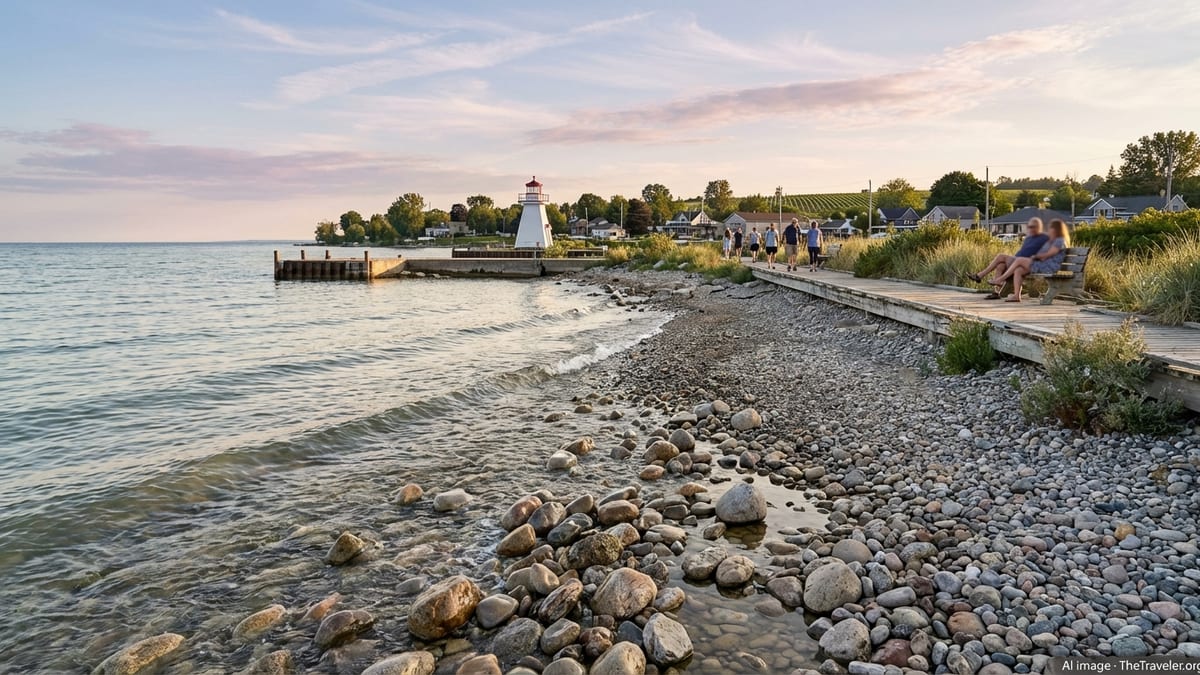
The lakefront is the village’s outdoor living room. Wellington Beach is a long, mostly pebble and stone shoreline that looks directly across West Lake toward the sand dunes of Sandbanks Provincial Park. A boardwalk runs along the water, leading to a compact lighthouse that serves as both navigational aid and photo backdrop. On summer evenings the boardwalk becomes a casual promenade, with locals and visitors strolling, dogs tugging at leashes and the sound of waves carrying across the stones.
Just back from the beach, a waterfront park provides open lawns, picnic tables and a playground. This is where you see multigenerational groups gather, where children alternate between the swings and the water’s edge, and where beach coolers might hold as many local wines and ciders as soft drinks. The atmosphere is relaxed and low-key, more cottage-country than resort strip, which is precisely what many visitors are seeking.
On Saturdays from late spring through early autumn, Wellington’s farmers’ market adds an extra layer of energy. Stalls typically feature County-grown produce, baked goods, prepared foods, artisan crafts and, increasingly, products linked to the wine and beverage scene such as preserves made with local grapes or snacks designed to pair with tasting-room flights. The market offers a concise snapshot of the broader food ecosystem that underpins the wine industry, from growers supplying the area’s restaurants to hobbyists experimenting with small-batch creations.
Inside the Wine Village: Tasting Rooms and Wine Culture
What distinguishes Wellington from a generic lakeside town is the way wine culture has woven itself into village life. Within the village proper and in the surrounding countryside, visitors encounter tasting rooms, wine bars, bottle shops and restaurants that centre local wine on their menus. Many operations are small and independently owned, reflecting the broader character of Prince Edward County’s wine industry, which is built on family-run estates rather than large corporate brands.
Within a short drive of Wellington’s main street, vineyards spill across gently rolling land. The soils and mesoclimates vary from one site to another, but the constant is proximity. It is possible to visit several wineries in a single afternoon without racking up many kilometres, especially along the country roads leading toward Hillier. Some estates occupy repurposed barns, others sleek contemporary tasting rooms, yet most share an emphasis on outdoor spaces where guests can sip while looking over vines or out toward the lake.
Inside the village, wine bars and specialty bottle shops provide another entry point. A growing number of venues focus on small-batch Ontario wines, both from the county and from other regions, giving visitors a curated overview of the province’s evolving wine scene. It is here that you may encounter more experimental bottlings, limited releases or wines too small in production to reach wider retail shelves. Staff tend to be well-versed in the local terroir and can often bridge the gap between visitors and producers with personalized recommendations.
Crucially, Wellington’s wine culture is designed to be inclusive. Tastings might offer flights that highlight the difference between vineyard sites or vintages, but the tone is generally accessible rather than overly technical. Many visitors arrive with only a casual interest in wine, drawn more by the lake and village atmosphere, and find that tasting experiences are pitched to meet them where they are. Children and non-drinkers are usually accommodated with outdoor seating, juice, local sodas or snacks, making winery visits a realistic option even for mixed-interest groups.
Beyond the Glass: Food, Lodging and Experiences
Wine alone rarely sustains a destination. In Wellington, the culinary scene has evolved alongside the vines, with restaurants, cafes and lodgings oriented toward visitors who care about what is on their plate as much as what is in their glass. Despite the village’s modest size, the choices are surprisingly broad, ranging from simple lakeside takeout to chef-driven dining rooms that attract food-focused travellers from major cities.
Lakeside restaurants are a particular draw, offering patios that look out over the water, sometimes with firepits or lawn seating that blur the line between restaurant and backyard. Menus typically lean on seasonal, locally sourced ingredients, reflecting the county’s agricultural base. Expect Lake Ontario fish when available, County-raised meats, and plenty of produce from nearby farms. Wine lists offer a chance to compare local bottles with selections from other cool-climate regions abroad, reinforcing Wellington’s place within a wider wine conversation.
Accommodation in and around Wellington spans several styles. There are design-forward boutique hotels that blend contemporary art with rustic materials, restored inns in heritage buildings and numerous bed and breakfasts and vacation rentals scattered along quiet side streets and rural lanes. The variety makes the village suitable for both couples’ getaways and extended family stays, with options ranging from simple rooms above a restaurant to multi-bedroom lakefront homes suited to longer visits.
Beyond eating and drinking, Wellington offers activities that complement the wine experience without overwhelming it. The harbour serves as a launch point for paddleboarding, kayaking and small-boat excursions, with rentals commonly available in the warmer months. Cyclists use the relatively flat terrain and rural road network to string together winery visits with shoreline detours, while walkers gravitate to the boardwalk, nearby Millennium Trail and short strolls through residential streets lined with mature trees and gardens.
Planning Your Visit: Seasons, Logistics and Etiquette
Wellington’s character changes noticeably with the seasons. Summer brings the fullest crowds, warm lake breezes and the most reliable beach weather, but also the highest demand for accommodation and restaurant reservations. Late spring and early autumn can be particularly appealing for wine-focused trips, with fewer visitors, cooler temperatures and vineyard landscapes transitioning between budburst, full canopy and harvest. Winter is quieter again, with some wineries and venues reducing hours, but the village takes on a contemplative, almost introspective feel that appeals to repeat visitors.
Reaching Wellington usually involves driving. The village sits south of the main highway corridor that connects Toronto and Montreal, and is most commonly accessed via Belleville or Trenton. Once in the county, distances remain short, but rural roads, limited public transport options and the dispersed nature of vineyards make having your own vehicle or arranging a local driver highly practical. Several tour operators and shuttle services in the county offer winery circuits that start or stop in Wellington, giving visitors an alternative to self-driving.
When planning tasting visits, it is wise to check seasonal hours and consider booking ahead, especially during peak months and weekends. Many wineries remain small operations where the same staff handling the crush or vineyard work also pour in the tasting room. Reservations help them manage capacity and ensure guests have enough time to enjoy flights or tours. For walk-in visitors, midweek and earlier in the day tend to be quieter times.
Basic wine-country etiquette applies in Wellington. Designate a driver if you plan to visit multiple wineries in a day, taste rather than drink full pours, and respect the rural setting by keeping noise down and sticking to marked paths among the vines. If you are travelling with children or dogs, check individual winery policies in advance, as some welcome families and pets on leashes while others maintain more controlled environments. Above all, remember that for many residents the village is home first and tourist destination second, and approach interactions with the unhurried politeness that defines life in the county.
Why Wellington Works as an Intro to Canadian Cool-Climate Wine
For travellers curious about Canadian wine but unsure where to start, Wellington offers a particularly approachable entry point. Its compact scale, walkable core and closeness to multiple wineries reduce the logistical friction that sometimes comes with exploring rural wine regions. You can arrive, park your car, and spend much of your time moving on foot between beach, main street and dinner, punctuating days with short drives or tour pick-ups to nearby vineyards.
The style of wine produced around Wellington also lends itself to discovery. Cool-climate Chardonnay and Pinot Noir, along with crisp sparkling and aromatic whites, tend to have moderate alcohol levels and bright acidity, making them accessible to a wide range of palates. Winegrowers here are still young in generational terms, often more driven by experimentation and learning than by rigid traditions, which can translate into open, conversational tasting room experiences.
At the same time, the larger context of Prince Edward County positions Wellington at the intersection of several broader travel trends. There is a growing appetite for rural escapes that combine food, wine and nature without requiring long-haul flights. There is interest in low-intervention and terroir-driven wines that express specific places. There is also a renewed appreciation for smaller communities revitalizing themselves through creative, locally anchored economies. Wellington embodies all of these threads, yet remains small enough that visitors can still sense its underlying rhythms and not just its surface offerings.
Perhaps most importantly, the village shows how wine can enhance rather than overwhelm a place. Vineyards and tasting rooms have arrived, but they coexist with community institutions such as the local school, heritage museum and weekly market. The boardwalk remains as important as any bar stool. On any given day, the lake may be more crowded than the wineries. That balance gives Wellington staying power as a destination and preserves the authenticity that first drew people to the county’s shores.
The Takeaway
Wellington’s emergence as a wine village on Lake Ontario represents both continuity and change. The continuity lies in its longstanding relationship with agriculture, its dependence on the waters that shape local weather and livelihoods, and its scale as a tight-knit community where main street businesses still greet regulars by name. The change lies in the grapes now clustering where other crops once stood, the tasting rooms sharing space with hardware stores and grocery aisles, and the visitors arriving not only for beach days but for flights of Chardonnay and Pinot Noir.
As more travellers seek destinations that feel grounded and genuine, Wellington stands out by being exactly what it is: a small lakeside village that has embraced wine culture without surrendering its character. The pebble beach, the lighthouse, the weekend market and the quiet residential streets are as central to its identity as any acclaimed bottle. For those willing to slow down, taste carefully and look closely, Wellington offers a concentrated, walkable introduction to Canadian cool-climate wine and a compelling reason to linger on this particular corner of Lake Ontario.
FAQ
Q1. Where exactly is Wellington located?
Wellington is a small village on the north shore of Lake Ontario in Prince Edward County, eastern Ontario, roughly south of Belleville and Trenton.
Q2. Why is Wellington known as a wine village?
Wellington sits within the Prince Edward County appellation, surrounded by vineyards and wineries that specialize in cool-climate wines such as Chardonnay, Pinot Noir and sparkling wine.
Q3. What types of wine is the region best known for?
The area around Wellington is particularly noted for mineral-driven Chardonnay, elegant Pinot Noir and crisp sparkling wines, alongside smaller volumes of aromatic whites and rosés.
Q4. When is the best time to visit Wellington for wine tasting?
Late spring through early autumn offers the fullest range of open wineries and events, with summer busiest and shoulder seasons generally quieter but still rewarding.
Q5. Do I need a car to explore wineries near Wellington?
A car or organized tour is highly practical, as vineyards are spread along rural roads with limited public transport, though some visitors also incorporate cycling for shorter distances.
Q6. Is Wellington suitable for families as well as wine enthusiasts?
Yes, the village beach, boardwalk, playground, farmers’ market and outdoor dining options make it appealing for families, though parents should check winery policies regarding children in advance.
Q7. How many days should I plan to stay in Wellington?
A weekend allows for a snapshot of the village, beach and a few wineries, while three to four days provide enough time to explore more vineyards and nearby attractions at a relaxed pace.
Q8. What should I wear when visiting wineries around Wellington?
Smart-casual clothing is typical, with comfortable footwear for walking between tasting bars and outdoor seating; layers are useful as lake breezes can change temperatures quickly.
Q9. Are reservations required for tastings and restaurants?
During peak summer and holiday periods, reservations are strongly recommended for both winery tastings and popular restaurants, while walk-ins are more feasible midweek and in shoulder seasons.
Q10. Can I visit Wellington without being a serious wine drinker?
Absolutely. Many visitors come for the lakeside setting, local food, markets and relaxed village atmosphere, treating wine as one element of a broader Prince Edward County escape.