

More news on this day
Escalating conflict in West Asia and widespread airspace closures are forcing many Pune residents to shelve long-planned Gulf holidays, as disrupted flights and soaring airfares push travellers toward European city breaks and premium domestic destinations instead.
Get the latest news straight to your inbox!
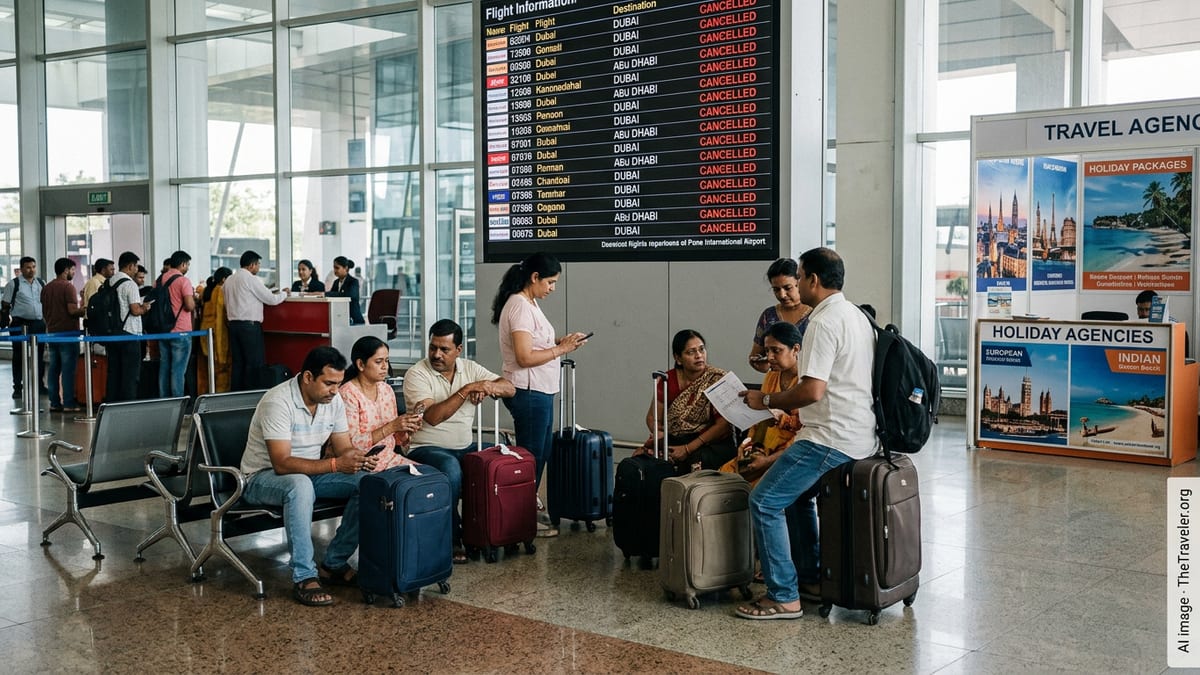
Flight Cancellations Leave Pune–Gulf Corridor in Disarray
Recent disruptions across Gulf airspace have translated into abrupt cancellations on key Pune routes, interrupting what is typically a steady stream of leisure and family traffic to Dubai, Abu Dhabi and other West Asia hubs. Published coverage on Pune airport operations indicates that multiple flights on the Pune–Dubai and Pune–Abu Dhabi sectors have been scrubbed or rerouted in the wake of the latest escalation, leaving outbound tourists with few same-day alternatives.
The wider regional picture shows that Pune is caught up in a much larger aviation shock. Reports from international and Indian media describe airspace closures over Iran, Iraq, Kuwait, Bahrain, Qatar and parts of the United Arab Emirates, effectively shutting down major hubs in Dubai, Abu Dhabi and Doha. These airports function as critical connectors for Indian travellers, and their partial or full suspension has sent shock waves through airline schedules and ticket inventories.
Industry-focused reports tracking Indian carriers note that on peak disruption days in early March, more than 250 international flights to and from West Asia were cancelled across the country in a single day. Those scrapped services include a mix of point-to-point Gulf flights and long-haul sectors to Europe and North America that normally transit through the region, underscoring how vulnerable Indian outbound travel remains to volatility in West Asia.
Travel advisories and public statements from airlines show that carriers have introduced temporary waivers on change fees and are offering full refunds on specific Middle East and connecting itineraries. For many Pune-origin passengers, however, the immediate reality has been missed departures, long queues at airline counters, and difficult choices between postponing holidays altogether or paying substantially more to reroute via alternative hubs.
Surging Airfares Price Out Leisure Trips to the Gulf
Even where flights are technically operating, the cost of reaching Gulf destinations from India has climbed sharply. Business media tracking fare trends report that economy-class return tickets on India–West Asia routes are now trading at up to three or four times their usual levels on some dates, driven by war-risk insurance surcharges, longer detours to avoid conflict zones, and constrained seat supply.
Specialist aviation analyses suggest that war-risk insurance alone can add tens of thousands of rupees per passenger on certain high-exposure sectors, on top of already elevated fuel and operational costs. For Pune holidaymakers heading to popular shopping and entertainment hubs such as Dubai, what might have been a relatively affordable family getaway a month ago now risks breaching overall budget caps before hotel and activity costs are even factored in.
Personal finance coverage of the disruption points to a noticeable shift in consumer behaviour across India, with online travel agencies and tour operators reporting a 20 to 25 per cent rise in cancellations or rescheduling requests on routes touching the Middle East. For price-sensitive leisure travellers from Pune, this combination of uncertainty and cost escalation appears to be tilting decisions toward either full cancellation or a pivot to destinations that are perceived as safer and more predictable.
Industry associations have warned that if airspace restrictions and geopolitical tensions persist into the summer peak, outbound leisure traffic to the Gulf could see an extended downturn. The Gulf region accounts for a disproportionately high share of India’s outbound movements, and a prolonged squeeze on that corridor would reverberate through airlines, hotels and ground operators that rely heavily on Indian tourists.
Europe Beckons as Airlines Reroute Around the Gulf
While the Gulf is bearing the brunt of cancellations, Europe is emerging as both a challenge and an opportunity for Indian travellers. Coverage of long-haul markets shows that fares on some India–Europe routes have also risen, particularly for nonstop services and last-minute bookings, as airlines reconfigure flight paths to skirt conflict zones and cope with the continuing closure of Pakistani airspace.
However, European tourism boards and carriers that do not rely on Gulf hubs are becoming relative beneficiaries of the shift. Travel-industry reports indicate that with Dubai, Abu Dhabi and Doha temporarily constrained, many Indians bound for Europe are rebooking via alternate gateways such as Addis Ababa, Colombo and select Central Asian cities, or opting directly for European carriers operating over more northerly corridors. This has kept the Europe leisure pipeline open, even as routings become more complex.
For Pune residents, that means a changing conversation in travel agencies and online planning forums. Instead of short Gulf city breaks, itineraries are being reworked into longer European holidays that justify higher airfares by packing in multiple destinations, such as London paired with Paris, or central European circuits that combine Prague, Vienna and Budapest. Package operators are highlighting these multi-stop options to travellers who would rather upgrade to a longer-haul experience than lose a valuable block of annual leave.
Industry observers note that the disruption to one of India’s busiest travel corridors may accelerate an existing trend: the steady diversification of outbound preferences beyond the Gulf. Over the past few years, Europe has been drawing a growing share of first-time international tourists from tier-two cities like Pune. The current crisis, by redirecting demand away from West Asia, is likely to give that trend further momentum through 2026.
Domestic Tourism and Short-Haul Alternatives Gain Ground
With uncertainty clouding Gulf itineraries and some Europe routes turning pricier, domestic destinations are moving quickly into the spotlight for Pune travellers. Reports on India’s travel market in early 2026 show robust demand for hill stations, coastal resorts and heritage circuits, with many properties in Goa, Rajasthan, Uttarakhand and Himachal Pradesh reporting strong forward bookings for the summer months.
Booking data cited in national business coverage suggests that a growing number of customers who originally intended to travel to Dubai or other Gulf cities are shifting to Indian beach or mountain holidays instead. For families in Pune, a week in Goa, the Konkan coast or the Western Ghats offers a combination of cost control, easier access and minimal visa or routing complications compared with navigating disrupted international hubs.
Short-haul international alternatives in Southeast Asia are also attracting attention as relatively stable and affordable stand-ins for Gulf breaks. Travel industry trackers note that routes to Bangkok, Singapore and Kuala Lumpur remain largely unaffected by the West Asia conflict, and in some cases still offer competitive fares relative to the inflated prices on Gulf sectors. These cities provide shopping, nightlife and family attractions that appeal to the same demographic that often chooses Dubai or Abu Dhabi.
Tour operators are responding by repackaging existing domestic and Southeast Asian products as “Gulf alternative” holidays, according to trade reports. From Pune’s perspective, this means more aggressive promotion of fly-and-stay deals to Goa and Kerala, self-drive itineraries in Maharashtra, and bundled packages to Thailand or Singapore that can be reached without transiting volatile airspace.
What Pune Travellers Should Watch in the Weeks Ahead
Analysts following the aviation and tourism sectors advise that the trajectory of outbound travel from cities like Pune over the next few months will largely depend on how long airspace closures and conflict conditions in West Asia persist. If hub airports in the Gulf reopen fully and war-risk premiums moderate, airlines may gradually restore capacity and adjust fares, pulling some leisure demand back to traditional corridors.
In the near term, publicly available airline advisories and financial press coverage highlight several points that Pune travellers are being urged to monitor. These include the validity of change-fee waivers and refund windows, potential schedule revisions on connecting European flights, and any fresh government travel guidance related to conflict zones. Passengers holding tickets that involve transits through Gulf hubs are being encouraged, in widely distributed consumer reports, to check booking status frequently and keep alternative routings in mind.
As the situation evolves, the disruption is also expected to shape booking behaviour for the next holiday season. Industry commentators note that travellers burned by last-minute cancellations are more likely to seek flexible fares, buy additional travel insurance and diversify destination choices, spreading trips across Europe, Southeast Asia and domestic circuits rather than relying heavily on the Gulf alone.
For Pune’s travel market, the immediate impact of the West Asia conflict is visible in cancelled Gulf holidays and anxious queues at airport counters. The longer-term effect may be a more structurally diversified outbound pattern in which Europe and high-quality domestic options permanently claim a larger share of the city’s holiday calendar.