

More news on this day
Escalating conflict in West Asia is forcing airlines from Hong Kong to the Gulf to rip up carefully planned schedules, suspend key routes and rapidly redraw the global map of long haul travel, with Cathay Pacific now joining Thai Airways, Saudia, Emirates, Etihad, Qatar Airways, Gulf Air and others in pausing services across the region.
Cathay Pacific Halts Middle East Services as Risk Spreads
Hong Kong flag carrier Cathay Pacific has suspended all passenger and cargo flights to Dubai and Riyadh as the security situation in West Asia deteriorates and airspace closures ripple across the Gulf. Services were initially paused from 28 February, with the suspension currently covering departures into mid March while the airline reviews fast moving military and regulatory developments.
The decision places Cathay in the same camp as a growing roster of global airlines that have pulled out of the region, at least temporarily, after hostilities between Iran, Israel and the United States triggered missile strikes and prompted multiple Gulf states to restrict or close their airspace. Travel advisories issued to corporate clients describe the move as a risk based response to evolving overflight restrictions rather than a reflection on any one destination.
Cathay is offering flexible options for affected passengers, including fee free rebooking, rerouting via alternative hubs and refunds. Corporate travel managers have been urged to audit itineraries for unintended stopovers in embargoed airspace and to ensure that duty of care obligations cover travellers whose journeys may now involve complex multi stop routings.
The suspensions have come at a delicate time for Cathay, which has been steadily rebuilding its long haul network since the pandemic. Analysts warn that even a short interruption in Middle East flying could slow Hong Kong International Airport’s recovery as a connecting gateway between North Asia, Europe and Africa.
Gulf Super Connectors Disrupted as Hubs Fall Quiet
The wider region has seen an unprecedented shutdown of aviation activity. Emirates in Dubai, Etihad in Abu Dhabi, Qatar Airways in Doha, Saudia and Gulf Air have all announced sweeping suspensions or severe reductions in services as airspace across Iran, Iraq, Israel, Jordan, Lebanon, Kuwait, Qatar, the United Arab Emirates, Oman and Saudi Arabia is restricted.
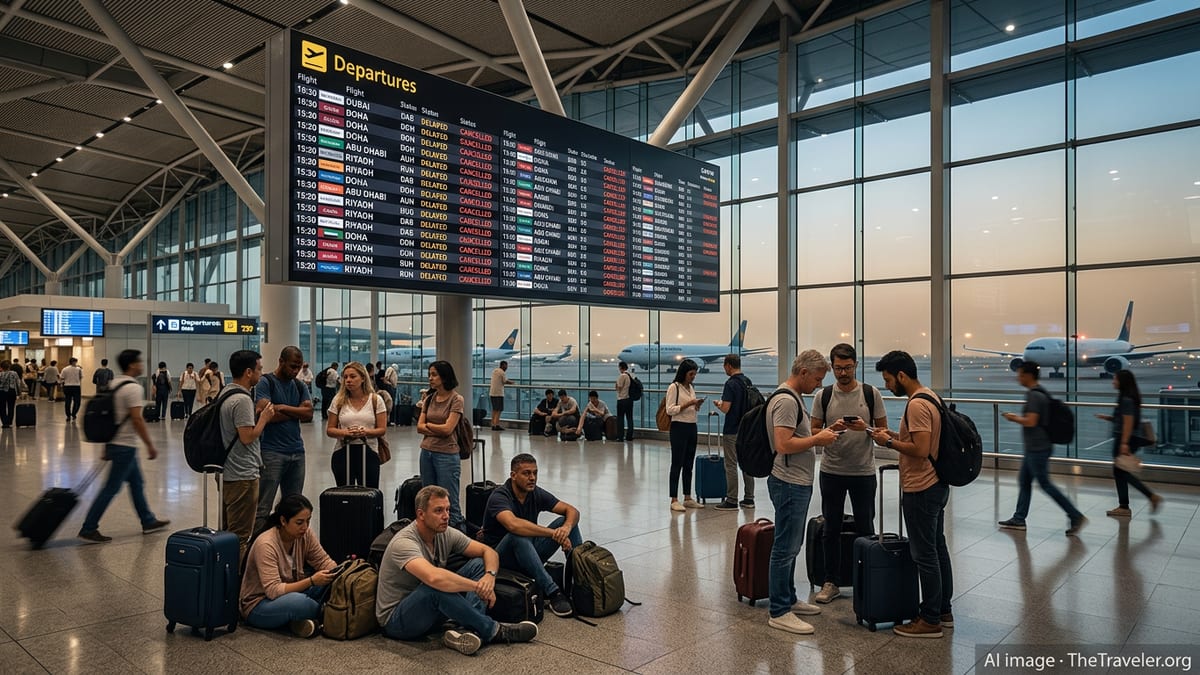
Key transfer hubs that normally handle tens of thousands of connecting passengers a day have at times fallen eerily quiet, with departure boards dominated by the word “cancelled.” Passengers who started their journeys in Europe or Asia before the conflict escalated have found themselves stranded in airports from Singapore to Istanbul as onward Gulf flights disappeared from schedules.
Some Gulf carriers have begun operating limited services using elongated routings that avoid contested skies, adding two to five hours to flight times between Europe and Asia. These detours increase fuel burn and crew costs, and they strain aircraft and crew rotations that were optimised for shorter, more direct routes via Iranian and neighboring airspace.
Regional airlines are also grappling with the sudden loss of intra Gulf and religious traffic, including services to key Saudi gateways used by pilgrims. For Saudia and Gulf Air, the combined hit to local demand and connecting flows is expected to weigh heavily on first half financial results.
Thai Airways, Saudia and Other Carriers Reroute or Suspend
Beyond the Gulf, a growing list of Asian, European and African airlines is altering flight paths or suspending services that touch West Asia. Thai Airways has adjusted schedules on selected Middle Eastern routes and is warning of possible delays and short notice changes even on flights that continue to operate.
Saudia has scaled back operations to several regional destinations as authorities balance security concerns with the need to maintain essential connectivity. Other carriers, including major European groups, have cut flights to Tel Aviv, Beirut, Amman and various Gulf cities, while also rerouting long haul services between Europe and Asia to avoid closed or high risk airspace.
Indian and Southeast Asian airlines are particularly exposed because many of their Europe bound flights typically rely on corridors that run close to or through the Gulf. In recent days they have published rolling updates detailing cancellations, extended block times and revised routings via the Caucasus or further south over Egypt and the Red Sea.
For travellers, the patchwork of airline responses can be difficult to navigate. Two passengers flying between the same city pairs on different carriers may face dramatically different experiences, from relatively normal services via northern corridors to multi stop journeys involving lengthy unscheduled layovers.
Global Network Knock On Effects and Longer Journeys
The sudden loss or restriction of West Asian airspace has upended the traditional geography of global air travel. For more than a decade, Gulf hubs have acted as a bridge between Europe, Africa and Asia, allowing airlines such as Emirates, Etihad and Qatar Airways to build dense global networks with convenient one stop connections.
With that bridge at least partially severed, airlines are turning to alternative routings that add distance and complexity. Some Europe to Asia flights are being pushed north through congested corridors over the Caucasus and Central Asia, while others loop south around the Arabian Peninsula, threading narrow paths between restricted zones.
These longer routes have immediate operational consequences. Flight times rise by hours, fuel consumption surges, and aircraft that would normally operate two long haul sectors a day may now be able to complete only one. That, in turn, reduces capacity on key trunk routes and exerts upward pressure on fares, particularly in premium cabins where demand from business travellers remains resilient.
Air cargo flows are also being reshaped. Freighter operators and belly cargo dependent airlines are rebalancing networks to maintain critical supply chains, sometimes shifting capacity to alternative hubs in South Asia, East Africa or Southern Europe. The additional flying time and insurance costs are likely to feed through to higher logistics prices in the weeks ahead.
Travellers Face Uncertainty, Higher Fares and Shifting Hubs
For passengers, the most immediate impact of the West Asia conflict is uncertainty. Timetables that once appeared stable are now subject to last minute change, and travellers are being advised to monitor airline apps and notifications closely in the days leading up to departure.
Flexible rebooking policies introduced by carriers such as Cathay Pacific, Emirates, Etihad, Qatar Airways and Thai Airways provide some relief by allowing date or routing changes without additional fees. However, rebooking onto alternative flights can be challenging as seats on unaffected routes, particularly those that bypass the Gulf entirely, fill up quickly.
Travel agents and corporate travel departments report a surge in interest for itineraries that avoid the conflict zone altogether, even at the cost of longer total travel times. Routes across the North Pacific and through Northeast Asian hubs have become especially attractive for journeys between North America and South or Southeast Asia, benefiting airlines that can offer competitive one stop options without relying on Gulf overflights.
In the medium term, aviation analysts expect the crisis to accelerate a gradual rebalancing of global connectivity. While Gulf carriers are likely to remain major players once conditions stabilise, the current disruption is highlighting the strategic value of alternative hubs in cities such as Istanbul, Hong Kong, Singapore and select South Asian gateways. For now, though, the industry’s focus remains firmly on managing day to day operations in an environment where airspace, risk assessments and passenger confidence can all shift overnight.