

More news on this day
A sudden escalation of conflict across West Asia has triggered one of the worst aviation disruptions since the pandemic, grounding more than ten thousand flights in a matter of days, closing key airspaces, and throwing global travel plans into chaos from Dubai and Doha to Delhi, London, and New York.
How the West Asia Conflict Shut the Skies
The current wave of disruption stems from U.S. and Israeli strikes on Iran that began on 28 February 2026, followed by Iranian missile and drone attacks across the Gulf. In response, airspace over Iran, Iraq, Kuwait, Israel, Bahrain, the United Arab Emirates, Qatar, and Syria has been partially or fully closed, forcing airlines to cancel or divert flights on a massive scale.
The closures hit at the heart of the global aviation network. Dubai, Abu Dhabi, and Doha function as critical east–west hubs linking Asia, Europe, Africa, and North America. With these corridors effectively severed for days, carriers from multiple continents have been forced into widespread cancellations and long detours around the region, adding hours of flying time and pushing schedules beyond their limits.
By early this week, data compiled by industry trackers and aviation authorities indicated more than 13,000 flight cancellations linked directly to the West Asia crisis since Saturday, with thousands more significant delays as aircraft and crews fell out of position worldwide. Analysts describe it as the most disruptive single geopolitical shock to global aviation since the reopening phase after COVID-19.
The knock-on effects are now stretching far beyond the Middle East. Flights between Europe and India, Southeast Asia, and Australia have been particularly affected, as have routes between South Asia and the Gulf. Even services that do not touch the region are seeing delays because aircraft and crews are stranded or arriving late from disrupted rotations.
Which Airlines and Routes Are Most Affected
Gulf mega-carriers have been hit first and hardest. Emirates, Etihad, Qatar Airways, flydubai and Air Arabia have all suspended large parts of their networks for at least several days, cancelling or severely curtailing flights to and from Dubai, Abu Dhabi and Doha as airspace restrictions shifted hour by hour. Limited emergency and evacuation flights, often operated in coordination with governments, are running, but regular schedules remain skeletal.
Across South Asia, Indian carriers have announced sweeping cancellations. Air India has scrapped dozens of international services, including onward connections from Delhi, Mumbai and Bengaluru to major European cities, after being forced to reroute around closed corridors. Low-cost and hybrid airlines such as IndiGo, SpiceJet and Air India Express have suspended or sharply reduced operations to Gulf destinations including Dubai, Sharjah, Doha, Muscat and Dammam on safety grounds.
The disruption is not confined to regional airlines. European majors like British Airways, Lufthansa, Air France-KLM and Virgin Atlantic, along with North American carriers, have cancelled or rerouted flights that normally overfly Iran and surrounding airspace on their way to India and Southeast Asia. Some long-haul services are operating on extended tracks over Central Asia or the Caucasus, but with reduced frequencies due to fuel, crew duty-time and fleet constraints.
Within the region, airports such as Dubai International, Abu Dhabi’s Zayed International, Hamad International in Doha, Jeddah, Dammam, Manama, Tel Aviv and Tehran have all reported hundreds of cancellations and delays over the past 72 hours. Pakistan, which kept its airspace open, has nonetheless cancelled more than 500 domestic and international flights in three days as airlines adjusted operations and dealt with diversions and congestion.
What Travelers Are Experiencing on the Ground
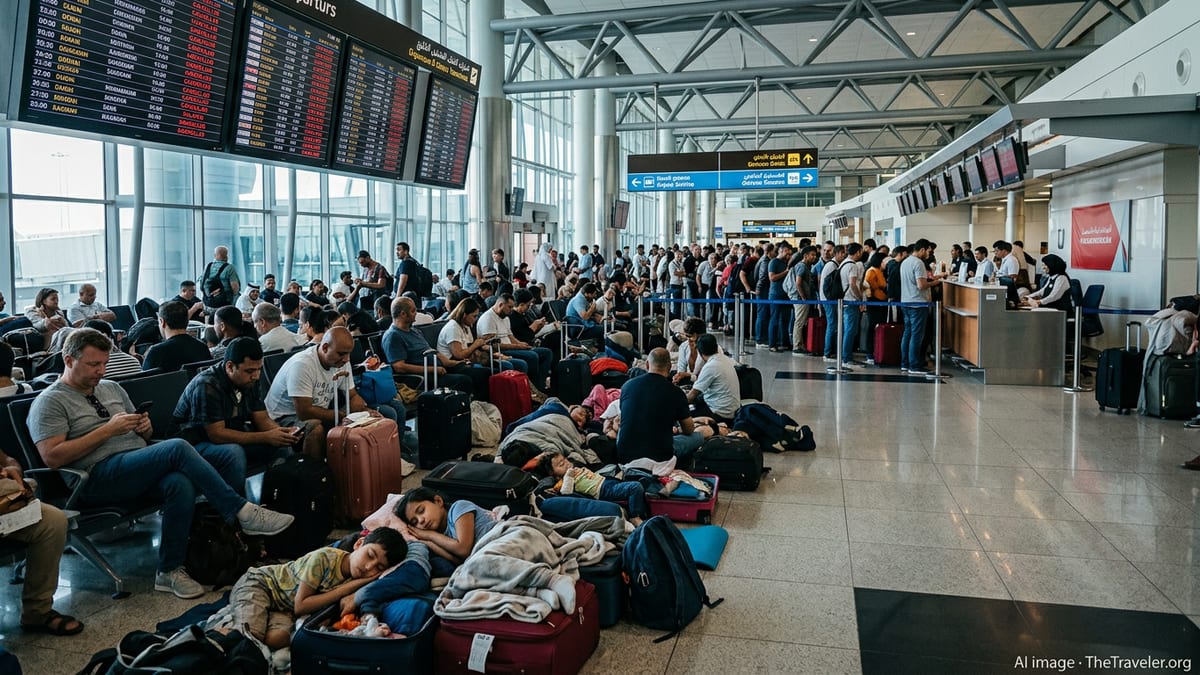
For passengers, the crisis has translated into long lines, crowded terminals and deep uncertainty about when they will reach their destinations. At major hubs in the UAE, Qatar and Saudi Arabia, tens of thousands of travelers are stranded, some sleeping in departure halls as rolling waves of cancellations outpace the supply of hotel rooms and rebooked seats.
Travelers transiting the Gulf are among the hardest hit. Many itineraries from Asia to Europe or North America rely on single-ticket connections via Dubai, Abu Dhabi or Doha. With those hubs largely offline, passengers are being rebooked on limited alternative routings via Istanbul, Central Asia or direct point-to-point flights, often days later than planned. Others are being routed back to their origin cities to wait out the crisis.
Scenes of confusion have unfolded far from the conflict zone. In Indian cities such as Delhi, Hyderabad and Chennai, airports have seen waves of last-minute cancellations to West Asia and beyond, leaving migrant workers, business travelers and families heading for holidays scrambling for information. In Europe, passengers bound for Asia are confronting abrupt overnight changes to routings and departure times as airlines rework flight plans.
Evacuation and repatriation efforts are adding another layer of complexity. Governments including the United States, several European states and Asian countries such as India and the Philippines are organizing special flights to extract citizens from the most affected areas. These operations, often secured with special airspace permissions, further strain limited airport capacity and ground resources.
Your Rights, Risks and Practical Next Steps
For travelers currently booked to fly through or over West Asia, the first rule is not to assume your flight is operating just because it appears on a booking confirmation. Schedules are changing by the hour as military activity, airspace notices and diplomatic negotiations evolve. Airlines are urging passengers to monitor their booking status via official apps and contact centers and to avoid showing up at the airport without confirmation.
Most carriers are offering flexible options, including free rebooking, travel vouchers or refunds, particularly for journeys touching closed airspace or suspended routes. However, the extent of these waivers varies by airline and ticket type. Premium and directly booked passengers generally have more generous options than those holding discounted fares purchased through online travel agencies or third parties.
Travel insurance is another critical piece of the puzzle. Many standard policies exclude coverage for disruptions related to war, hostilities and acts of terrorism, which means accommodation, meals and alternative transport may not be reimbursed. Travelers should review their policies carefully and, where possible, seek written clarification from insurers about what is and is not covered in the context of the current conflict.
Security experts advise that travelers reconsider non-essential trips that require transiting the affected region in the coming days, particularly leisure travel that can be postponed. Those who must travel for urgent reasons should build in substantial buffer time, carry essential medications and valuables in hand luggage, and be prepared for sudden changes to routing, stopovers and arrival times.
Planning Future Trips While the Situation Evolves
Looking ahead, much depends on how long active hostilities and related airspace closures persist. Aviation authorities and airlines are conducting rolling risk assessments, balancing pressure to restore connectivity with the overriding priority of keeping passengers and crews out of potential conflict zones. Even once missiles and drone attacks subside, regulators are expected to take a cautious approach before reopening key corridors.
For travelers planning trips in the coming weeks, flexibility will be more valuable than ever. Choosing itineraries that avoid multiple connections through the Gulf, opting for airlines with robust long-haul alternatives, and booking tickets that allow changes without punitive fees can all reduce exposure to sudden disruptions. Where possible, direct flights between continents that use more northerly routings may prove more resilient.
Agents and corporate travel managers are also revising their guidance. Many are temporarily advising clients to avoid routings via Dubai, Abu Dhabi and Doha, to consider alternative hubs such as Istanbul, and to keep contingency budgets for accommodation and ground transport in case of disruptions. Travelers with fixed-date events, such as cruises or large conferences, are being urged to arrive at least a day early and to secure refundable arrangements wherever possible.
While there are early signs of limited resumptions on select routes, industry analysts caution that the scale of cancellations, the dispersal of aircraft and crews, and the ongoing geopolitical uncertainty mean that normal schedules are unlikely to return quickly. For now, anyone planning to cross continents would be wise to treat routing via West Asia as high risk, stay closely informed, and build maximum flexibility into their travel plans.