

More news on this day
Austria’s southern rail axis has entered a new era as private operator Westbahn begins high-speed services from Vienna to Graz, Klagenfurt and Villach, a move poised to transform how tourists traverse the country.
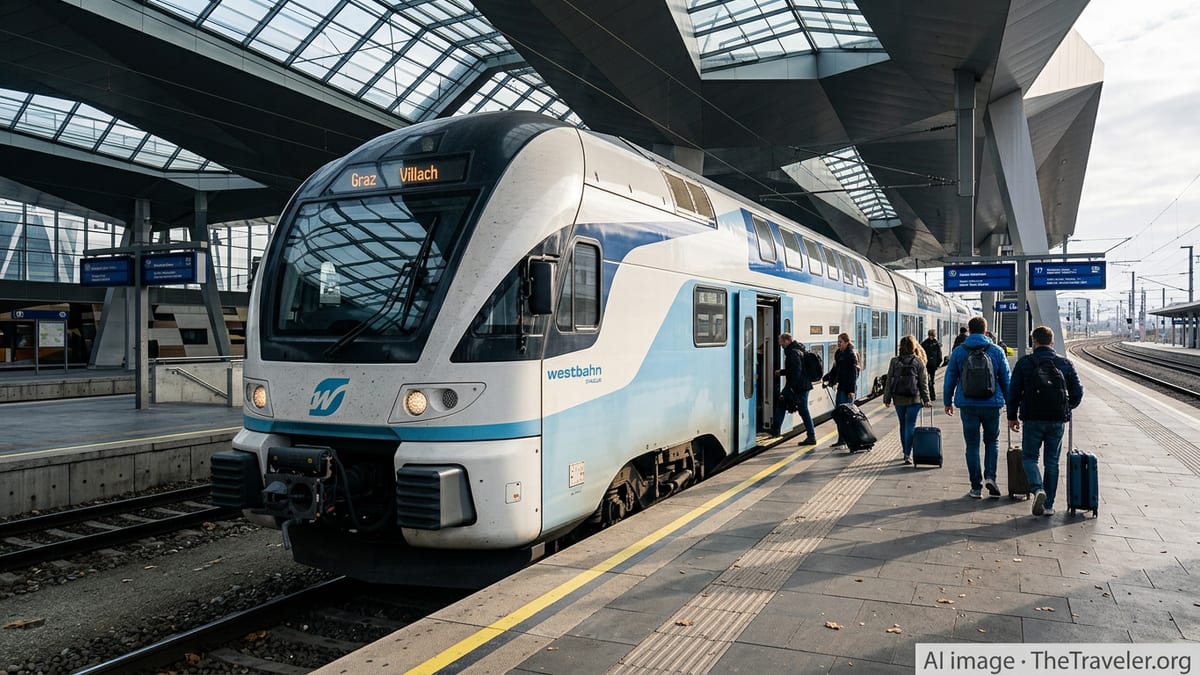
High-Speed Launch on Austria’s Southern Axis
From early March 2026, Westbahn trains are running for the first time on the Südbahn between Vienna, Graz, Klagenfurt and Villach, opening a privately operated alternative on one of Austria’s most strategically important rail corridors. The launch follows years of planning around the new Koralmbahn high-speed line, which links Styria and Carinthia and drastically shortens east–west travel times in the south of the country.
Initially, three daily Westbahn services per direction connect Vienna Hauptbahnhof with Villach via Graz and Klagenfurt, with a ramp up to five train pairs planned over the coming weeks. The operator is positioning the new route as a direct, high-comfort service for both business and leisure travellers, complementing and competing with existing long-distance services run by state operator ÖBB.
For Vienna, the expansion marks a decisive step beyond Westbahn’s original western axis between the capital and Salzburg. With the addition of Graz, Klagenfurt and Villach, the company now anchors both Austria’s western and southern high-speed corridors, signalling a more competitive long-distance rail market nationwide.
New Stadler SMILE Trains Raise the Bar
To operate on the Koralmbahn and associated high-speed sections, Westbahn has introduced new 11-car Stadler SMILE electric multiple units, capable of speeds up to 250 kilometres per hour. These are the first Stadler high-speed trains in Austria and represent a significant upgrade in rolling stock on the southern route, where higher speeds are essential to unlocking the full benefit of the new infrastructure.
Inside, the trains are configured for a mix of comfort and capacity, with large windows, power outlets at seats and reliable onboard Wi-Fi targeted at both tourists and commuters. Separate quiet zones and family-friendly areas aim to broaden the appeal beyond traditional business travellers, while luggage space and bicycle capacity are geared toward Austria’s growing active tourism market.
The SMILE fleet also underpins Westbahn’s branding as a modern, passenger-centric challenger. By matching or exceeding the comfort standards of ÖBB’s Railjet fleet, the company hopes to differentiate on service quality, punctuality and transparent pricing rather than on ticket discounts alone, a strategy that could encourage more travellers to choose rail over domestic flights or long-distance driving.
Tourism Links Between Vienna, Graz, Klagenfurt and Villach Strengthened
The new Westbahn services are expected to significantly reshape tourism flows across southern Austria by compressing journey times and strengthening direct city-to-city links. Graz and Klagenfurt, already brought much closer together by the Koralmbahn, are now tied directly to Vienna and Villach by an additional high-speed operator, giving visitors more timetable options and greater flexibility when planning multi-city itineraries.
Tourism officials in Styria and Carinthia are highlighting the potential for new rail-based routes that combine city stays with lakes and mountains. Travellers can now plan itineraries that start in Vienna, include a cultural stop in Graz, continue to the Wörthersee region around Klagenfurt and Pörtschach, and finish in Villach as a gateway to hiking and ski areas, all without changing operators. Direct stops such as Kühnsdorf-Klopeiner See further integrate popular holiday regions into the high-speed network.
Improved connectivity is also expected to shift domestic travel habits. With faster and more frequent rail options, weekend trips from Vienna to Graz or Carinthia become more attractive compared with driving, especially given parking and congestion concerns in historic city centres. Travel agencies are already beginning to package rail-inclusive city breaks and lake escapes that leverage the denser timetable on the southern axis.
Competitive Pressure and Capacity on the Southern Corridor
Westbahn’s move onto the Südbahn intensifies competition with ÖBB on a corridor that has only recently gained a full high-speed alignment. The presence of two long-distance operators on parallel Vienna–Graz–Klagenfurt–Villach routes increases total seat capacity and adds timetable diversity, which could prove crucial during peak holiday periods and major events in Graz or around Carinthian lakes.
For passengers, competition is likely to manifest in pricing strategies, loyalty offers and onboard amenities rather than in raw journey time, which is heavily dictated by infrastructure. Industry observers expect introductory fares and targeted promotions as Westbahn works to build brand awareness in markets where ÖBB’s long-distance products have long dominated. In turn, this could keep overall long-distance rail prices in check and help sustain the broader modal shift from road to rail.
The additional trains also enhance resilience on the corridor. In the event of disruption or capacity constraints on one operator’s services, travellers may find it easier to rebook on another provider, a benefit that has been evident for years on the busier western main line between Vienna and Salzburg. For tourism businesses that rely on reliable access for guests, this added redundancy is a welcome development.
Beyond the Koralmbahn: A New Spine for Austrian Tourism
The combination of the Koralmbahn high-speed line and Westbahn’s entry onto the Südbahn is creating what many in the sector describe as a new tourism spine across Austria’s south. Cities and resort regions along the Vienna–Graz–Klagenfurt–Villach axis are now better positioned to market themselves collectively, presenting a rail-linked chain of destinations rather than isolated local offers.
In the medium term, this could encourage more international visitors to explore beyond Vienna and Salzburg. With improved through-connections from Germany and other neighbouring countries into Graz and Villach, and with Westbahn now visible as an additional brand on booking channels, Austria’s southern regions gain a stronger platform to compete for city break, nature and active holiday segments.
As services bed in and frequencies rise toward the planned five daily Westbahn train pairs in each direction, the real test will be whether travellers embrace the new options in sufficient numbers. If they do, the Vienna–Graz–Klagenfurt–Villach line will not only symbolise Austria’s latest high-speed achievement, but also serve as a template for how infrastructure investment and private competition can jointly reshape national tourism connectivity.