

I arrived at Pacific Rim National Park Reserve with my head full of moody Instagram shots: mist curling over endless surf, empty beaches, and quiet forest trails where I would walk alone under dripping cedars. What I found was more complicated.
The park gave me some of the most powerful coastal scenery I have ever experienced, but it also tested my patience, my budget, and my expectations.
This is what it really felt like to visit, not as a brochure fantasy, but as one slightly damp, slightly sunburned, sometimes frustrated traveler.
Getting There: The First Reality Check
My Pacific Rim experience started long before I saw the ocean, on the slow, twisting drive across Vancouver Island. On a map, the park looks deceptively close to civilization. In reality, reaching the Long Beach Unit between Tofino and Ucluelet meant hours on a two-lane highway that wound through mountains, with construction zones, sharp curves, and the occasional line of RVs crawling along at a patient pace. I had imagined a relaxed coastal approach; instead I arrived with white-knuckled hands and stiff shoulders. If you are sensitive to motion or easily stressed by unpredictable driving conditions, this part of the trip is not a small detail. It sets the tone.
By the time I passed the Pacific Rim National Park Reserve sign, I had already learned my first lesson: this is not a quick, casual day trip. It is an investment of time, energy, and fuel. I also realized that I had underestimated the logistics. Everything from gas to food to accommodation becomes more precious the farther west you drive. The scenery along the way is beautiful, but the sense of remoteness is very real, and with that comes higher prices and fewer choices. I wish I had been more mentally prepared for that before I started out.
On the upside, the moment the forest opened and I caught my first glimpse of that grey-blue expanse of Pacific, the drive suddenly felt worth it. Even from the highway, the park’s coastal character is unmistakable: wall-to-wall trees, low clouds snagging on ridgelines, and signs pointing to beaches that already sounded iconic in my head. The contrast between the cramped, controlled experience in the car and the open, wind-swept promise outside the window was sharp, and in that tension I started to understand what visiting this place would be like.
Fees, Passes, and the Cost of “Wild”
I knew there would be fees, but I did not grasp just how central the park pass would be to my entire stay. At Pacific Rim National Park Reserve, simply existing on the beaches and trails within park boundaries requires a valid entry pass. The daily rate for an adult or a family group struck me as reasonable on paper, but in practice it added up quickly once I factored in multiple days and the fact that passes are checked at popular access points. I found myself doing mental math more than I expected, debating whether a quick beach stroll justified another day of fees or whether I should compress more activities into fewer days.
The pass system itself is clearly explained, and Parks Canada staff were patient when I asked questions. There are options like day passes, a four-hour “beach walk” pass, and annual passes. Still, as a visitor, I had to keep track of what I had bought, when it expired, and where to display it. The process reminded me less of stepping into wilderness and more of entering a managed attraction. I do not begrudge the concept of paying for conservation and services, but there was a moment of cognitive dissonance standing barefoot on a seemingly wild beach while also calculating the value of my park access against my budget.
For anyone planning a visit, I would strongly suggest running the numbers in advance. If you are staying several days and moving between beaches and trails often, an annual park-specific pass or even a broader Parks Canada Discovery Pass can make more financial sense than stacking daily fees. I did not do that homework beforehand, and I ended up paying more than I needed to. It was a small but irritating realization, because it was preventable with a bit of planning.
First Impressions of Long Beach: Wild Beauty, Human Crowds
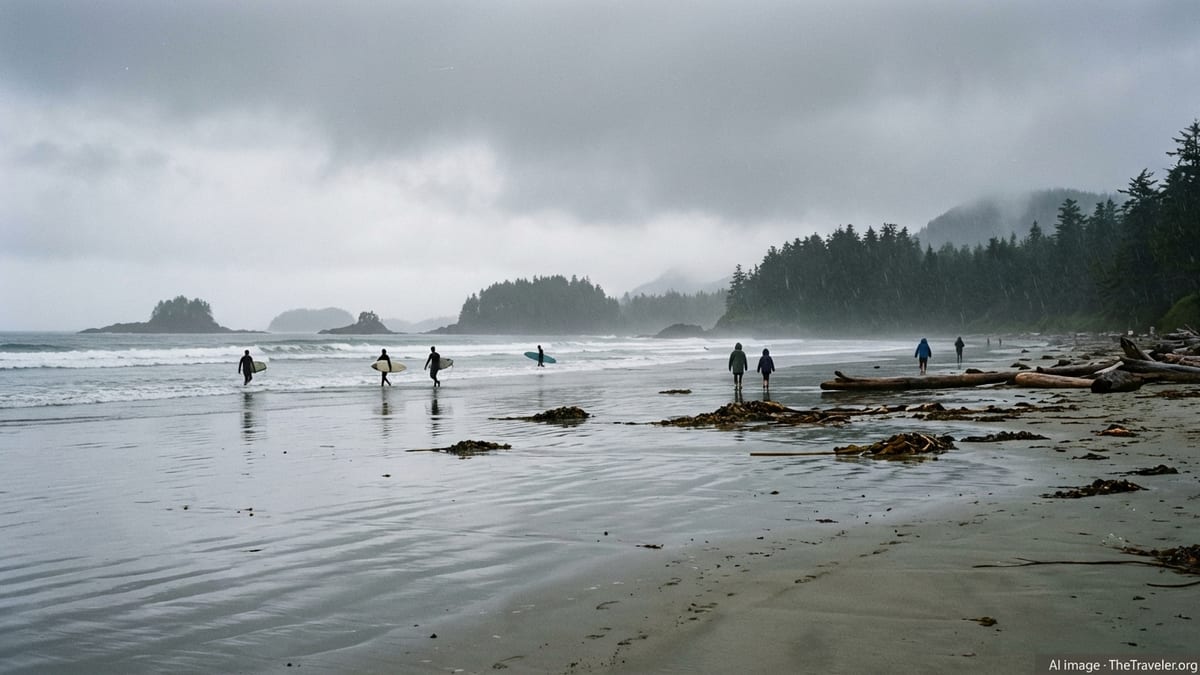
Like most visitors, I gravitated first to Long Beach, the most accessible and famous stretch of sand in the park. Stepping out from the parking lot, I finally confronted the image that had lived in my head for years. Even surrounded by other people, the place is impressive: a long arc of hard-packed sand, surf rolling in with steady rhythm, small islands of dark rock jutting out just offshore, and a horizon that seems to go on forever. The air smelled like seaweed and wet wood, and the wind carried a fine mist that found every bit of exposed skin.
It was also busy. On my first afternoon, the parking lot was almost full, with cars squeezed into improvised spaces along the road edges. Families hauled coolers and beach toys; surfers wriggled into wetsuits in between car doors; dogs chased each other in frenzied loops. It was not the empty, contemplative shore I had daydreamed about. At first, I was disappointed. Then I reminded myself that for many people, including local residents, this is a beloved, everyday beach, not a museum exhibit kept quiet for outsiders.
Once I walked a little farther from the main access point, the crowd thinned. Within fifteen minutes, I had more breathing room and could finally let the scene sink in. The scale of the place is humbling. Even with other humans dotted along the shore, the beach still feels big enough to absorb them. I realized that my frustration had less to do with the number of people and more to do with my unrealistic expectation of solitude at a popular, accessible coastline in peak season. In shoulder season or on a grey, wet morning, I suspect the atmosphere would be very different.
Weather, Mood, and the Reality of a Coastal Rainforest
Every glossy photo I had seen of Pacific Rim featured atmospheric fog or golden sunset light. In real life, the weather was almost a character of its own, and not always a cooperative one. During my visit, conditions flipped from sideways rain and gusty winds to brilliant sunshine and back again, sometimes within a single afternoon. I came prepared with a rain shell and layers, but I still underestimated how damp I would feel after a full day outside. The humidity seeps into everything: clothing, camera gear, even your mood if you let it.
On one rainy morning, I tried to walk the shoreline, only to have the wind drive sand into my face and soak through the lower half of my pants. The beach, which had felt refreshing in the sun the day before, now felt harsh and unwelcoming. I retreated to the car, irritated with myself for not enjoying it “enough,” as if my appreciation of the landscape needed to match the romantic notion I had carried with me. That tension between what I thought I should feel and what I actually felt became a repeating theme.
Then, almost without warning, the sky would split open and the whole world would change. One late afternoon, the low clouds thinned just enough for the sun to break through, turning the wet sand into a mirror and throwing long, dramatic shadows behind every driftwood log. The temperature rose a few degrees, people emerged from their vehicles, and the beach suddenly buzzed with quiet energy. It was one of those fleeting, perfect windows that coastal places sometimes offer if you are patient and a little lucky. The same weather pattern that made planning difficult also created some of the most memorable moments of the trip.
Walking the Trails: From Highway Noise to Deep Green Silence
Beyond the beaches, the park’s rainforest trails were where I hoped to find refuge from the crowds. Some of them delivered exactly that, while others reminded me that Pacific Rim is threaded by a busy road. On shorter loop trails, I often started my walk with the background rumble of traffic accompanying birdsong. The wooden boardwalks, while necessary to protect sensitive ground and make the trails accessible, sometimes gave the experience a slightly theme-park feel. I was aware that I was on an engineered route through nature, not lost in it.
Yet it would be unfair to dismiss those trails as inauthentic. Once I moved a little deeper into the forest, the sound of the highway usually faded, replaced by dripping leaves and the occasional raven call. Massive cedars and hemlocks rose up around me, their trunks furred with moss, nurse logs sprouted new growth along their entire length, and the air felt almost thick with plant life. More than once I slipped on wet boardwalks or steps, a reminder that the rainforest here is not a polished attraction but a living, slick, constantly decomposing environment that demands attention.
The new multi-use path, apsčiik t as ii, which runs roughly parallel to the highway through the Long Beach Unit, offered a different perspective. I biked a section of it and appreciated how it got me off the road and into the forest, even if I could still hear vehicles from time to time. The path is wide and well graded, and it clearly reflects a significant investment in both visitor safety and environmental protection. At the same time, its popularity means you need to watch for pedestrians, other cyclists, and families with strollers. It is not a place to race or zone out completely, but it is a solid way to experience the park without constantly dodging traffic.
Indigenous Presence, History, and My Responsibilities as a Visitor
One of the most meaningful aspects of visiting Pacific Rim National Park Reserve for me was recognizing that this is not a pristine wilderness in the “untouched” sense that tourism brochures sometimes imply. The land and waters here are part of the traditional territories of several Nuu-chah-nulth Nations, and that reality is present in signage, place names, and interpretive materials throughout the park. I encountered Nuu-chah-nulth language on trail signs, learned about the role of First Nation guardians and beach keepers, and saw how Indigenous knowledge is integrated into stewardship and interpretation.
That said, the level of cultural engagement depends heavily on how much effort a visitor is willing to put in. It is easy to treat the Indigenous presence as background decoration and focus only on scenery. I had to deliberately seek out exhibits at the Kwisitis Visitor Centre and pay attention when local voices were quoted on interpretive panels. When I did, my experience deepened significantly. Stories of long-standing relationships with these coasts, of villages that once stood where boardwalks now run, and of current Indigenous-led conservation work all made the park feel less like a playground and more like a living homeland I had been temporarily allowed to pass through.
At the same time, I was aware that I was still just skimming the surface. This is not a neatly packaged cultural experience where everything is laid out for visitor consumption, and that is a good thing. It forced me to reflect on my own role and limitations as a short-term guest. If you come here expecting to “check off” Indigenous culture in a day, you will likely be disappointed. If you come willing to listen, read, and support local Indigenous businesses in the surrounding communities, you will walk away with a more honest understanding of where you have been.
Crowds, Parking, and the Less Romantic Logistics
By the second day, I learned that the biggest friction points were not dramatic storms or wild animals but basic logistics. Parking at popular beaches can be surprisingly competitive, especially in summer. I circled one lot more times than I care to admit, waiting for someone to vacate a space while keeping one eye on the clock and another on the fuel gauge. Arriving early or later in the day helped, but it meant shaping my schedule around parking availability rather than pure whim.
On the beach, crowding took subtler forms. There is plenty of physical space, but if you crave a sense of solitude, the constant presence of other people can wear on you. Drones occasionally whined overhead despite regulations, and barking dogs sometimes dominated the soundscape more than crashing surf. I watched one group set up a Bluetooth speaker and turn part of the sand into an informal party zone. Staff and signage do emphasize respectful behavior, but enforcement can only go so far across such a large area.
Food and lodging also come with trade-offs. While the park itself does not have a town, it sits between Tofino and Ucluelet, and both communities are firmly on the tourist map. That means high-season pricing, limited last-minute availability, and restaurants that can be genuinely excellent but also expensive. After paying for gas to get there, park passes to access the beaches, and a place to sleep, I became much more conscious of every extra coffee and meal. The cumulative cost can make the trip feel less accessible, especially for families or budget travelers.
Expectations vs Reality: What Surprised Me Most
Before coming, I pictured Pacific Rim National Park Reserve as rugged and remote. In reality, it sits at an odd intersection of wildness and ease of access. You can stand on a vast, dramatic beach and then be back in a car, driving to a well-reviewed restaurant, within minutes. That contrast was both convenient and disorienting. Part of me loved being able to warm up with a hot drink shortly after getting drenched by a squall. Another part felt that the quick retreat diluted some of the intensity I associate with more remote backcountry experiences.
I was also surprised by how emotional my response to the coastline was despite these contradictions. There were moments, walking alone at low tide with only a few scattered figures in the distance, when the combination of light, wind, and the sheer sound of the surf hit me hard. It was not the curated solitude I had once imagined, but a messier kind of awe that accounted for human presence as well as natural power. The ocean did not feel like a backdrop; it felt like a force I could sense through my chest as much as my ears.
What did not meet my expectations were the opportunities for quieter, longer hikes without intense logistics. Multi-day treks like the West Coast Trail require extensive planning, permits, and a level of physical and logistical commitment that I did not have on this particular trip. Shorter trails were beautiful but, for me, rarely reached the sense of remoteness I had hoped for. If your primary goal is a deep backcountry immersion, this park may not be the easiest fit unless you are ready to commit fully to a major expedition.
The Takeaway: Who This Trip Is Really For
By the time I left Pacific Rim National Park Reserve, my camera card was full, my rain jacket permanently crinkled from repeated soakings, and my budget a little more strained than I had planned. I also carried a quieter, more grounded appreciation for a coastline that is both spectacular and thoroughly lived in. This is not some untouched edge of the world. It is a place where powerful natural systems, long-standing Indigenous territories, and high demand for recreation all overlap, with all the frictions and compromises that entails.
If you are dreaming of absolute solitude and low-cost travel, this might not be the right destination, at least not in peak season. You will deal with fees, parking headaches, unpredictable weather, and the feeling that you are sharing every beautiful moment with many other people. You will need to plan more than you might expect for a trip that, on the surface, looks simple: drive, walk, look at the ocean.
But if you can accept those realities, or plan strategically around them, Pacific Rim National Park Reserve can be deeply rewarding. Come with layers, realistic expectations, and a willingness to slow down. Choose shoulder seasons if you can. Spend time reading the signs and listening to the stories of the people who have called this place home long before it was a park. Wander farther along the sand than most people bother to go. In those stretches of slightly less trampled beach, with the wind in your face and the sound of the surf roaring in your ears, the park’s true character reveals itself. For travelers who value raw coastal energy over postcard perfection, and who are comfortable with a bit of discomfort and compromise, it is absolutely worth it.
FAQ
Q1. Do I really need a park pass just to go to the beach?
Yes. To access beaches and trails within Pacific Rim National Park Reserve, you need a valid park entry pass, even if you are only visiting for a few hours.
Q2. Is Pacific Rim National Park Reserve suitable for budget travelers?
It can be challenging on a tight budget. Park fees, fuel, and high-season accommodation and food costs add up quickly, especially for multi-day stays.
Q3. How bad is the weather, really?
It is changeable and often wet. You might experience heavy rain, wind, and cool temperatures in the same day as sunny breaks, so good rain gear is essential.
Q4. Will I find solitude on the beaches?
Not usually near the main access points in peak season. If you walk farther along the shore or visit early or late in the day, you can find quieter stretches.
Q5. Is it worth visiting if I am not a hardcore hiker or surfer?
Yes. Even without surfing or multi-day hikes, the combination of beaches, short trails, and coastal scenery makes the park rewarding for casual visitors.
Q6. How much driving is involved once I arrive in the area?
Expect frequent short drives between trailheads, beaches, and nearby towns. The main highway is busy, so travel times can be longer than distances suggest.
Q7. Can I visit without a car?
It is possible but inconvenient. Local shuttles and tours exist, but schedules are limited. Having a car or bike gives you far more flexibility.
Q8. How visible is Indigenous culture and history in the park?
It is present in signage, place names, and interpretive exhibits, but you need to actively engage with it. Doing so adds important context to the landscape.
Q9. When is the best time to avoid crowds?
Shoulder seasons outside school holidays are quieter. Weekdays, early mornings, and rainy days also tend to be less crowded than sunny summer afternoons.
Q10. Would I go back, and what would I do differently?
I would return in shoulder season, stay longer in one place, buy an appropriate pass in advance, and plan more time for slower walks and cultural interpretation.